 Total Visitors
  Online Users
  Today
Today  Yesterday

In a Nutshell
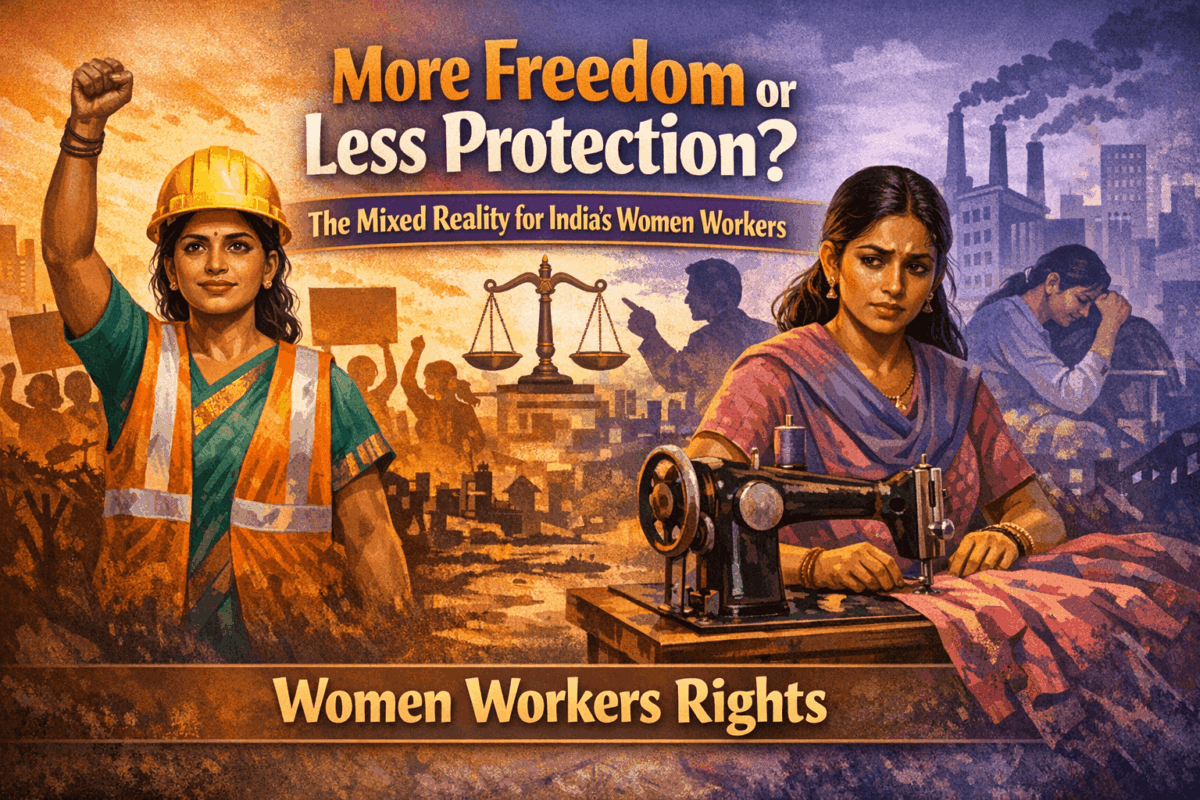
For decades, Indian laws treated women workers like fragile glass, banning them from night shifts and hazardous jobs in the name of safety. The new labour codes remove those bans and open doors, but in doing so, replace hard legal shields with softer promises that depend on employer goodwill and future government rules.
The Breakdown
The big shift: From “protection” to “enablement”
India’s old labour regime had an unusual approach. Laws like the Factories Act of 1948 and the Mines Act of 1952 shut women out of night work and dangerous industries entirely. The intention was noble; keeping women safe from exploitation. But the effect was quietly discriminatory. Women had no real choice except to accept lower-paying day jobs, locked out of continuous-process industries that run through the night.
The Madras High Court saw this clearly in R. Vasantha v. Union of India, striking down Section 66(1)(b) of the Factories Act. The provision, which barred women from night shifts, was declared unconstitutional; violating Articles 14 (equality), 15 (non-discrimination), and 16 (equal opportunity).
By 2002, the Second National Commission on Labour formalised what courts had been signalling for years: India needed to move away from a “protectionist mindset” toward an “enablement approach.”
Night shifts now allowed — with conditions
Under the new framework, women can work in all establishments and all types of work including hazardous industries and night shifts for the first time. But this freedom comes tethered to three conditions:
- Explicit consent from the woman worker is mandatory.
- Safety measures — secure transport, CCTV surveillance, and adequate security arrangements must be provided by the employer.
- The employer must be genuinely satisfied that these protections are in place before permitting night work.
The Occupational Safety, Health and Working Conditions Code (OSHWC) formalises these changes, permitting women to work before 6 AM and beyond 7 PM for the first time across sectors including mining and heavy machinery.
Family definition expands; crèche rules unchanged
The Code on Social Security has quietly changed something important for women. The definition of “family” now includes parents-in-law for female workers. This means social security benefits and certain leave provisions can extend to in-laws acknowledging the real caregiving burdens many women carry.
Crèche facilities remain mandatory in establishments with 50 or more workers. Women can visit the crèche up to four times a day, including during rest breaks, to nurse or feed their children until the child turns 15 months old.
A seat at the table: grievance committees
The Industrial Relations Code now requires adequate representation of women on Grievance Redressal Committees (GRCs). The mandate is not a fixed number but a principle: representation should be “not less than their proportion in the total workforce.”
This matters for issues like workplace harassment, maternity rights disputes, and safety concerns. Women raising complaints now see peers on the panel reviewing their case; a design meant to build trust and fairness. But the phrase “adequate representation” leaves room for interpretation, a point worth watching.
The Compliance Lens — procedural gaps and practical challenges
While the ideological shift from protection to enablement is widely welcomed, the new codes introduce several areas for improvement from a legal certainty perspective:
- Diluted enforceability: Under the old regime, restrictions on women’s work were hard legal bans with clear penalties. Under the new codes, many provisions shift responsibility to employer consent or delegated state rules, weakening the certainty of protection at the ground level.
- Implementation dependency: Night shift permissions depend on employers genuinely satisfying themselves about safety arrangements. Without robust inspection mechanisms, a well-intentioned provision could become a paper formality rather than a lived reality.
- Unorganised sector coverage gap: While the codes expand social security, women in domestic work, construction, and agriculture forming the bulk of female labour may still struggle to access benefits due to lack of formal registration and awareness.
- Procedural ambiguity on GRC representation: The requirement for “adequate representation of women” in grievance committees lacks a precise formula, leaving room for tokenism rather than meaningful inclusion.
What this means for women workers today
The new labour codes hand women a key: the door to night shifts, hazardous industries, and better-paying roles is now open. But the lock has changed. Where older laws used the rigid metal of statutory prohibition, the new codes use the soft rubber of employer consent and procedural guidelines.
For urban, organised-sector women in formal employment, this is largely progress. For the 150 million women workers in India’s informal economy, the real test will be whether these codes translate into enforceable rights or remain promises on paper.
Disclaimer
This content is for general informational purposes only and does not constitute legal or professional advice. Labour law interpretations vary; readers should consult qualified professionals for advice specific to their circumstances.