 Total Visitors
  Online Users
  Today
Today  Yesterday

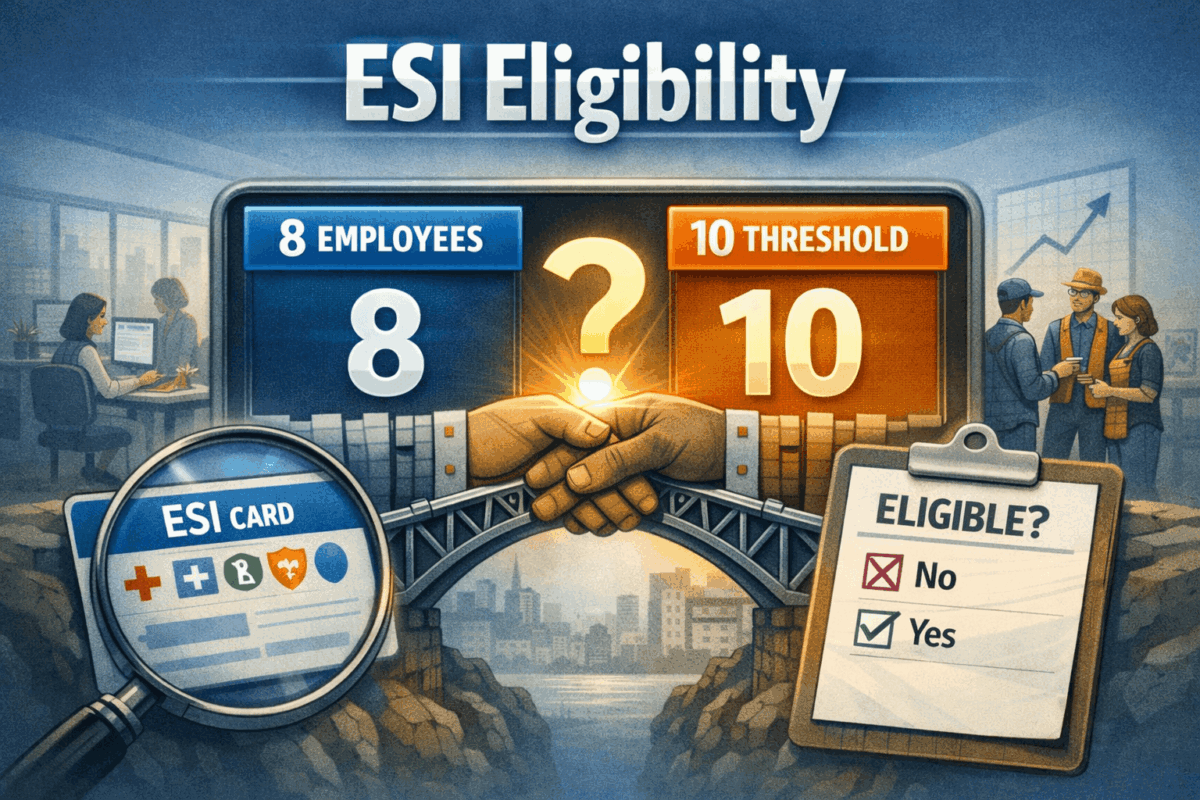
Starting a small business in India comes with exciting milestones and complex compliance questions. One of the most common queries entrepreneurs’ faces is: “Is ESI applicable to my business with less than 10 employees?” The Employees’ State Insurance (ESI) scheme, governed by the ESI Act, 1948 and now integrated into the Code on Social Security, 2020, provides medical, maternity, and disability benefits to employees. But the applicability threshold, whether it’s 10 or 20 workers often confuses startups, shops, and offices. In this guide, we break down the ESI employee threshold, the “once covered, always covered” rule, and how the 2026 labour codes reshape compliance for small businesses. If you’re running a team of 8 employees, this article explains exactly where you stand, what to prepare for, and how to plan ahead for growth.
1. The Magic Threshold: 10 vs. 20
- Factories (ESI Act, 1948, Section 2(12)): Mandatory registration if 10 or more employees are engaged in a factory using power (20 if without power).
- Establishments (shops, hotels, offices): Originally 20 employees, but most states (including Maharashtra) have reduced the threshold to 10 through notifications.
Verdict for 8 Employees:
With only 8 employees, you are below the statutory threshold and not yet liable for mandatory ESI registration.
2. The “Once In, Always In” Rule
- Principle: Once an establishment becomes coverable under ESI, it remains covered even if the employee strength later falls below 10.
- Implication: If you ever had 10 or more employees, even temporarily, you must register and continue compliance.
3. The 2026 Perspective: ESI Under the Social Security Code
- Section 28, Code on Social Security, 2020: ESI continues as a statutory scheme under the new Code.
- Voluntary Coverage: Establishments below the threshold may opt for voluntary registration to provide medical, maternity, and disability benefits.
- Hazardous Occupations: The government may mandate ESI coverage for establishments engaged in hazardous work, regardless of employee count.
4. Counting Employees: The Compliance Trap
When calculating the “10‑employee” threshold, inspectors include:
- Regular full‑time employees.
- Part‑time staff.
- Contractual or casual workers engaged through agencies.
- Apprentices (except those under the Apprentices Act, 1961).
Example: If you have 8 permanent staff plus 3 outsourced cleaners, you may legally be treated as having 11 employees, triggering ESI coverage.
5. Helpful Peer Action Plan
- Audit Headcount: Review all categories of workers over the past 12 months.
- Monitor Growth: Prepare for contributions (3.25% employer, 0.75% employee) once you cross 10.
- Bridge the Gap: With fewer than 10 employees, group medical cover is usually unavailable and voluntary ESI cannot be opted individually. Instead, explore subsidizing individual health insurance policies, encourage family floater plans, or leverage government micro‑insurance schemes until you cross the statutory threshold.
- Digitize Records: The Code mandates digital compliance. Adopt payroll software early to ease future filings.
ESI Applicability: Old Act vs. New Code
This comparison table highlights how the Employees’ State Insurance (ESI) scheme is applied under the ESI Act, 1948 and the Code on Social Security, 2020 (effective 2026).
| Aspect | ESI Act, 1948 | Code on Social Security, 2020 |
| Threshold – Factories | Mandatory if 10 or more employees (with power); 20 if without power | Continues at 10 employees (with power); government retains discretion to modify |
| Threshold – Establishments | Originally 20 employees; reduced to 10 in most states via notifications | 10 employees for most establishments; central/state governments empowered to notify lower thresholds |
| Counting Rule | Includes full-time, part-time, casual, and contract workers; apprentices excluded if under Apprentices Act | Same principle continues; digital record-keeping mandated |
| Once Covered, Always Covered | Establishments remain covered even if headcount falls below threshold | Principle continues under the Code |
| Voluntary Coverage | Not explicitly provided; establishments below threshold could not opt in easily | No general voluntary opt‑in. Government may extend coverage to notified establishments or hazardous occupations, but individual small employers cannot register voluntarily |
| Hazardous Occupations | No special carve-out; threshold applied uniformly | Government empowered to mandate coverage regardless of employee count if hazardous work is involved |
| Compliance Mode | Paper-based filings; state-specific portals | Unified digital compliance under the Code; mandatory electronic records |
Bottom Line
- Under both regimes, the 10-employee threshold is the key trigger for mandatory ESI coverage.
- Crossing 10 employees, even temporarily triggers permanent coverage
- Contract staff count toward the threshold.
- The Code on Social Security, 2020 modernizes compliance, introduces voluntary coverage, and allows special rules for hazardous occupations.
- Employers with less than 10 employees should still monitor headcount closely and consider voluntary coverage for employee welfare.
Disclaimer
This blog is for educational purposes only. ESI applicability depends on the Employees’ State Insurance Act, 1948, state notifications, and the Code on Social Security, 2020. For case‑specific compliance, consult a qualified Labour Law Consultant or Advocate.