 Total Visitors
  Online Users
  Today
Today  Yesterday

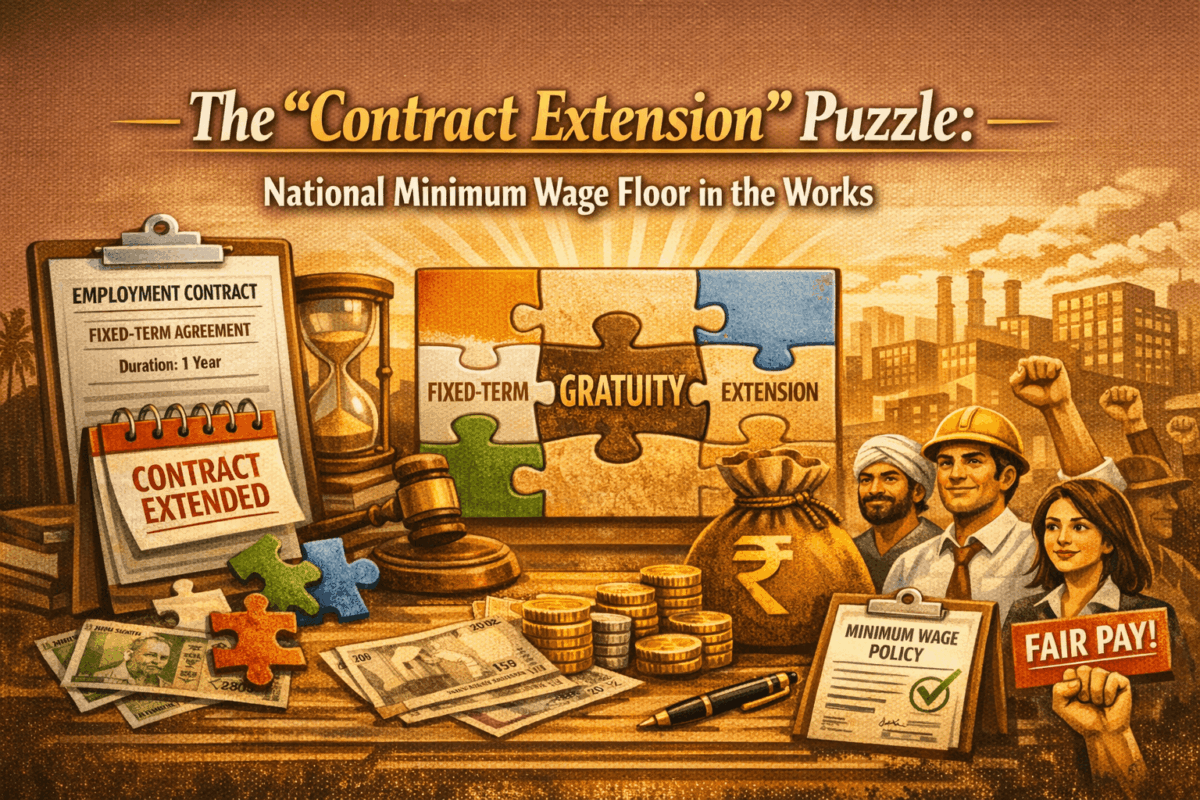
Rolling contracts are now a defining feature of India’s modern workplace. Project consultants, IT professionals, and even teachers often sign one-year contracts that are quietly renewed again and again. But this raises a stressful question: If gratuity is payable to Fixed-Term Employees (FTEs) after one year, what happens when contracts are extended multiple times?
1. The Legal Revolution: From 5 Years to 1 Year
- Earlier Law (Payment of Gratuity Act, 1972): Employees had to complete 5 years of continuous service to qualify for gratuity. Leaving at 4 years meant forfeiting the benefit entirely.
- New Law (Code on Social Security, 2020, Section 53):
- One-Year Milestone (for FTEs): Fixed-Term Employees qualify for gratuity after just one year of continuous service.
- Pro-Rata Entitlement (for FTEs only): Section 53(2) explicitly states that gratuity for FTEs shall be paid on a pro-rata basis for the actual period worked. This carve-out does not apply to permanent employees, who remain subject to the 5-year eligibility requirement.
This change was revolutionary. It recognized the reality of short-term contracts and ensured that project-based employees are not excluded from social security benefits.
2. What Happens if Your Contract is Extended?
This is where confusion arises.
- Continuous Service Principle: Back-to-back contracts with the same employer are treated as continuous service unless there is a genuine break.
- No Reset: Employers cannot argue that each extension is a “new job” to avoid gratuity.
- Payout Timing: Gratuity is generally paid at the time of separation (resignation, non-renewal, or termination), not at the end of each contract year.
- Eligibility Check: Even if contracts are shorter (e.g., 11 months + 11 months), once cumulative service exceeds 365 days, gratuity entitlement arises for FTEs.
3. Relatable Reality: The “Rolling Contract” Scenario
Sameer’s Story – Project Consultant
Sameer was hired on a one-year fixed contract. His performance was strong, so the company extended him for another two years.
- Total Tenure: 3 years.
- Employer’s Claim: “You aren’t permanent, so gratuity doesn’t apply.”
- Legal Outcome: Under Section 53 of the Code on Social Security, 2020, Sameer is a Fixed-Term Employee. Since he completed more than one year of continuous service, he is entitled to 3 years’ worth of pro-rata gratuity. Extensions strengthened his rights; they did not cancel them.
This example shows how the law protects employees against denial of benefits simply because their contracts are “fixed-term.”
4. Judicial Context: Continuity of Service
While the one-year gratuity entitlement for FTEs is a new statutory right under the 2020 Code, courts have long dealt with issues of continuity of service and artificial breaks:
- Artificial Breaks: Courts have consistently condemned artificial breaks as “colourable devices” used to deny statutory benefits.
- Continuity Principle: Successive contracts with no genuine break are treated as continuous service.
These principles now reinforce Section 53 of the Code, ensuring rolling contracts cannot reset the gratuity clock.
5. The Calculation: How Much Do You Get?
The formula remains the same as for permanent employees, but without the 5-year barrier for FTEs:
Gratuity = (Last Drawn Basic + DA) × 15 × Years of Service ÷ 26
Example (FTE):
Basic + DA = ₹50,000
Years of Service = 2
Gratuity = (50,000) × 15 × 2 ÷ 26
Gratuity = approx. ₹57,692
6. Expanded Employee Action Plan
- Check Contract Language: Ensure “Fixed-Term Employment” is explicitly mentioned.
- Track Service Days: Keep records of actual working days to prove continuity.
- Audit Settlement: At separation, verify gratuity is included in your F&F statement.
- Challenge Artificial Breaks: If breaks are inserted to deny gratuity, cite Section 53 and continuity principles.
- File Nomination (Form F): Mandatory for gratuity entitlement, even for FTEs.
Bottom Line
- Fixed-Term Employees are entitled to gratuity after one year of continuous service.
- Pro-rata entitlement applies only to FTEs, not to permanent employees.
- Extensions build rights, not reset them.
- Artificial breaks can be challenged as unlawful.
- Courts have consistently upheld continuity of service in gratuity disputes, reinforcing the statutory protection under Section 53.
Disclaimer
This content is for educational and informational purposes only and does not constitute legal advice. The application of the 1-year gratuity rule depends on the specific classification of the employee as “Fixed-Term” under the Code on Social Security and the Industrial Relations Code. For specific legal disputes, please consult with a qualified Advocate.