 Total Visitors
  Online Users
  Today
Today  Yesterday

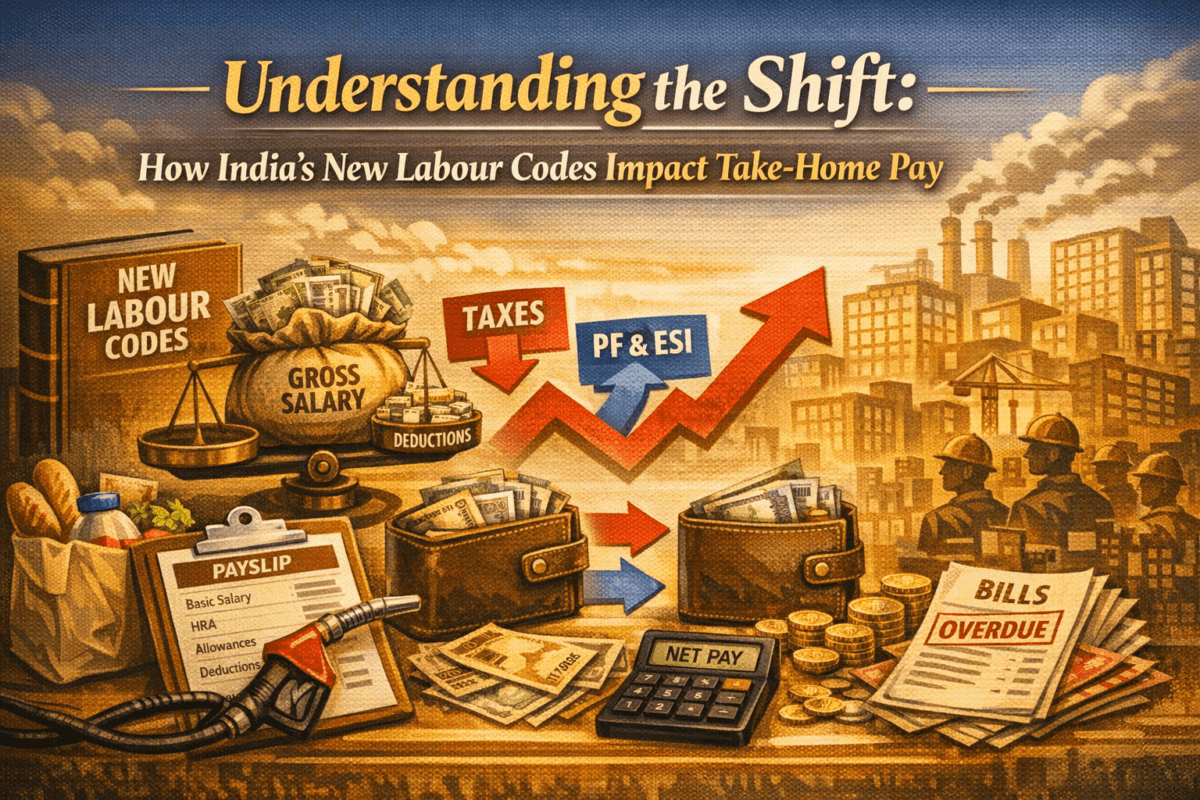
Mumbai, April 16: As India transitions to a unified labour law framework, professionals across sectors are beginning to see changes in how their monthly salaries are structured. While the immediate effect may be a dip in cash-in-hand income, experts emphasize that the reforms are designed to strengthen long-term financial security through provident fund and gratuity contributions.
The 50% Rule Redefines Wages
Under the Code on Wages, 2019, the definition of “wage” has been standardized. Employers must now ensure that Basic Pay constitutes at least 50% of the total Cost to Company (CTC). Previously, many firms kept Basic Pay low and relied on allowances to maximize take-home pay. The new rule brings uniformity and ensures statutory benefits are calculated on a larger base.
Take-Home vs. Retirement Savings
Because contributions to the Provident Fund (PF) and Gratuity are linked to Basic Pay, employees will see higher deductions. For a professional earning ₹6 lakh annually, this could mean less monthly liquidity but a faster-growing retirement corpus. Labour specialists describe this as a “forced savings” mechanism that prioritizes long-term stability over short-term spending.
Boosting Wealth and Tax Efficiency
The higher PF contribution not only builds retirement wealth but also provides tax advantages under certain regimes. However, a higher Basic Pay may alter taxable income brackets, requiring employees to balance immediate liquidity with future financial security.
Compliance Challenges for Employers
- Restructuring CTC Models: Organizations must realign contracts to meet the 50% threshold without increasing overall costs.
- Communication Gap: Many employees perceive reduced take-home pay as a loss. Experts stress the need for workplace financial literacy initiatives to explain the benefits.
- Inter-State Standardization: With staggered implementation across states, companies operating nationally face procedural hurdles in ensuring uniform compliance.
Legal Perspective
- Code on Wages, 2019 – Section 2(y): Defines “wages” and underpins the 50% rule.
- Payment of Gratuity Act, 1972 (read with Codes): Gratuity calculations now rise with higher Basic Pay.
- Industrial Relations Code, 2020 – Section 4: Requires clear communication of employment terms, including wage restructuring.
- ILO Standards: India’s commitment to fair wage practices aligns with international conventions on worker protection.
Outlook
The new labour codes mark a significant shift in India’s wage architecture. While employees may initially feel the pinch in monthly budgets, the reforms aim to deliver stronger retirement benefits and financial resilience. Legal experts advise both employers and employees to treat the transition as an opportunity to align pay structures with statutory obligations and long-term wealth creation.
Disclaimer: This content is provided for informational purposes only and does not constitute legal, financial, or professional advice. Readers should consult with official government sources, HR professionals, or legal experts regarding specific salary structures and labour law compliance.