 Total Visitors
  Online Users
  Today
Today  Yesterday

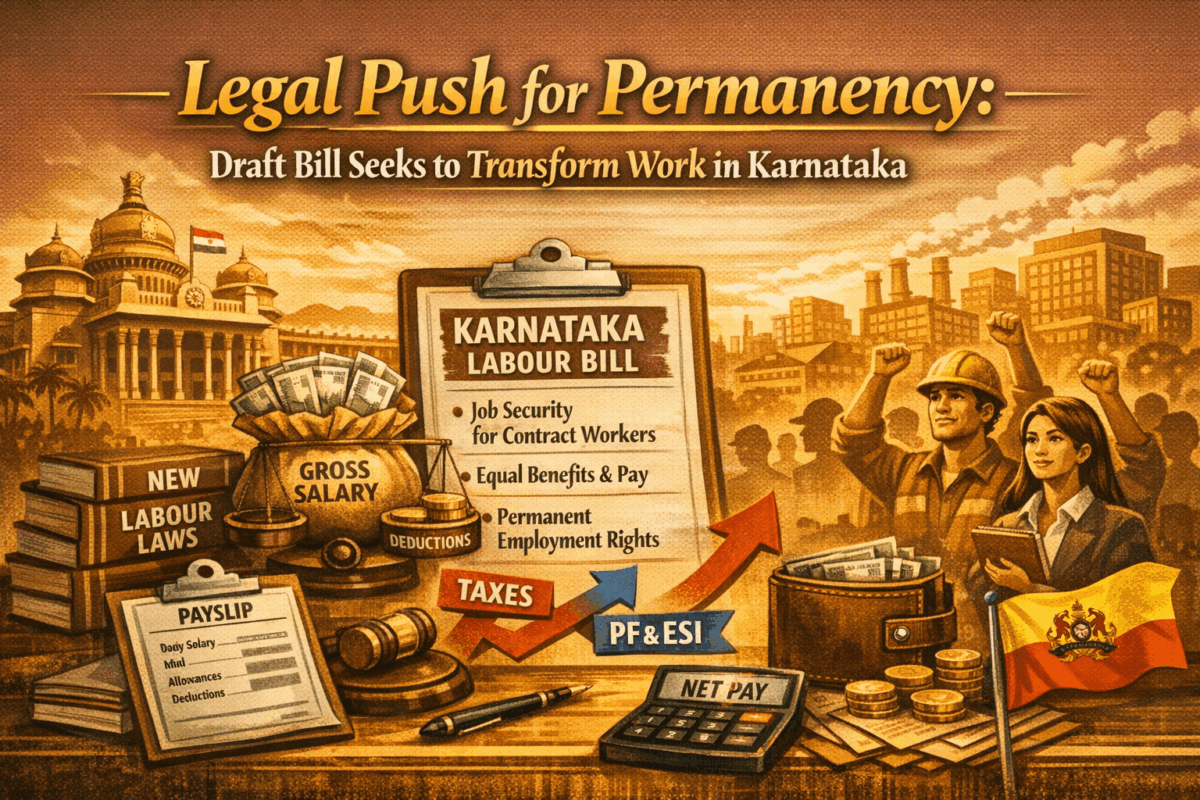
Bengaluru, April 16: A new draft proposal by legal advocates in Karnataka is seeking to grant permanent job status to workers who complete 180 days of service within a year. The initiative, titled the Karnataka Conferment of Permanent Status to Workmen Bill, aims to address concerns over contract labour and provide greater stability to the state’s workforce.
The 180-Day Rule
At the heart of the draft bill is a clear timeline: any employee whether in a factory, construction site, government office, or private firm who works for 180 days in a 12-month period would automatically be entitled to permanent status. This provision significantly shortens the path to permanency compared to existing labour models.
Tackling Contractual Loopholes
The proposal seeks to curb the practice of “artificial breaks,” where contracts are terminated and restarted to prevent workers from qualifying for permanent benefits. By recognizing the continuity of service rather than contractual paperwork, the bill aims to ensure fair treatment for long-term employees.
Expanding Coverage
Unlike earlier frameworks that focused primarily on industrial workers, the draft explicitly includes construction labour, journalistic staff, and outsourced government personnel. Advocates note that contract workers often earn 36% to 45% less than permanent staff for identical tasks, a disparity the bill seeks to reduce.
Enforcement and Penalties
To ensure compliance, the draft prescribes penalties for employers who fail to regularize eligible workers. Proposed consequences include fines up to ₹1 lakh or imprisonment of up to one year, underscoring the seriousness of worker welfare obligations.
Compliance Lens
Legal experts highlight several areas where organizations will need to adapt if the bill is enacted:
- Service Records: Transparent, digital attendance and service logs will be essential to verify the 180-day threshold.
- Financial Planning: Employers must account for liabilities such as gratuity and pension once workers gain permanent status.
- National Alignment: Harmonization with the Code on Wages, 2019 and other central labour codes will be critical to avoid conflicts for companies operating across multiple states.
Legal Context
- Industrial Disputes Act, 1947 / Industrial Relations Code, 2020: Currently governs regularisation of workers, but does not mandate permanency after 180 days.
- Directive Principles of State Policy (Article 43): Calls for securing a living wage and decent working conditions.
- State vs. Central Jurisdiction: As labour is a concurrent subject under the Constitution, any state law must align with central codes to ensure enforceability.
Outlook
The draft bill represents a significant push toward job security in Karnataka. While it is not yet enacted law, its provisions could reshape employment practices by curbing contractual loopholes and expanding worker protections. Observers note that careful alignment with national labour codes will be key to its successful implementation.
Disclaimer: This content is provided for informational purposes only and does not constitute legal, financial, or professional advice. The “Bill” mentioned is currently a proposal drafted by a legal association (AILAJ) and is not yet enacted law. Readers should consult with official government gazettes or legal experts for statutory compliance.