 Total Visitors
  Online Users
  Today
Today  Yesterday

India’s labour landscape is undergoing its most significant transformation since independence, with the consolidation of 29 legacy laws into four unified Labour Codes. The reform seeks to balance business flexibility with worker security by modernizing wage definitions, streamlining compliance, and extending protections to gig and platform workers.
In a Nutshell
The new framework introduces uniform wage standards, portable social security, flexible workweek options, and stronger safety mandates, reshaping both employer obligations and employee rights.
The Breakdown
- The Power of Consolidation: The four codes—Wages, Social Security, Industrial Relations, and Occupational Safety (OSH)—replace fragmented laws with a unified structure. This reduces administrative friction and promotes “ease of doing business” through single-window compliance and inspections.
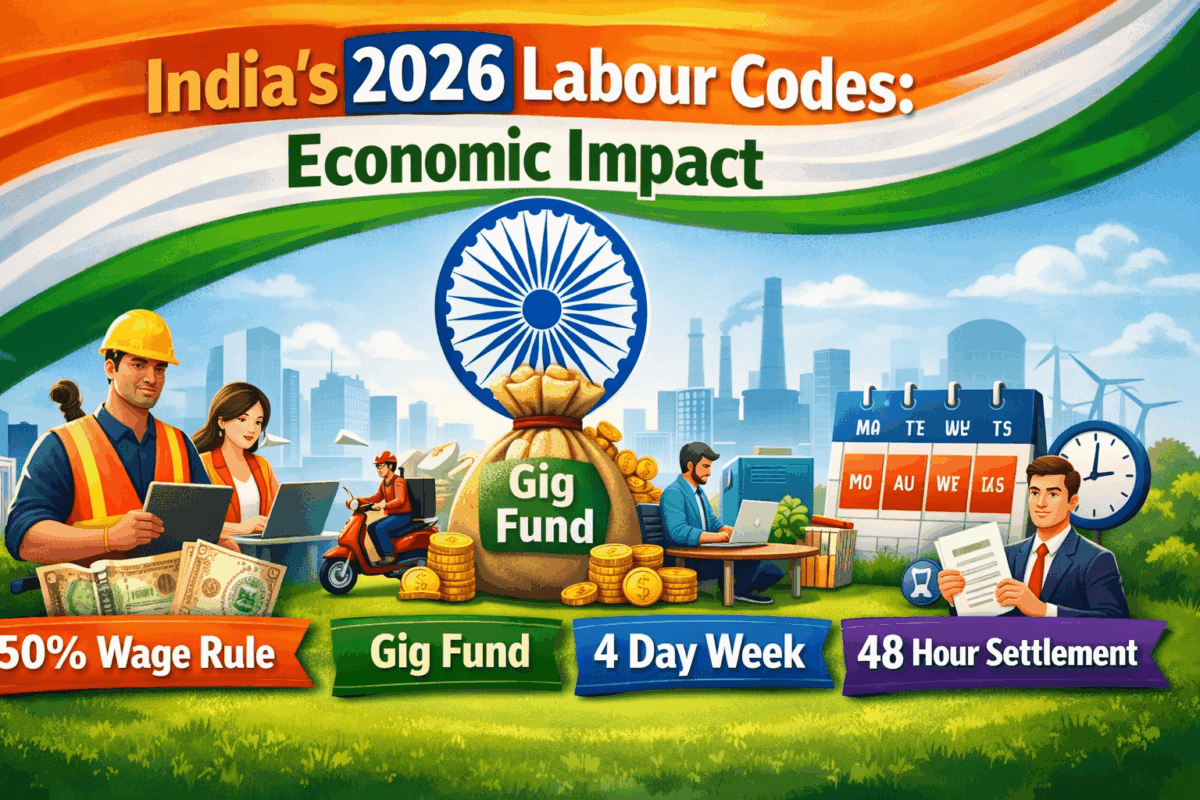
- A Safety Net for New Realities: Gig and platform workers are formally recognized under the Social Security Code, 2020. Digital platforms must contribute 1–2% of turnover to a Social Security Fund, extending health and disability insurance to delivery partners and freelancers.
- Uniform Wage Standards: The National Floor Wage ensures no state sets minimum pay below a central baseline. The 50% Wage Rule mandates that basic pay comprise at least half of total compensation, ensuring Provident Fund (PF) and Gratuity are calculated on a fairer wage base.
- Operational Agility and Safety: Employers may adopt four-day work weeks, provided weekly hours remain capped at 48 and daily spread-over does not exceed 12 hours. The OSH Code strengthens safety mandates, including compulsory annual health check-ups and protections for women working night shifts, subject to consent and safe transport.
Compliance Lens
Legal and professional experts highlight several challenges:
- The 48-Hour Settlement Window: Employers must complete Full and Final (F&F) settlements within two working days of an employee’s exit. Legacy payroll systems may struggle, requiring investment in automated digital payroll technology.
- Hiring Cost Adjustments: The 50% wage rule increases the wage base for PF and Gratuity, potentially raising manpower costs by 5% to 15%. MSMEs must model financial impacts to avoid budget overruns.
- State-Rule Synchronization: Labour being a concurrent subject means states must notify their own rules. Delays in alignment create temporary compliance “gray zones” for pan-India companies.
Legal Context
- Code on Wages, 2019: Establishes wage definitions, national floor wage, and the 50% rule.
- Social Security Code, 2020: Extends coverage to gig and platform workers.
- Industrial Relations Code, 2020: Revises dispute resolution and layoff thresholds.
- OSH Code, 2020: Governs working hours, safety, and health mandates.
Outlook
The 2026 Labour Codes represent India’s most comprehensive labour reform in decades. Observers note that while the framework promises stronger worker protections and simplified compliance, its success will depend on payroll modernization, financial planning for increased contributions, and harmonization of state-level rules with the central framework.
Disclaimer: This content is provided for informational purposes only and does not constitute legal, financial, or professional advice. The implementation and interpretation of the Labour Codes are subject to specific government notifications and judicial review. Readers should consult with official government sources or qualified legal consultants regarding statutory compliance.