 Total Visitors
  Online Users
  Today
Today  Yesterday

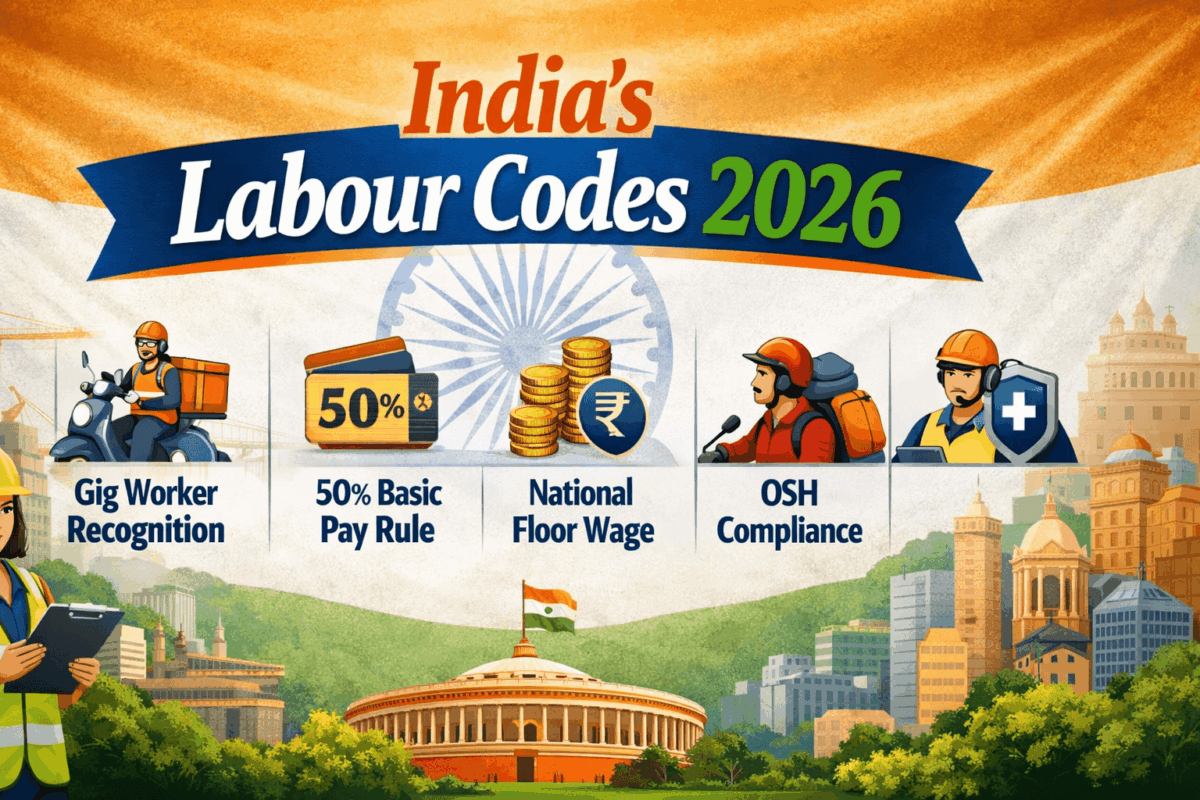
India has entered a new era of industrial relations with the consolidation of 29 central labour laws into four streamlined Labour Codes. The reform seeks to expand the social safety net to millions of workers including gig and platform partners while standardizing wages, safety, and compliance across states.
In a Nutshell
The new framework introduces a national floor wage, formal recognition of gig workers, stricter wage definitions, and enhanced workplace safety provisions. The challenge now lies in ensuring smooth implementation across diverse industries and states.
The Breakdown
- A Safety Net for the Gig Economy: For the first time, gig and platform workers are legally recognized under the Code on Social Security, 2020. Delivery partners and freelancers can access benefits such as life and disability insurance, funded by platform contributions of 1–2% of annual turnover into a dedicated Social Security Fund.
- The 50% Wage Rule: The Code on Wages, 2019 mandates that basic pay must comprise at least 50% of total remuneration. This change curbs allowance-heavy structures, slightly reducing take-home pay but significantly boosting Provident Fund (PF) and Gratuity contributions.
- Universal Minimum Wage: A new National Floor Wage ensures that no state sets its minimum wage below the central benchmark, providing a baseline standard of living across India.
- Empowering Women at Work: Women are permitted to work night shifts across all sectors, subject to consent and strict safety and transport provisions. The threshold for mandatory crèche facilities has also been standardized to support working parents.
Compliance Lens
Legal and professional experts highlight several challenges:
- Digital Register Transition: Employers must replace 84 physical registers with 8 digital ones. Smaller enterprises face a “tech-gap” in adopting automated HR systems for single-window electronic returns.
- Threshold Adjustments: The requirement for government approval before layoffs has increased from 100 to 300 workers. Ensuring effective use of the Worker Re-skilling Fund for retrenched employees remains a procedural gap.
- State-Level Variation: Labour being a concurrent subject means states issue their own rules. Synchronizing central and state portals is essential to avoid overlapping compliance burdens for multi-state companies.
Legal Context
- Code on Wages, 2019: Establishes wage definitions and national floor wage.
- Code on Social Security, 2020: Expands coverage to gig and platform workers.
- Industrial Relations Code, 2020: Revises thresholds for layoffs and strengthens dispute resolution.
- OSH Code, 2020: Standardizes workplace safety and welfare provisions.
Outlook
The 2026 implementation of the Labour Codes marks India’s most significant labour reform in decades. Observers note that while the policy intent is clear i.e. simplification, inclusion, and safety; the success of the transition will depend on digital readiness, state-level harmonization, and effective enforcement of new worker protections.
Disclaimer: This content is provided for informational purposes only and does not constitute legal, financial, or professional advice. Labour laws and regulatory frameworks are subject to frequent government updates and state-specific variations. Readers should consult with official government sources or qualified legal consultants regarding statutory compliance.