• Home
  • About Us
  • Services
  • Edu Room
    • Educational Videos
    • Press Release
    • Useful Links
    • Statutory Calculator
    • Ready Recknor
      • Holiday List
        • 2026
        • 2025
        • 2024
      • Leave And Working Hours
      • Professional Tax
      • Contract Labour (Regulation & Abolition) Act (CLRA)
      • Labour Welfare Fund
  • Notification
  • Law Library
  • Contact Us
  • Blog
  • +91 88282 14812 +91 96192 52079
  • support@key4comply.com
  • Mumbai
  • 9:00AM to 6:00 PM Monday To Friday
    • Facebook
    • YouTube
Call Us
  • +91 88282 14812
  • +91 99670 52116
support@key4comply.com Mumbai 9:00AM to 6:00 PM Monday To Friday
  • Facebook
  • LinkedIn
  • X
Key4comply

key4comply | Labour Codes | Labour Law Compliance of India

  • Home
  • About Us
  • Services
  • Edu Room
    • Educational Videos
    • Press Release
    • Useful Links
    • Statutory Calculator
    • Ready Recknor
      • Holiday List
        • 2026
        • 2025
        • 2024
      • Leave And Working Hours
      • Professional Tax
      • Contract Labour (Regulation & Abolition) Act (CLRA)
      • Labour Welfare Fund
  • Notification
  • Law Library
  • Contact Us
  • Blog
Posted inEdu Room, Press Release

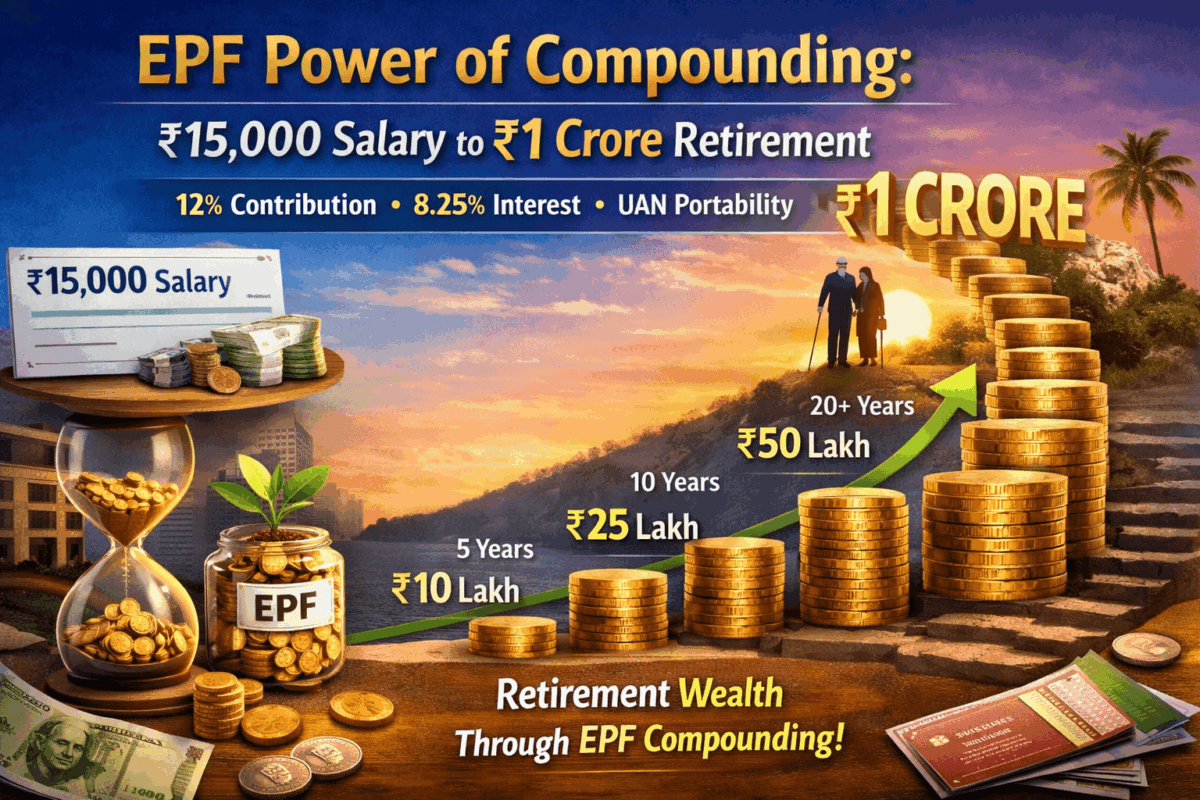
EPF Power of Compounding: ₹15,000 Salary to ₹1 Crore Retirement – 12% Contribution, 8.25% Interest, UAN Portability

by Key4complyteamMay 7, 2026May 7, 2026
EPF Power of Compounding: ₹15,000 Salary to ₹1 Crore Retirement - 12% Contribution, 8.25% Interest, UAN Portability
SHARE ON

Financial independence is not limited to high earners. India’s Employees’ Provident Fund (EPF) demonstrates how disciplined saving and the principle of compounding can transform modest monthly contributions into a substantial retirement corpus. With a starting salary of ₹15,000, young professionals can realistically target savings exceeding ₹1 crore over a 30–35-year career.

In a Nutshell

By mandating contributions from both employees and employers, EPF ensures long-term wealth creation. The key lies in consistency, compounding, and resisting premature withdrawals.

The Breakdown

  • The Math of 12%: Employees contribute 12% of basic pay plus dearness allowance (DA) to EPF. Employers match this, with 3.67% directed to EPF and 8.33% (capped at ₹1,250 per month) allocated to the Employees’ Pension Scheme (EPS).
  • The Compounding Magic: EPF currently offers an annual interest rate of 8.25% (2025–26), compounded yearly. Over decades, this “snowball effect” multiplies savings, turning modest deposits into significant wealth.
  • The Salary Hike Factor: With annual increments of 5–7%, contributions rise alongside paychecks, accelerating corpus growth.
  • Discipline Over Decades: Avoiding non-essential withdrawals is critical. While EPFO permits advances for housing or emergencies, leaving funds untouched maximizes compounding power.

Compliance Lens

Legal and professional experts highlight several challenges:

  • The ₹15,000 Ceiling Challenge: Employer contributions to EPS are capped at a ₹15,000 wage ceiling. Policy discussions in 2026 have suggested raising this to ₹25,000, which would enhance pension security.
  • Taxation Thresholds: Under current tax rules, interest earned on employee contributions exceeding ₹2.5 lakh annually is taxable. High earners using Voluntary Provident Fund (VPF) must monitor this limit to avoid unexpected liabilities.
  • UAN Portability: Ensuring seamless transfer of the Universal Account Number (UAN) during job changes is vital. Dormant accounts stop earning interest, slowing progress toward the ₹1 crore goal.

Legal Context

  • EPF Act, 1952: Governs provident fund contributions and withdrawals.
  • Employees’ Pension Scheme, 1995 (EPS-95): Provides pension benefits, subject to the wage ceiling.
  • Income-tax Act, 2025: Introduces taxation thresholds for high-value PF contributions.
  • Social Security Code, 2020: Consolidates retirement and social security provisions under a unified framework.

Outlook

The EPF system demonstrates how modest salaries, disciplined savings, and compounding can create substantial retirement wealth. Observers note that raising the EPS ceiling, improving UAN portability, and clarifying taxation rules will be key to strengthening retirement security for India’s workforce.

Disclaimer: This content is provided for informational purposes only and does not constitute legal, financial, or professional advice. The calculations mentioned are indicative based on specific assumptions regarding interest rates and salary hikes. Actual returns may vary based on EPFO policy changes, taxation, and individual employment history. Readers should consult with a qualified financial advisor or use the official EPFO calculator for personalized planning.

Tagged: 12% EPF contribution breakdown, avoid premature EPF withdrawal discipline, Code on Social Security 2020 subsumes EPF Act, Code on Social Security universal account number, compounding loss not transferring EPF balance, compounding magic snowball effect EPF, disciplined saving compounding EPF India, disciplined saving over 30-35 years career, e-Shram portal for unorganised workers, employee provident fund wealth creation, Employees Pension Scheme 1995 wage ceiling ₹15000, Employees Provident Fund Organisation retirement planning, employer 12% contribution allocation 3.67% EPF 8.33% EPS, employer PF contribution mandatory for all employees, EPF Act 1952 Section 6 contribution rules, EPF Act Section 2(b) employee employer contribution, EPF balance transfer online using UAN, EPF contribution on basic pay plus dearness allowance, EPF contributions employee share 12% basic DA, EPF interest rate 8.25% 2025-26 compounded yearly, EPF MP Act 1952 provisions for retirement savings, EPF power of consistency, EPF tax deduction Section 80C, EPFO automatic claim settlement pilot project, EPFO Central Board of Trustees CBT interest rate notification, EPFO digital governance direct benefit transfer, EPFO dormant account interest stops after 36 months, EPFO inoperative account interest non-contributing period, EPFO partial withdrawal housing marriage medical education, EPS 8.33% contribution capped at ₹1250 per month, financial independence low salary EPF, higher pension scheme on actual contribution, Income Tax Act 2025 PF taxation threshold, interest on PF contribution exceeding ₹2.5 lakh taxable, long-term wealth creation government backed scheme, minimum pension under EPS increased demand, minimum service period reduced for withdrawal, multiple EPF accounts merging for compounding, pension scheme wage ceiling revision demand 2026, RBI household savings report financial security, resistance premature withdrawal EPFO advances, retirement nest egg one crore EPF calculation, salary hike 5-7% annual increment EPF growth, Social Security Code 2020 consolidation EPF Act 1952, social security for unorganised workers welfare, Supreme Court judgment PF on special allowances, transfer EPF account to new employer UAN, UAN portability across jobs, unclaimed EPF balances inoperative accounts, voluntary provident fund VPF tax implications, withdrawal limits education 10 times marriage up to 5 times, ₹15000 salary to ₹1 crore retirement corpus
Previous PostHaryana Exempts Dual Registration: Shop Act & OSH Code 2020 – One Registration Sufficient
Next PostWorkforce Fragmentation India 2026: Gig Workers, Subcontracting & Portable Social Security Under New Labour Codes

Recent Comments

No comments to show.
Key4comply

Worried about workplace issues?

We protect your business and empower your workforce through expert labour law consultancy. Resolve disputes swiftly, understand complex laws, and transform labour challenges into opportunities. Schedule a free consultation today. Let's build a stronger future for your business.

Contact us today and let's build a stronger, more secure future for your business.

Quick Links

  • Holiday List
    • 2026
    • 2025
    • 2024
  • Leave and working hours
  • Labour welfare fund
  • Contract Labour (Regulation & Abolition) Act (CLRA)
  • Contact Us
  • Terms And Conditions
  • Privacy Policy

Connect With Us

+91 88282 14812 / +91 99670 52116

support@key4comply.com

Mumbai

9:00AM to 6:00 PM Monday To Friday

  • Facebook
  • LinkedIn
  • X

Total Visitors: 4758

Download All Four Codes
Legal Disclaimer
The information provided on this website including articles, blog posts, news updates, and educational videos is intended solely for general informational purposes and does not constitute legal advice. While we strive to ensure accuracy and relevance, we do not guarantee completeness or reliability due to the evolving and complex nature of labour laws. Accessing or using this website does not create a lawyer-client relationship. Users must consult a qualified legal professional for specific advice tailored to their individual circumstances. Key4Comply shall not be liable for any direct, indirect, or consequential loss or damage arising from reliance on information provided here or through external links.

Additionally, this website includes links to educational videos hosted on external platforms and social media. These videos remain the intellectual property of their original creators or respective copyright holders. Key4Comply does not claim ownership, nor endorse or guarantee the accuracy, completeness, or reliability of the content in these videos. Users accessing such linked videos do so at their own discretion and are encouraged to verify information independently. By accessing this website, you accept these terms; if you disagree, please refrain from using this website.
© 2024 - 2026 Key4comply.