 Total Visitors
  Online Users
  Today
Today  Yesterday

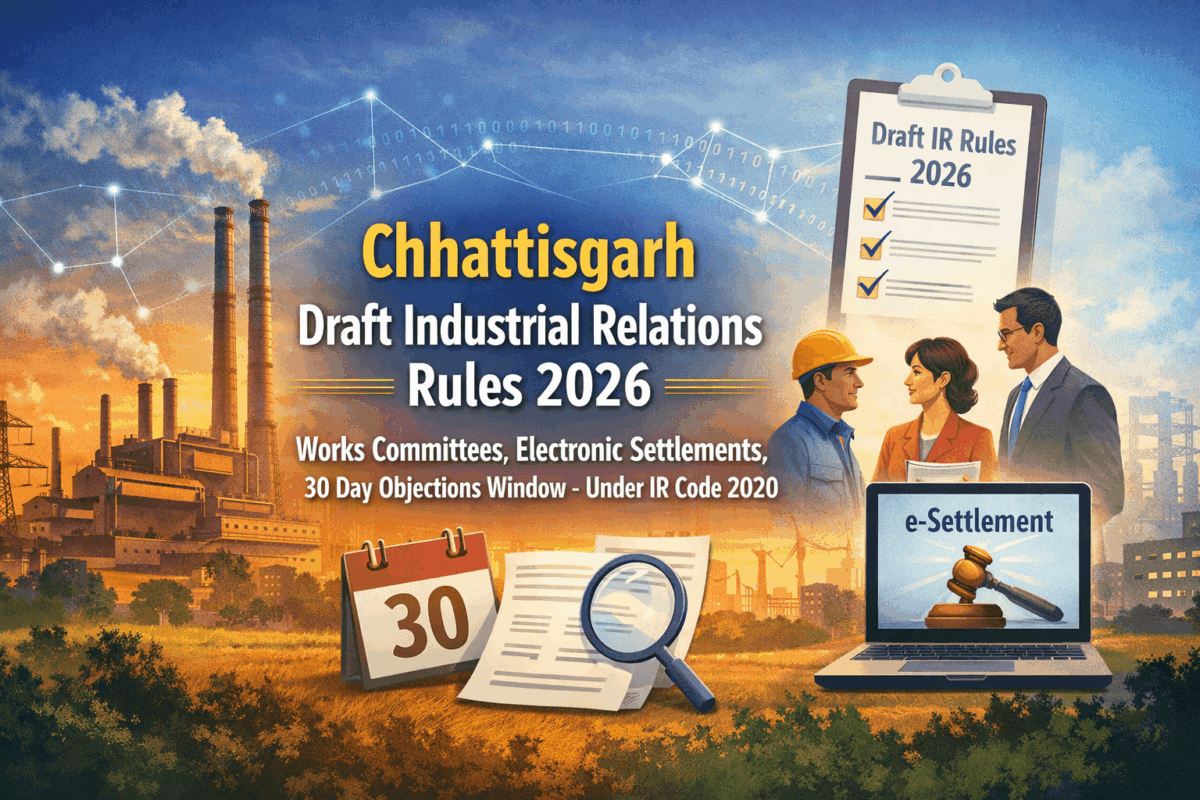
The Government of Chhattisgarh, Labour Department, has issued a notification dated 10 April 2026, published in the state gazette on 13 April 2026, introducing the Chhattisgarh Industrial Relations Rules, 2026. These draft rules have been framed under Section 99(1) of the Industrial Relations Code, 2020 (No. 35 of 2020) and repeal earlier state-specific labour regulations including the Chhattisgarh Industrial Disputes Rules, 1957, Chhattisgarh Trade Union Regulations, 1961, and Chhattisgarh Industrial Employment (Standing Orders) Rules, 1963. The notification invites objections and suggestions from stakeholders within 30 days of publication.
Key Highlights of the Notification
- Applicability:
- Rules apply across the entire state of Chhattisgarh to establishments where the state government is the appropriate authority.
- Settlement Agreements (Chapter I):
- Agreements between employers and workers must follow prescribed formats.
- Signatures required from authorized employer representatives and designated trade union officials or worker representatives.
- Settlements reached during conciliation proceedings must be reported to the Labour Commissioner.
- Settlements outside conciliation must be jointly submitted electronically or by registered post to the Labour Commissioner and Conciliation Officer.
- Record-Keeping:
- Conciliation officers must maintain registers of all settlements, including details of parties, dates, and whether the settlement was reached through conciliation or direct negotiation.
- Bipartite Forums (Chapter II):
- Employers must constitute Works Committees to promote harmony and good relations between employers and workers.
- Committee membership capped at 20, with equal or greater representation for workers compared to employers.
- Adequate representation for women workers is mandatory, proportionate to their presence in the establishment.
- Worker representatives to be nominated by recognized negotiating unions, negotiating councils, or elected directly by workers where no union exists.
- Employers may conduct elections electronically via IT applications or online platforms.
- Objections and Suggestions:
- Stakeholders may submit objections or suggestions to the Labour Department, Chhattisgarh, within 30 days of publication.
- Submissions must specify the rule proposed for amendment, the suggested modification, and reasons for the change.
Impact on Employers and Employees
- For Employers: The draft rules mandate structured settlement procedures, formalized bipartite forums, and stricter compliance with industrial relations governance. Employers must prepare for electronic record-keeping and transparent dispute resolution processes.
- For Employees: Workers gain stronger representation through Works Committees and formalized settlement procedures, ensuring transparency and recognition of trade unions in industrial relations.
- For HR/Compliance Teams: Immediate review of draft rules is necessary to prepare objections or suggestions within the 30-day window and to align workplace practices with the proposed framework under the Industrial Relations Code, 2020.
For detailed reading of this notification and to access all other important updates, please visit the Notifications tab on our website.
Disclaimer: This news post is for informational purposes only. It does not constitute legal advice. Readers are advised to consult the official gazette notification issued by the Government of Chhattisgarh or seek professional legal counsel before taking any compliance-related action.