 Total Visitors
  Online Users
  Today
Today  Yesterday

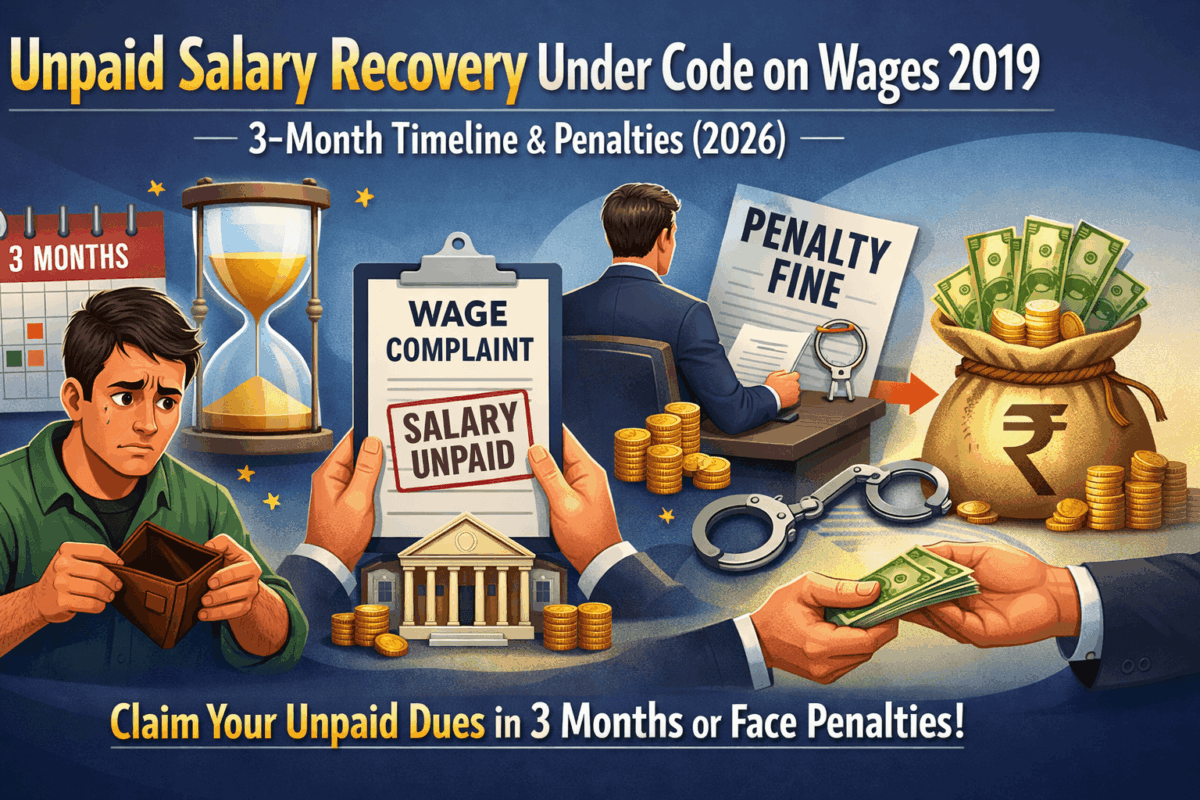
Imagine opening your banking app on the first of the month, expecting to see your hard-earned salary credit notification. Instead, you see the same stagnant balance. Now imagine this happening for three months straight. Rent is due, bills are piling up, and your polite emails to HR are met with radio silence or vague promises of “funding coming soon.”
If you are currently facing this stressful scenario in India, you are far from alone. Non-payment or delayed payment of salary is one of the most frequent friction points between employers and employees.
With India transitioning into the New Labour Codes, specifically the Code on Wages, 2019, a lot of buzz has been generated around a revamped, “fast-track” recovery mechanism. But what are the exact ground-level steps to get your money? And more importantly, is this fast-track process a genuine operational upgrade or simply a theoretical promise?
Let’s break down your legal rights, your step-by-step roadmap, and a realistic timeline for recovering your unpaid wages.
The Shift: Legacy Laws vs. The Code on Wages
Before the introduction of the unified Code on Wages, a worker’s recourse depended heavily on their salary bracket and job description, split across the Payment of Wages Act, 1936 and the Minimum Wages Act, 1948.
The old framework had two massive roadblocks for employees:
1. The Wage Ceiling Trap
The old Payment of Wages Act only protected employees earning below a specific statutory monthly threshold. Anyone earning above that threshold often had to resort to lengthy civil suits or standard corporate legal notices, keeping relief out of reach for middle-management employees.
2. The Strict Timeline Trap
Under legacy rules, you generally had a tight window of just 12 months from the date your wages were due to file an official claim. If you spent a year believing your employer’s promises, you could lose your statutory right to claim.
The New Architecture
The Code on Wages, 2019 changes the game by removing restrictive wage ceilings for protection. Furthermore, it expands the limitation window dramatically. Under Section 49 of the Code, the timeline for a worker to file an unpaid salary legal action in India has been extended from 1 year to 3 years. This gives employees a significantly larger window to seek justice without fear of their claims lapsing due to administrative delays.
Key upgrade: Universal coverage and no wage ceiling, no exclusion for “managerial staff” on this front.
The Step-by-Step Recovery Blueprint – FREE
If your employer has defaulted on your salary for 3 months, you do not have to wait for the system to move on its own. Here is the exact path to take under the updated legal structure.
Step 1: Formal Written Demand (The Paper Trail)
Before executing formal legal steps, establish an airtight evidentiary trail. Send a formal, written demand notice to your employer via registered email and physical post. Specify the exact amount owed, the 3-month duration, and provide a clear 7-to-15-day window for settlement.
Under the Code, this initial documentation serves as vital evidence that the employer willfully defaulted despite clear notification.
Step 2: Approach the Inspector-cum-Facilitator
Under the old regime, inspectors acted almost entirely as enforcement police. The New Code rebrands this role into an Inspector-cum-Facilitator.
- Action: You can approach the local labour desk or file an online complaint via the centralized labour portal.
- The statutory duty: The Facilitator’s primary statutory duty is to first advise and guide the employer to comply with the law.
- The Outcome: In many corporate cases, a formal inspection warning or an official digital notice from a Facilitator prompts companies to settle outstanding dues immediately to avoid heavier penalties.
Step 3: Filing a Formal Claim Before the Appointed Authority
If the employer refuses to comply during the facilitation phase, you (or your trade union / legal representative) can file a formal claim under Section 45 of the Code on Wages before the designated competent Authority (usually a regional Labour Commissioner or an officer appointed by the State Government).
Who can file?
- The individual employee
- A trade union registered under the Trade Unions Act, 1926 (on behalf of an employee)
- A single application for multiple employees (class-action style)
The Fast-Track Mechanism: Reality Check vs. Theoretical Promise
The Code on Wages contains a highly encouraging statutory mandate under Section 45(4): the appointed Authority “shall endeavour to decide the claim within a period of three months.”
On paper, a 3-month resolution window for a wage dispute in India sounds revolutionary. But is it working seamlessly on the ground, or is it just a theoretical promise?
The Concrete Upgrades (Why it has real teeth)
The fast-track process isn’t just an empty promise because the new Code backs it up with severe financial penalties that make employers think twice:
- Double Damages: The Authority has the power to direct the employer to pay not just the missing wages, but also compensation up to ten times the amount of unpaid wages. For a 3-month salary backlog, this penalty can ruin a defaulting company’s finances.
- Compounding Burden:
- First-time offenders face fines up to ₹50,000 under Section 54(1)(a).
- If an employer repeats the offense within 5 years, they face imprisonment up to 3 months or a fine up to ₹1,00,000 (one lakh rupees) , or both.
The Operational Challenges (Why delays can still happen)
While the law is powerful, the timeline can experience friction due to administrative bottlenecks:
- The Burden of Infrastructure: The “endeavour to decide within 3 months” is a directory guideline for the officer, not a strict statutory guillotine. If a regional authority is understaffed or handling hundreds of corporate default cases simultaneously, the 3-month window can stretch.
- State-Level Rules Customization: Because labour falls under the Concurrent List of the Indian Constitution, individual States must finalize their specific procedural rules. Variations in State portal efficiencies can occasionally impact speed. (As of 2026, several States are still in the process of finalizing their rules.)
The Verdict
The fast-track process is not a hollow theoretical promise. It is a highly potent legal upgrade because it eliminates arbitrary salary caps and threatens employers with crippling fines. However, calling it an “instant click-and-resolve” mechanism would be unrealistic. It is a robust, time-bound legal process that requires active follow-up from the worker or their consultant.
Additional Practical Tips for Employees – FREE
- Document everything – keep salary slips, bank statements, emails, WhatsApp messages, and HR correspondence.
- Do not resign in haste – unpaid salary can be claimed even after resignation, but a constructive dismissal claim has different requirements.
- Trade unions can help – even if you are not a member, a registered trade union can file a claim on your behalf.
- Recovery as arrears of land revenue – Once the Authority issues a recovery certificate, the Collector/District Magistrate can recover the amount like land revenue, which is a powerful enforcement tool.
- Deadlines matter – You have 3 years from the date the salary became due. Do not rely on employer promises beyond that period.
Final Word
Delayed salary is not a minor inconvenience; it is a statutory violation under the Code on Wages, 2019. The law now gives you a clearer, faster, and penalty-backed route to recover what is rightfully yours.
If you are facing a 3-month salary default, start with the written demand notice today. The clock is on your side but only if you act.
Disclaimer: This content is provided solely for general informational and educational purposes and does not constitute legal advice, lawyer-client relationship, or any form of legal representation. Laws, regulations, and judicial interpretations vary by jurisdiction and are subject to change without notice. The Code on Wages, 2019, along with the three other Labour Codes (Industrial Relations Code, 2020; Code on Social Security, 2020; and Occupational Safety, Health and Working Conditions Code, 2020), was brought into force from 21 November 2025 across India. However, individual State rules are still being finalized as of the date of publication, and enforcement mechanisms may vary from State to State. Readers are strongly advised to consult a qualified legal professional admitted to practice in the relevant jurisdiction for advice tailored to their specific factual circumstances. Nothing in this content should be relied upon as a substitute for professional legal counsel. The author and publisher expressly disclaim all liability in respect of any actions taken or not taken based on any contents of this publication. Court decisions, administrative orders, and subsequent amendments may modify or supersede the information provided herein. Prior results do not guarantee similar outcomes.