 Total Visitors
  Online Users
  Today
Today  Yesterday

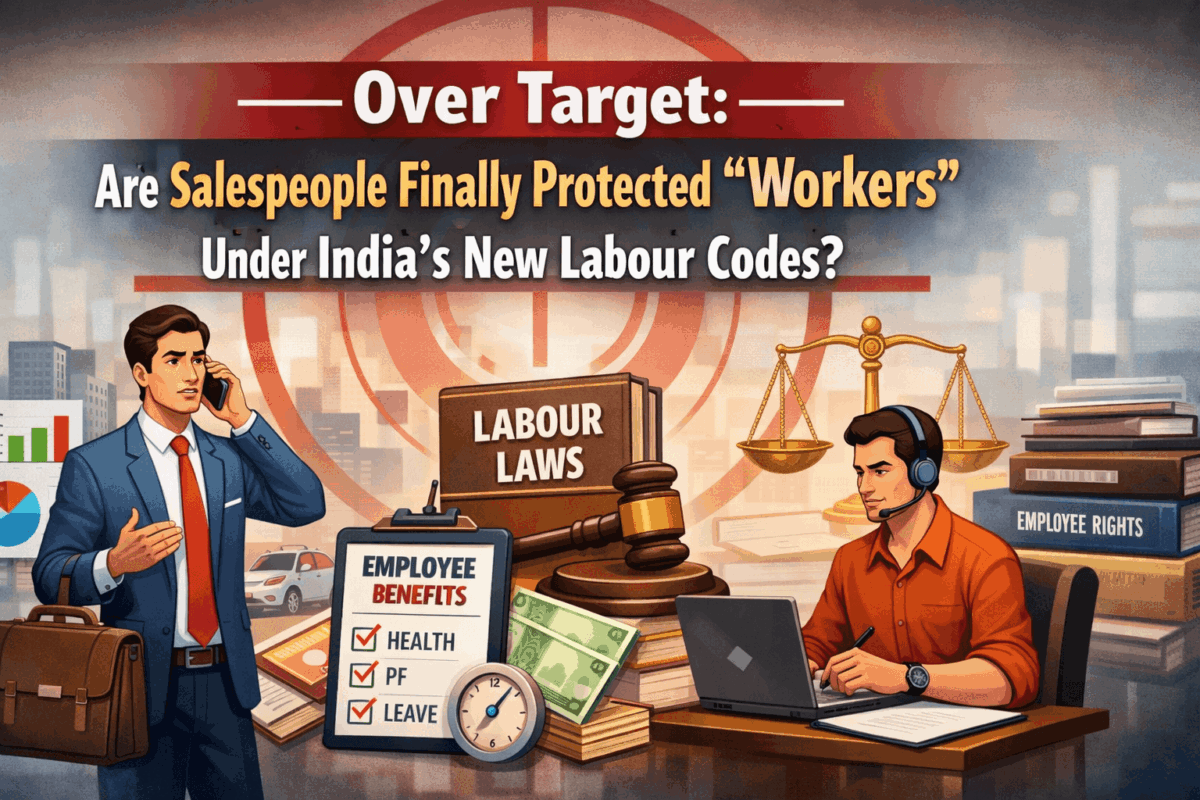
First, Let’s Clear Up a Common Confusion: Employee vs. Worker
Before we dive into whether salespeople are protected, we need to understand two legal terms that sound similar but mean very different things under India’s new labour codes.
“Employee” is the broader umbrella term. Under the Code on Wages, 2019, every single person working for wages in an establishment is an “employee” including managers, administrators, supervisors, clerical staff, and salespeople. This status gives you basic rights like timely payment of wages, minimum wage, and bonuses.
“Worker” is a narrower, more powerful sub-category under the Industrial Relations Code, 2020. Being a “worker” unlocks extra job security protections: retrenchment compensation, mandatory notice before termination, access to grievance committees, and trade union representation.
Key takeaway: All workers are employees, but not all employees are workers.
Now imagine this scenario: You are a Business Development Executive at a fast-growing corporate office in Mumbai. You pull long hours, chase aggressive quarterly targets, and your compensation structure consists of a fixed salary of ₹25,000 per month, supplemented by variable performance commissions.
One afternoon, during a restructuring meeting, you hear whispers about potential workforce downsizing. You immediately think about your safety net. If things turn south, does the law protect you? Can your company terminate your employment with a simple 30-day email, or are you entitled to statutory retrenchment compensation, legal notice periods, and formal grievance redressal?
When you look up older labour statutes, you hit a frustrating brick wall. Your company tells you, “You’re part of the corporate staff, not a factory worker. These laws don’t apply to you.”
But is that actually true today? With the rollout of India’s 4 New Labour Codes; specifically the Industrial Relations Code, 2020; the legal definition of who qualifies as a “worker” (and thus gets those extra protections) has undergone a massive change.
Let’s unpack the IR Code 2020 definition of worker, look at how it treats commissions and salaries, and determine exactly where a salesperson earning ₹25,000 per month stands.
The Legacy Gray Area: Why Salespeople Were Left Stranded
To appreciate why the new laws matter, we have to look at the legal hurdles sales professionals faced under the legacy framework.
Under the old Industrial Disputes Act, 1947, statutory protections were reserved strictly for individuals classified as “workmen.” To qualify, your daily routine had to be primarily manual, clerical, technical, or unskilled.
This created a major legal blind spot for the sales sector:
- The “Intellectual Selling” Argument: Employers routinely argued in labour courts that because a salesperson uses creativity, persuasion, marketing acumen, and psychological strategy to close deals, their work cannot be called “clerical” or “manual.”
- The Statutory Silo: While the specialized Sales Promotion Employees (Conditions of Service) Act, 1976 (SPE Act) was enacted to protect sales staff, its operational application remained largely siloed. For decades, it primarily protected sales representatives; initially focused on the pharmaceutical industry, later extended to sectors like cosmetics, ready-made garments, soft drinks, automobiles, and electronics leaving millions of corporate sales executives in tech, real estate, banking, and retail completely vulnerable to arbitrary employment actions.
- If you weren’t in a covered sector and didn’t perform manual labour, you were automatically grouped into “management”; even if you had absolutely no power to hire, fire, or approve budgets.
The Radical Shift: Enter the Industrial Relations Code, 2020
The Industrial Relations Code, 2020 completely changes this dynamic by rewriting the foundational baseline rules. Under Section 2(zr) of the IR Code, the definition of a “worker” has been structurally expanded.
The law no longer leaves space for companies to debate whether selling counts as manual labour. The Code explicitly states that the term “worker” includes:
- Working Journalists
- Sales Promotion Employees
By directly absorbing sales promotion employees into the core definition of a worker, the new code grants standard corporate salespeople, field executives, and account managers the exact same core legal protections previously reserved for traditional factory-floor workers.
Official Government Confirmation: The Sales Promotion Employees (Conditions of Service) Act, 1976, has now been subsumed into the new Labour Codes. Sales promotion employees are now included in the definition of ‘workers’ under both the OSH Code and the Industrial Relations Code, 2020.
The Core Question: Does a ₹25,000 Salary Disqualify You?
Now let’s tackle the vital detail in our scenario: Your earning structure of ₹25,000 per month plus commission.
When reading articles online about the new codes, you will frequently see a specific number mentioned: ₹18,000 per month. Many people mistakenly read this and assume: “Since I earn ₹25,000, which is over the ₹18,000 limit, I am automatically excluded from worker status and considered managerial staff.”
This is a widespread misunderstanding.
Let’s look at the exact text of the law to clarify this confusion. The supervisory wage threshold under the IR Code states that the definition of a worker excludes two and only two distinct categories of people:
| Category | Exclusion Condition |
| Category A | Anyone employed mainly in a managerial or administrative capacity (this exclusion applies regardless of how much money you make) |
| Category B | Anyone employed in a supervisory capacity who draws wages exceeding ₹18,000 per month |
Breaking Down Your Status
Are you a supervisor? Do you spend your day assigning work to a team, conducting performance reviews, approving leaves, or managing a department’s output?
- If NO: You are an individual contributor focused on sales promotion. Because your core role is sales promotion rather than supervision, the ₹18,000 salary cap does not apply to you.
- The Result: Your fixed salary of ₹25,000 does not strip away your statutory rights. You are fully classified as a “worker” under the IR Code, 2020, and are eligible for complete legal protections against arbitrary dismissal, layoff compensation, and unfair labour practices.
Important nuance: Even if you were a supervisor (e.g., a Team Lead with 5 people reporting to you), you would still be a worker only if your monthly wages were ≤ ₹18,000. If you earn ₹25,000 as a supervisor, you would not qualify as a worker. But for an individual contributor salesperson, the ₹18,000 limit does not apply at all.
What About Your Sales Commissions?
Under the unified definition of “wages” introduced across all four codes, core remuneration includes basic pay, dearness allowance, and retaining allowance.
Variable sales commissions linked to performance targets generally do not count toward your baseline statutory wage calculations for exclusions, provided your primary duties remain centered on individual sales generation rather than administrative or team management.
Function Over Form: The “Manager” Title Trap
A common tactic in corporate HR is assigning impressive titles to employees. A company might designate your role as an “Account Manager,” “Business Development Manager,” or “Regional Sales Lead.”
Do not let a corporate title cause you panic. Indian labour jurisprudence has consistently maintained that the nature of your actual job functions dictates your legal status, not the text printed on your business card.
| True Managerial/Admin Capacity | True Worker Capacity (Sales) |
| Power to hire, terminate, or initiate disciplinary actions against staff | Focus is on executing sales deals and meeting individual targets |
| Holds direct independent financial or budget sanctioning authority | No independent authority over company operational or financial budgets |
| Primary duty is supervising team members and workflow delivery | Primary duty is external sales promotion and client acquisition |
If your company calls you a “Territory Manager” but your daily routine consists entirely of cold-calling clients, pitching products, and closing sales without a team reporting to you, the law looks past the title. You are a sales promotion employee, and you fall under the protective umbrella of a worker; meaning you get all the enhanced protections of the Industrial Relations Code.
The Practical Value: What Protections Do You Actually Get as a “Worker”?
Now that you know you qualify as a worker (not just a basic employee), what does this look like in practice? If your company faces sudden financial headwinds, your worker status grants you significant operational leverage:
| Protection | What It Means |
| Mandatory Notice and Compensation | Your employer cannot suddenly terminate your employment without providing a statutory notice period (or wages in lieu of notice) alongside mandatory retrenchment compensation calculated based on your years of continuous service |
| Protection from Unfair Labour Practices | If an employer attempts to alter your core employment conditions or withhold your earned commissions arbitrarily, you have the right to raise a formal industrial dispute through an Inspector-cum-Facilitator or approach the newly constituted Industrial Tribunals for speedy resolution |
| Re-skilling Fund | For retrenched workers, employers must deposit an amount equal to 15 days’ wages into a re-skilling fund to enhance your employability |
| Grievance Redressal | In establishments with 20+ workers, you have access to a Grievance Redressal Committee |
| Trade Union Representation | You can join or form a trade union to collectively bargain |
The Verdict
If you are an individual salesperson (no team reporting to you) earning ₹25,000 per month plus commissions, the new labour architecture is a massive victory for your career security.
You are NOT considered managerial staff simply because you work at a corporate desk or earn above a basic minimum line.
As long as your day-to-day work is focused on client acquisition rather than running the department, the IR Code 2020 definition of worker protects you; giving your white-collar sales career real, enforceable statutory teeth.
Disclaimer – This content is provided solely for general informational and educational purposes and does not constitute legal advice, attorney-client relationship, or any form of legal representation. Laws, regulations, and judicial interpretations vary by jurisdiction and are subject to change without notice.The Industrial Relations Code, 2020, along with the three other Labour Codes (Code on Wages, 2019; Code on Social Security, 2020; and Occupational Safety, Health and Working Conditions Code, 2020), was brought into force from 21 November 2025 across India.The classification of a worker under Section 2(zr) of the IR Code ultimately depends on the specific facts and circumstances of each individual’s role, duties, and employment conditions. The presence of a “manager” title on a business card is not determinative; courts examine substantive job functions. However, this assessment is highly fact-specific, and misclassification can have serious legal consequences.Readers are strongly advised to consult a qualified legal professional admitted to practice in the relevant jurisdiction for advice tailored to their specific factual circumstances. Nothing in this content should be relied upon as a substitute for professional legal counsel. The author and publisher expressly disclaim all liability in respect of any actions taken or not taken based on any contents of this publication.Court decisions, administrative orders, and subsequent amendments may modify or supersede the information provided herein. Prior results do not guarantee similar outcomes.