 Total Visitors
  Online Users
  Today
Today  Yesterday

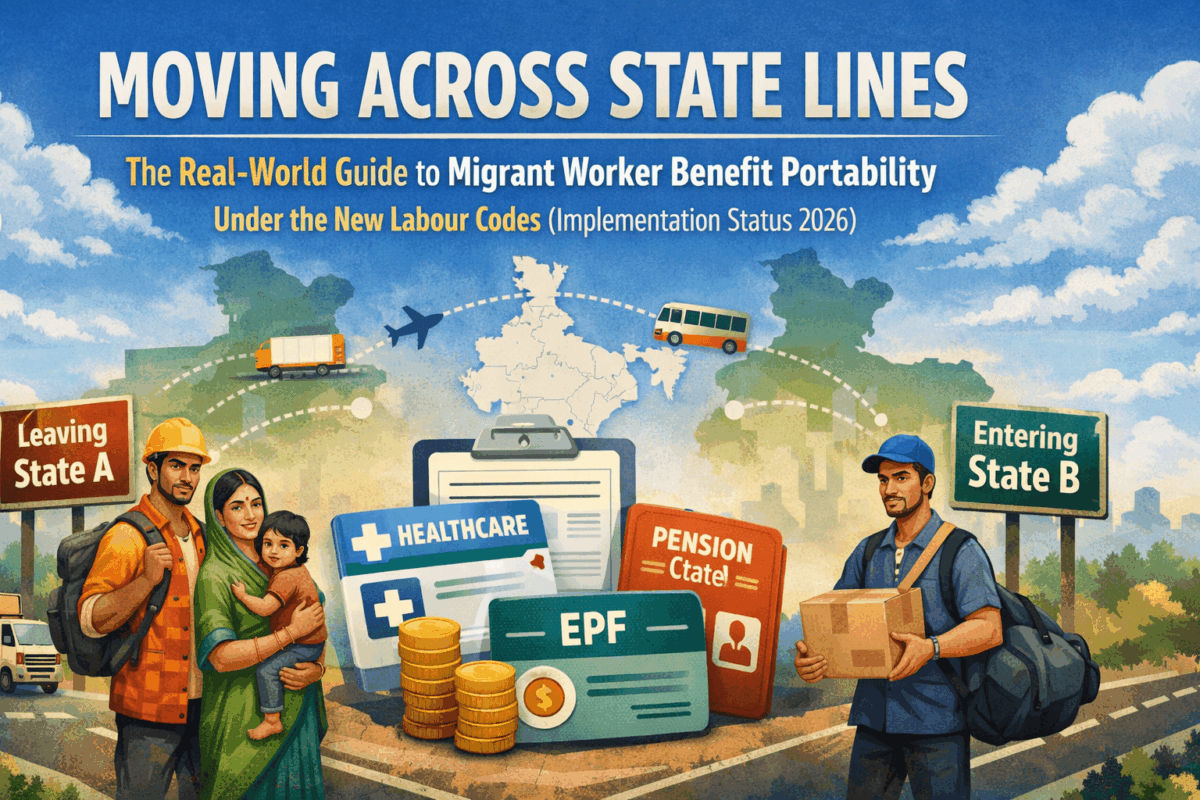
Imagine you are a construction foreman or an industrial operator working hard in the bustling factories of Pune or Thane. Your employer has dutifully registered you for statutory benefits. But circumstances change, and you decide to move back home to Patna, Bihar.
As you pack your bags, a string of stressful questions runs through your mind: What happens to my Provident Fund (PF) money? Will my Employee State Insurance (ESI) card clear medical bills for my family back in Bihar? Or does crossing a state border mean leaving my hard-earned social security safety nets behind?
For decades, crossing an Indian state line to look for work meant stepping into a legal twilight zone. The old laws failed to protect moving workers when they crossed provincial lines.
However, India’s New Labour Codes specifically the Code on Social Security, 2020 and the Occupational Safety, Health and Working Conditions (OSHWC) Code, 2020 promise a modernized era of inter-state migrant worker benefits portability. But how does this promise actually play out on the ground today? Let’s trace your journey from Maharashtra to Bihar and evaluate what the law intends, what technology enables (or still struggles with), and what the Supreme Court has observed about your rights.
The Legacy Trap vs. The New Code Architecture (Pending Full Notification)
Under the legacy system, governed primarily by the outdated Inter-State Migrant Workmen (RECS) Act, 1979, safety nets were tied entirely to your contractor. If your contractor changed, or if you packed your bags and moved to another state independently, your records disappeared. Benefits were fundamentally localized; a worker registered in Maharashtra could not easily unlock medical care or ration access in Bihar.
The New Labour Codes break down these provincial walls on paper by shifting the focal point from paper ledgers to decentralized digital identities. The law expands the definition of an inter-state migrant worker to include not just those hired via traditional contractors, but also self-migrated individuals who move across states on their own initiative.
Important caveat: While the Codes have received Presidential assent, most provisions are not yet fully notified across all states. State-specific rules are still being framed. The portability framework described below represents the intended legal architecture; some elements are already operational (e.g., UAN-based PF transfer), while others (e.g., full pan-India ESI access via e-Pehchan) are still rolling out gradually.
Portability in Action: From Maharashtra to Bihar
If your employer in Maharashtra has legally registered your employment, your social security relies on three major portable digital pillars. Here is how they function or are intended to function when you arrive in Patna.
1. Your PF Balance (The Universal Account Number)
Your Employees’ Provident Fund (EPF) is already portable; this is one area where the system works smoothly even before full Code implementation.
The Workflow: Your financial identity is locked into a unique, lifelong 12-digit Universal Account Number (UAN). When you leave your job in Maharashtra and take up employment in Bihar, you do not need to withdraw your PF or close the account. You simply provide your existing UAN to your new employer in Bihar. Your continuous service remains intact, and your retirement corpus continues to grow seamlessly via online UAN PF transfer capabilities.
Status: Fully operational.
2. The Patna Hospital Test: Does Your ESI Card Work?
The Direct Answer: Yes, but with location-based caveats.
Under the Code on Social Security, 2020, the Employees’ State Insurance Corporation (ESIC) has been progressively expanding its district-level medical footprint across India. However, not every district in Bihar has an ESI hospital or dispensary yet.
How it works in practice: Your employer in Maharashtra registers you on the unified ESIC portal, which generates a digital e-Pehchan card for you and your dependents.
Accessing Care in Patna: If your family is living in Patna, they can walk into any local ESIC Hospital (such as the ESIC Model Hospital in Phulwarisharif, Patna) or any designated ESIC dispensary where such infrastructure exists. By presenting the e-Pehchan card or your Aadhaar number, you can unlock medical benefits, outpatient care, and emergency treatments. The system operates on a single national server, meaning ESI card portability is technically hardwired but physical hospital presence in your home district remains a ground-level constraint.
Caveat: ESIC’s pan-India expansion is ongoing. Before moving, verify whether your destination district has an ESI facility. For areas without ESI coverage, you may need to rely on other arrangements.
3. The OSHWC Travel Bonus (Statutory Right – Subject to Rules)
As a statutory provision under the OSHWC Code, 2020, your employer in Maharashtra is legally obligated to pay you a lump-sum annual travel allowance to cover your public transport fare from your place of employment back to your home state address in Bihar. However, the exact amount and procedure depend on state-specific rules which are yet to be finalized in many states.
Status: Legally mandated but not uniformly enforced. Check with your state labour department.
What Has the Supreme Court Observed? (A Reality Check)
While the digital infrastructure is being built, is the system entirely flawless? Not yet. The judiciary has stepped in regularly to ensure these digital protections translate into ground-level reality.
In the landmark suo motu case In Re: Problems and Miseries of Migrant Labourers, the Supreme Court of India monitored the operational challenges of the e-Shram portal closely. While the Court praised the creation of a national registry that has successfully documented nearly 29 crore unorganized and migrant workers, it highlighted critical compliance challenges that state administrations must fix:
- The Ration Card Data Mismatch: The Supreme Court observed a significant gap where millions of migrant workers registered on the national e-Shram database were still missing from the public distribution system (PDS) databases. The Court issued strict directions to state governments to issue localized ration cards to all left-out workers within fixed deadlines, ensuring they can utilize the One Nation One Ration Card initiative to claim food grains wherever they are living.
- Lack of Dual-Address Mapping: A notable systemic challenge highlighted by policy experts and monitored by judicial oversight is that digital portals often prioritize a worker’s permanent native address (e.g., in Bihar). The Court has pushed for better data-sharing protocols so that host states (like Maharashtra) and home states can dynamically map alternate worksite addresses.
- Inter-State Data Integration: The Supreme Court heavily emphasized that a standard operating procedure (SOP) must be stringently maintained to seamlessly share e-Shram data across state borders. This prevents a worker from slipping out of the regulatory safety net the moment they cross from one state territory to another.
Structural Comparison: Migrant Worker Rights
| Feature | Legacy System (1979 Act) | Proposed Framework Under New Labour Codes (Pending Full Implementation) |
| Worker Coverage | Restricted to contractor-driven recruitments | Includes contractor-hired and self-migrated workers (on paper) |
| Medical Access | Bound to state of registration; localized | Intended to be portable pan-India via e-Pehchan but depends on ESIC hospital presence |
| PF Account Flow | Required tedious manual transfers | Already operational: instant, lifelong tracking via unified UAN |
| Food & Social Security | Tied to local home-village ration cards | Portable access intended via One Nation One Ration Card subject to state PDS linkage |
The Verdict: Empowerment with Active Follow-Up – And Patience
The new system on paper does not leave you stranded. If you move from Maharashtra to Bihar, your legal rights, your accumulated PF balance, and (where ESI infrastructure exists) your family’s medical eligibility move with you in your pocket.
However, as a proactive worker or consultant, the key to seamless transition lies in data hygiene and realistic expectations:
- Already works well: PF/UAN transfer, One Nation One Ration Card (where linked), e-Shram registration.
- Works in many but not all locations: ESI medical portability; verify before moving.
- Pending full implementation: Uniform travel allowance enforcement, complete PDS-e-Shram integration, dual-address mapping across all states.
Ensure that your Aadhaar is cleanly linked to your mobile number, your e-Pehchan family details are updated completely, and your UAN is shared with your employer from day one. The law has cleared the road for portability but implementation is still a work in progress across India’s federal structure.
Quick Action Checklist for Migrant Workers – FREE
| Step | Action |
| 1 | Register on e-Shram portal (eshram.gov.in) |
| 2 | Link Aadhaar with mobile number and UAN (EPFO) |
| 3 | Download e-Pehchan card from ESIC portal |
| 4 | Check ESI hospital availability in your home district via esic.nic.in |
| 5 | Verify One Nation One Ration Card linkage with local PDS |
| 6 | Retain job offer/contract showing your permanent address for travel allowance claim |
Disclaimer – This content is provided for general informational and educational purposes only and does not constitute legal advice. You should consult a qualified employment lawyer or your regional PF/ESI office before making any decisions based on this content. Laws change frequently, and this information may become outdated. For authoritative guidance, refer to official government portals (epfindia.gov.in, esic.nic.in, eshram.gov.in) or seek independent legal counsel.