

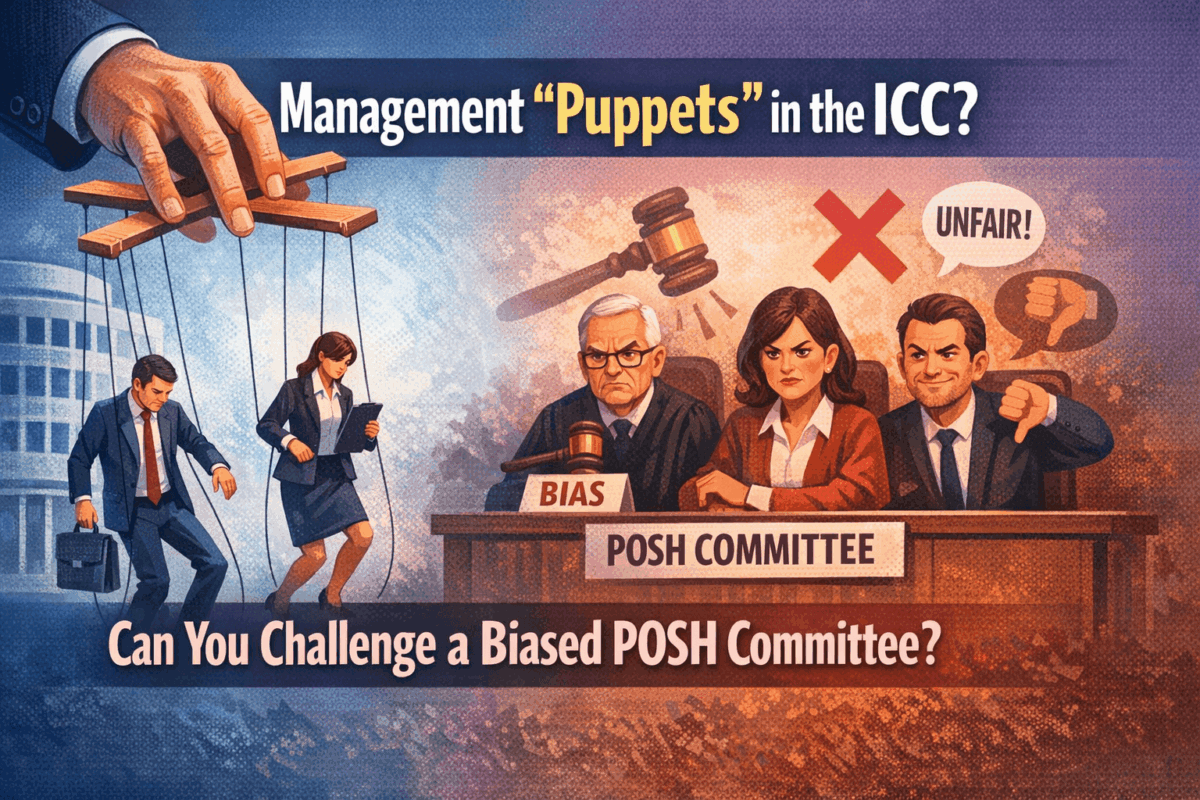
Imagine this: You finally gather the courage to report harassment. You look at the Internal Committee (IC) members and realize they are all “Yes‑Men” or “Yes‑Women” who report directly to the person you’ve accused. Or perhaps they are so close to the CEO that an unbiased inquiry feels like a fantasy.
Does the law allow you to say, “Stop, this committee isn’t fair”?
The answer is a resounding Yes. While an employer has the right to form the committee, the law grants employees the right to a fair and impartial inquiry. If a committee is under the undue influence of management, it isn’t just an HR issue, it’s a legal defect.
1. The Legal Shield: Principles of Natural Justice
The POSH Act isn’t just about checkboxes; it’s about Natural Justice. In Indian law, this means “no person shall be a judge in their own cause” and “justice must not only be done but must be seen to be done.”
If the members of the IC are “under the thumb” of the management or the respondent (the accused), the inquiry violates these principles. In 2026, courts are more vigilant than ever. If a committee is proven to be biased, its entire report can be set aside by a High Court.
2. When Does “Management Influence” Become Illegal?
Not every friendly relationship is a conflict of interest. However, an employee has a valid ground to complain if:
- Direct Reporting Lines: IC members report directly to the accused.
- The “Pocket” External Member: The External Member is actually the company’s long‑standing legal counsel or consultant who derives significant income from management.
- Personal Interest: A member has a financial or personal stake in protecting the accused.
- Previous Conduct: The committee has a history of suppressing complaints or mocking complainants.
3. The External Member: Your Statutory Safeguard
Section 4(2)(c) mandates an External Member from an NGO or association committed to women’s causes, or a person familiar with sexual harassment issues.
Key4Comply’s Expert Insight: Indian courts have clarified that the External Member must be truly independent. In Ruchika Singh Chhabra v. M/S. Air France India & Anr. (Delhi High Court, 2018), the IC was challenged because the External Member lacked NGO association and relevant expertise. The Court held this violated the statutory requirement and undermined the committee’s credibility. Similarly, High Court commentary has emphasized that appointing insiders such as company lawyers on retainer or ex‑employees compromises neutrality. While no judgment has explicitly banned such appointments, courts have consistently disapproved of arrangements where independence is questionable.
4. How to Complain: The Step‑by‑Step Approach
If you believe the committee is biased, you don’t have to wait for a bad verdict. You can act early:
- Raise an Interim Objection: Write to the Presiding Officer and HR Head, stating why you believe Member X or Y has a conflict of interest.
- Request Reconstitution: Ask for a specific member to be recused.
- Appeal to the Local Committee (LC): If ignored, approach the District Officer or LC to report lack of impartiality.
- Writ Petition: In extreme cases, employees have successfully moved the High Court to stay an inquiry because the IC was biased or improperly constituted.
5. Current Status: 2026 Compliance & The New Labour Codes
While the POSH Act remains the primary legislation, the Industrial Relations (IR) Code, 2020 (fully active in 2026) reinforces fair grievance redressal through Certified Standing Orders.
If a company forces an employee through a biased IC, it can be flagged as an Unfair Labour Practice. Management is now legally incentivized to ensure the IC is seen as independent to avoid fines and litigation.
FREE – Summary Checklist for a “Management‑Neutral” IC
- [ ] Distance Test: Ensure IC members are not from the same department as the accused.
- [ ] External Member [EM] Audit: Is the EM truly independent, or a company vendor?
- [ ] Bias Declarations: Do members sign a “No Conflict of Interest” form before each case?
- [ ] Rotation Policy: Does management rotate IC members every 3 years to prevent entrenched bias?
- [ ] Minimum Size: Does your IC have at least 4 members as required under Section 4?
Disclaimer: This blog is for educational and informational purposes only and does not constitute legal advice. While the principles of Natural Justice are universal, their application depends on specific case facts. Please consult a qualified legal professional for establishment‑specific challenges.