 Total Visitors
  Online Users
  Today
Today  Yesterday

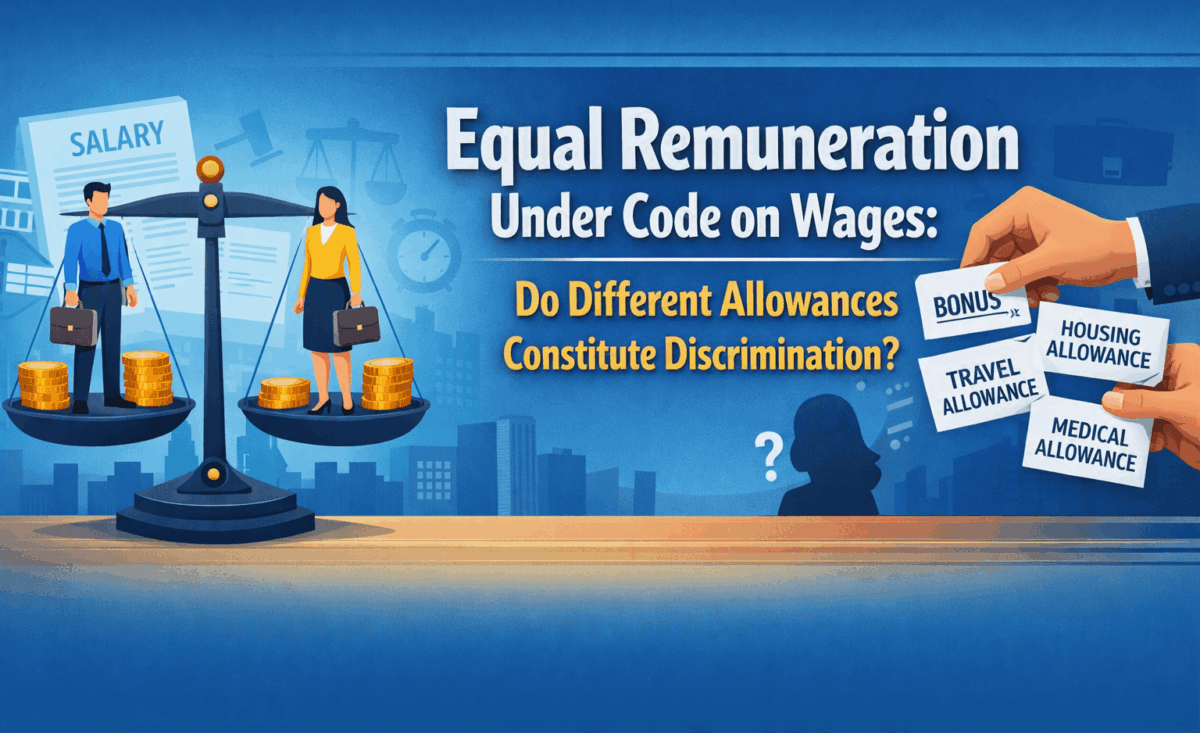
A question that has been troubling HR teams since the Labour Codes came into effect: the Code on Wages has subsumed the Equal Remuneration Act, 1976, and introduced a uniform definition of “wages” under Section 2(y). If an employer pays different allowances to male and female employees doing the same work, but the total “wages” (as defined under the new uniform definition) are equal, does this constitute discrimination under the Code’s equal remuneration provisions?
The short answer is nuanced. The Code’s definition of “wages” for equal remuneration purposes is broader than the general definition. And the prohibition on discrimination extends beyond just “wages” to the entire “remuneration” package. Let me break down exactly how this works.
The Legal Framework: What the Code Actually Says
Section 2(y): The Definition of Wages
Section 2(y) of the Code on Wages, 2019 introduced a uniform definition of “wages” across all four Labour Codes.
What is included:
- Basic pay
- Dearness allowance
- Retaining allowance
What is excluded (generally):
- Bonus
- House rent allowance
- Conveyance allowance
- Overtime allowance
- Employer’s contribution to PF/pension
- Gratuity payable on termination
- Retrenchment compensation
- Commission
- Value of house accommodation and utilities
The critical proviso (the 50% rule):
If the excluded components exceed 50% of total remuneration, the excess is deemed wages.
The Equal Remuneration Twist
Here is where the question gets interesting. For the purpose of equal wages to all genders and for the purpose of payment of wages, the Code explicitly requires that emoluments specified in clauses (d), (f), (g), and (h) of the exclusions list be taken for computation of wages.
These are:
- Clause (d): Conveyance allowance or value of any travelling concession
- Clause (f): House rent allowance
- Clause (g): Remuneration payable under any award or settlement or order of a court or Tribunal
- Clause (h): Overtime allowance
This means that for equal remuneration purposes, the definition of “wages” includes components that would otherwise be excluded from the general wage definition. The Code itself recognizes that equal pay assessment requires a broader view.
The Prohibition on Discrimination
Section 3 of the Code on Wages prohibits discrimination on the ground of gender in matters relating to wages by the same employer, in respect of the same work or work of a similar nature done by any employee. The Code has adopted a gender-neutral approach, prohibiting discrimination on grounds of gender including transgender persons.
The employer, while recruiting employees to carry out the same work or work of similar nature, must take into account the employee’s work experience in addition to skill, effort, and responsibility.
The prohibition is not limited to “wages” as defined under Section 2(y). It extends to “remuneration” – a broader concept that includes all allowances, benefits, and emoluments.
Does Differing Allowances with Equal Total Wages Constitute Discrimination?
Scenario Analysis
Consider two employees doing the same work:
| Component | Male Employee | Female Employee |
| Basic Pay | ₹40,000 | ₹30,000 |
| Dearness Allowance | ₹10,000 | ₹10,000 |
| House Rent Allowance | ₹10,000 | ₹20,000 |
| Conveyance Allowance | ₹5,000 | ₹5,000 |
| Special Allowance | ₹15,000 | ₹15,000 |
| Total Monthly CTC | ₹80,000 | ₹80,000 |
Step 1: Check for Equal Remuneration Purpose
For equal remuneration purposes, the Code requires including clauses (d), (f), (g), and (h) – conveyance, HRA, award-based remuneration, and overtime.
The wage base for equal remuneration comparison would be:
| Component | Male Employee | Female Employee |
| Basic Pay | ₹40,000 | ₹30,000 |
| DA | ₹10,000 | ₹10,000 |
| HRA (included for equal pay purpose) | ₹10,000 | ₹20,000 |
| Conveyance (included) | ₹5,000 | ₹5,000 |
| Wage Base (equal pay purpose) | ₹65,000 | ₹65,000 |
The wage base is equal. The total compensation is equal. On the face of it, there is no discrimination.
Step 2: Ask the Harder Question
The real question is whether the structuring itself is discriminatory. Why are the allowances structured differently? Is there a legitimate, non-discriminatory reason?
If the employer can demonstrate that the allowance differences are based on legitimate factors such as:
- Actual housing costs (e.g., female employee has higher actual rent)
- Legitimate business requirements
- Objective criteria unrelated to gender
Then the structure may be defensible.
However, if the structuring is designed to artificially inflate the female employee’s allowances while keeping basic pay lower, this may raise red flags. The ILO’s Committee of Experts on the Equal Remuneration Convention has noted that the Code’s definition of wages for equal remuneration purposes should be broad enough to include “any additional emoluments whatsoever payable directly or indirectly”.
The ILO’s Concerns
The ILO Committee of Experts has raised concerns about the Code’s definition of “wages” for equal remuneration purposes:
- Article 1(a) of Convention No. 100 sets out a broad definition of “remuneration” that includes “any additional emoluments whatsoever payable directly or indirectly, whether in cash or in kind, by the employer to the worker”
- The Committee has asked the Government to consider amending the definition of “wages” in Section 2(y) to allow for a broader definition
- The Committee has also noted that the Code’s “same work or work of similar nature” standard is more limited than the Convention’s “work of equal value” standard
This suggests that the narrow wage definition may face future scrutiny or amendment.
Practical Compliance Considerations
What Employers Should Check
| Action Item | Why It Matters |
| Compare total remuneration, not just basic pay | The prohibition covers all remuneration, not just wages |
| Include HRA, conveyance, overtime, and award-based payments | These are specifically included for equal pay purposes |
| Document legitimate reasons for allowance differences | Helps defend against discrimination claims |
| Review special allowances for universality | Under Vivekananda principles, universal allowances are wages |
| Ensure the 50% cap on exclusions is not violated | Excess exclusions become deemed wages |
| Conduct pay equity audits | Map roles and compensation data by gender |
The Role of the 50% Rule
The 50% rule may also play a role. If the allowance differences cause total exclusions to exceed 50% for either employee, the excess becomes deemed wages. This could potentially equalize the wage base further.
However, the key principle remains: the Code prohibits discrimination in remuneration, not just in the narrow definition of wages. Employers who structure compensation packages with different allowance components for male and female employees doing the same work face a compliance risk, even if the total amounts are equal.
What This Means for Your Compensation Strategy
For HR teams designing compensation packages:
| Consideration | Practical Impact |
| The wage base for equal remuneration includes HRA, conveyance, overtime, and award-based payments | These must be included when checking for discrimination |
| The general wage definition may differ from the equal pay wage definition | Don’t rely only on the general Section 2(y) definition |
| The prohibition on discrimination is gender-neutral | Applies to all genders, including transgender persons |
| Differences in allowances must be justified | Document legitimate, non-discriminatory reasons |
| The ILO has flagged the narrow wage definition | This may lead to future amendments or judicial scrutiny |
| Systematic pay equity audits are required | Identify statistically significant pay gaps |
The Bottom Line
If an employer pays different allowances to male and female employees doing the same work, but the total “wages” (as defined under the Section 2(y) general definition) are equal, this may still constitute discrimination under the Code’s equal remuneration provisions.
This is because:
- For equal remuneration purposes, the Code explicitly requires including HRA, conveyance, overtime, and award-based payments in the wage computation.
- The prohibition on discrimination extends to “remuneration,” not just the narrow definition of “wages”.
- The ILO has recommended a broader definition of remuneration under the Code.
Employers who structure compensation with different allowance components for male and female employees doing the same work face a compliance risk, even if the total amounts are equal. The safest approach is to ensure that both the wage base and the total remuneration are equal for employees doing the same work, and to document any legitimate, non-discriminatory reasons for differences.
Disclaimer: This content is for educational and informational purposes only and is based on available statutory provisions and judicial pronouncements as of the publication date. The Labour Codes and their interpretation are subject to ongoing judicial developments and state-specific notifications. This does not constitute formal legal counsel. Organizations should consult qualified legal professionals for advice specific to their circumstances, including jurisdiction-specific applicability and compliance obligations.