 Total Visitors
  Online Users
  Today
Today  Yesterday

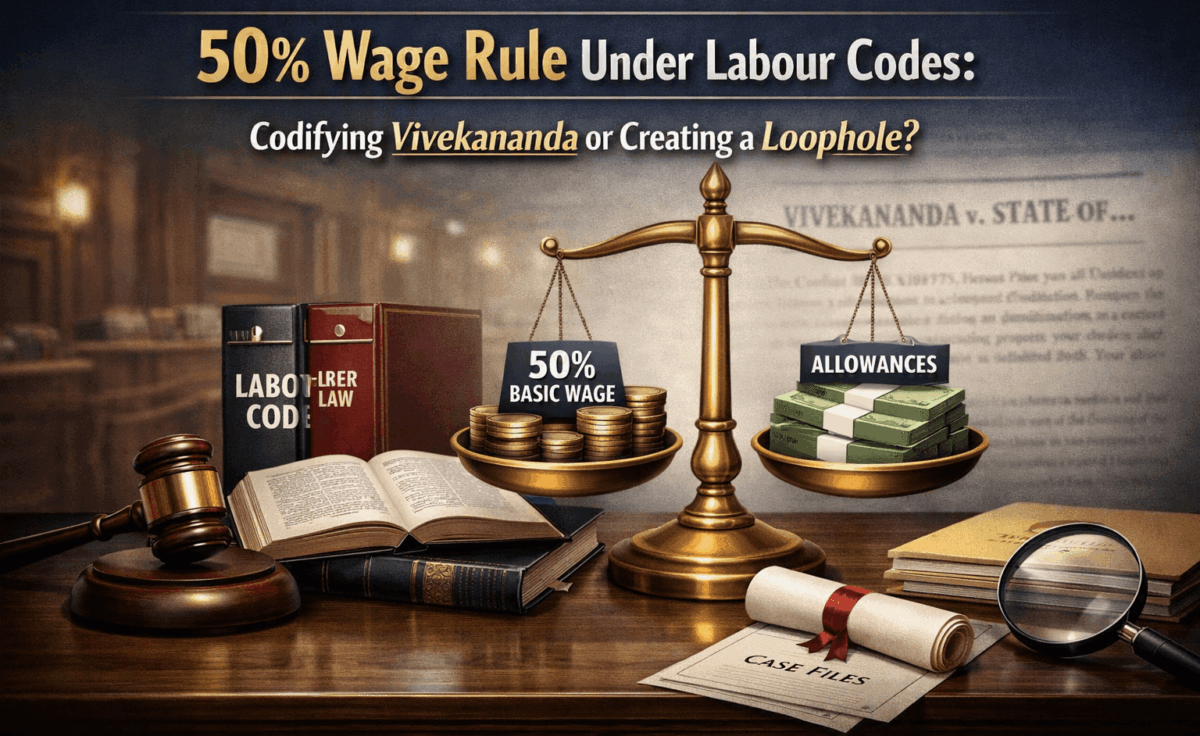
A question that has been circulating in compliance circles since the Labour Codes came into effect: Does Section 2(y) of the Code on Wages simply codify the Supreme Court’s 2019 ruling in Regional Provident Fund Commissioner v. Vivekananda Vidyamandir, or does the 50% cap on exclusions create a lower threshold that employers can still exploit?
The short answer is that the 50% rule is a legislative anti-avoidance mechanism, not a ceiling on wages. But the confusion is understandable, given how some employers and even advisors have interpreted it.
Let me walk you through exactly what the law says, how it connects to the Vivekananda judgment, and what this means for your compliance strategy.
The Vivekananda Judgment: What the Supreme Court Actually Held
The Supreme Court’s 2019 decision in Regional Provident Fund Commissioner v. Vivekananda Vidyamandir addressed a common question: whether special allowances paid by an establishment would fall within the expression “basic wages” under Section 2(b) of the EPF Act.
The Court laid down the “test of universality” as the determining factor. If an allowance is paid across the board to all employees in a particular category, it must be included in basic wages. Allowances that are variable or linked to individual efficiency or output, and not common to all, can be excluded.
Key findings from the judgment:
- Payments that are universally, necessarily, and ordinarily paid to all employees across the board are basic wages
- If an allowance is earned by all employees, regardless of performance, it cannot be disguised as a “special allowance”
- The crucial test is whether the payment has a “direct access and linkage” to something not common to all employees
- Variable earnings that differ from individual to individual based on efficiency and diligence stand excluded from basic wages .
The Court concluded that many employers were camouflaging portions of basic wages as allowances to avoid PF deductions. The ruling effectively expanded the PF contribution base by requiring employers to include universal allowances.
Section 2(y): The Legislative Response
Section 2(y) of the Code on Wages, 2019 introduced a uniform definition of “wages” that was a direct legislative response to persistent judicial concern regarding artificial wage fragmentation.
What Section 2(y) includes:
The definition includes all remuneration paid to an employee, including basic pay, dearness allowance, and retaining allowance.
What Section 2(y) excludes:
- Bonus
- House rent allowance
- Conveyance allowance
- Overtime allowance
- Employer’s contribution to PF/pension
- Gratuity payable on termination
- Retrenchment compensation
- Commission
- Value of house accommodation and utilities
The critical proviso:
If the excluded components (clauses a to i) exceed 50% of the total remuneration, the excess is deemed to be wages.
Section 9 of the Code also introduces the concept of a statutory floor wage, which the Central Government is empowered to fix, and minimum wages fixed by appropriate Governments must not be less than this floor wage.
Does the 50% Rule Codify the Vivekananda Judgment?
Yes and no. Let me explain.
The Vivekananda judgment addressed a different question: which allowances must be included in basic wages for EPF purposes. It established the “universality” test to prevent employers from artificially suppressing the PF contribution base.
Section 2(y) addresses a broader question: how do we define wages uniformly across all labour statutes to prevent fragmentation? It creates a single definition applicable to wages, bonus, equal remuneration, and social security contributions.
The connection works this way:
The Code’s 50% rule is an anti-avoidance mechanism that prevents employers from structuring compensation with excessive exclusions. It works not by defining which allowances must be included, but by capping the total value of exclusions.
A standard salary package under the Code would look like this:
| Component | Amount | Classification |
| Basic Pay | ₹50,000 | Wages (included) |
| Dearness Allowance | ₹10,000 | Wages (included) |
| House Rent Allowance | ₹20,000 | Exclusion (within cap) |
| Conveyance Allowance | ₹5,000 | Exclusion (within cap) |
| Special Allowance | ₹15,000 | Exclusion (exceeds cap) |
| Total CTC | ₹1,00,000 |
Here’s the compliance check:
- Total exclusions = ₹20,000 + ₹5,000 + ₹15,000 = ₹40,000 (40% of CTC)
- Exclusions are within the 50% cap, so compliant
- The ₹15,000 special allowance is excluded because exclusions total only 40%
Now consider this structure:
| Component | Amount | Classification |
| Basic Pay | ₹30,000 | Wages (included) |
| Dearness Allowance | ₹10,000 | Wages (included) |
| House Rent Allowance | ₹25,000 | Exclusion (within cap) |
| Conveyance Allowance | ₹10,000 | Exclusion (within cap) |
| Special Allowance | ₹25,000 | Exclusion (exceeds cap) |
| Total CTC | ₹1,00,000 |
Compliance check:
- Total exclusions = ₹25,000 + ₹10,000 + ₹25,000 = ₹60,000 (60% of CTC)
- Exclusions exceed the 50% cap by ₹10,000
- The excess ₹10,000 is deemed wages
The key insight: The 50% rule operates as a cap on exclusions, not a floor or ceiling on wages. It does not mandate that basic wages must be exactly 50%. It prohibits employers from having more than 50% of remuneration outside the wage definition.
The Loophole Question: Can Employers Still Exploit This?
The concern is valid: does the 50% cap actually incentivize employers to keep basic wages artificially low while using the 50% exclusion allowance as a shield?
Here’s the catch:
Under the Vivekananda judgment, any allowance paid universally must be included in basic wages. The Code’s 50% rule does not override this principle. It operates alongside it.
So, if an employer structures a package where basic pay is ₹30,000 (30% of CTC) and the remaining 70% is divided into exclusions like special allowance, conveyance, and HRA, the exclusions may exceed the 50% cap.
But here’s where the Vivekananda judgment adds another layer: If that special allowance is paid to all employees across the board, it should be included in basic wages regardless of the 50% cap. The courts would likely strike down such structuring as an attempt to camouflage basic wages.
The correct reading: The 50% rule is a floor on the wage base, not a ceiling. It ensures the wage base for social security and compliance purposes is not artificially compressed. In appropriately structured packages, wages may legitimately constitute 60%, 70%, or even 80% of the total CTC.
The Supreme Court’s universality test remains binding. The Code’s 50% cap does not override it; both operate together to prevent wage fragmentation.
What This Means for Your Compliance Strategy
For HR and Management
| Action Item | Why It Matters |
| Review all salary components for universality | Universal allowances must be included in wages |
| Ensure exclusions don’t exceed 50% | Excess exclusions are deemed wages under the Code |
| Consider increasing basic wages above 50% | Higher wage base is compliant and better for employees |
| Document the rationale for every allowance | Helps defend against universality challenges |
For Compensation Design
| Consideration | Practical Impact |
| The 50% cap is a minimum requirement | You can and should have wages above 50% |
| Special allowances can still be used | But if paid universally, they are wages under Vivekananda |
| The “test of universality” still applies | Vivekananda precedent is not overridden |
| PF, gratuity, and bonus calculations must use the deemed wage base | When exclusions exceed 50%, excess is added to the wage base |
Central Rules Update
The notification of the Code on Wages (Central) Rules on May 8, 2026, provides further operational clarity. Key provisions include:
- 8-hour workday and 48-hour work week – Rule 5 establishes these statutory caps
- Electronic compliance – Mandatory electronic filing of returns under the OSH Code framework
- Employee-facing due process – A shift from regulator approval to documented employee notice mechanisms for fines and deductions
- Minimum wage calculation – The detailed statutory formula from the Draft Rules has been omitted; criteria will be specified by separate Central Government orders
The Bottom Line
Section 2(y) does codify the judicial concern that drove the Vivekananda judgment by creating a single, non-fragmentable wage definition. But it does not simply repeat the Supreme Court’s holding. It adds a new statutory tool: the 50% cap on exclusions.
The 50% rule is a cap on exclusions, not a ceiling on wages. It is designed to prevent the very mischief the Vivekananda judgment addressed. An employer who structures compensation with more than 50% exclusions is in breach of the Code, regardless of whether those exclusions are permissible under the EPF Act.
Employers structuring wages with excessive exclusions risk non-compliance under both the Code’s 50% rule and the Vivekananda universality principle.
The Code’s approach is more comprehensive. It prevents fragmentation by making any excess exclusion automatically wage. This makes the old practice of loading CTC with allowances to minimize PF, gratuity, and bonus bases significantly more difficult.
Employers who attempt to keep basic wages at exactly 50% while packing the remaining 50% with exclusions may find themselves challenged under both the Code and the Vivekananda judgment’s principles. The law now has both a general anti-avoidance provision (the 50% cap) and the specific universality test from Vivekananda.
Disclaimer: This content is for educational and informational purposes only and is based on available statutory provisions and judicial pronouncements as of the publication date. The Labour Codes and their interpretation are subject to ongoing judicial developments and state-specific notifications. This does not constitute formal legal counsel. Organizations should consult qualified legal professionals for advice specific to their circumstances, including jurisdiction-specific applicability and compliance obligations.