 Total Visitors
  Online Users
  Today
Today  Yesterday

Statutory Genesis & Current Legal Posture
The Employees’ Pension Scheme (EPS) 2026 was notified by the Ministry of Labour and Employment on June 29, 2026, under the Code on Social Security, 2020, superseding the EPS, 1995, and the Employees’ Family Pension Scheme, 1971. The transition is designed for automatic migration of existing EPS-1995 members; no fresh application or re-registration is required.
The scheme retains the core framework: the pension formula remains unchanged (Monthly Pension = Pensionable Salary × Pensionable Service ÷ 70); contribution rates remain at 8.33% for employers and 1.16% for the Central Government; the 10-year service eligibility for monthly pension continues; and the minimum pension remains ₹1,000 per month.
The question of employer liability for a pension “shortfall” if the transition deadline is missed requires examining three distinct legal frameworks: the statutory continuity of the EPS scheme, the Bombay High Court’s April 2026 ruling on employer records, and the employer’s contribution obligations under the Code on Social Security, 2020.
The Core Legal Position: No Employer Liability for “Shortfall”
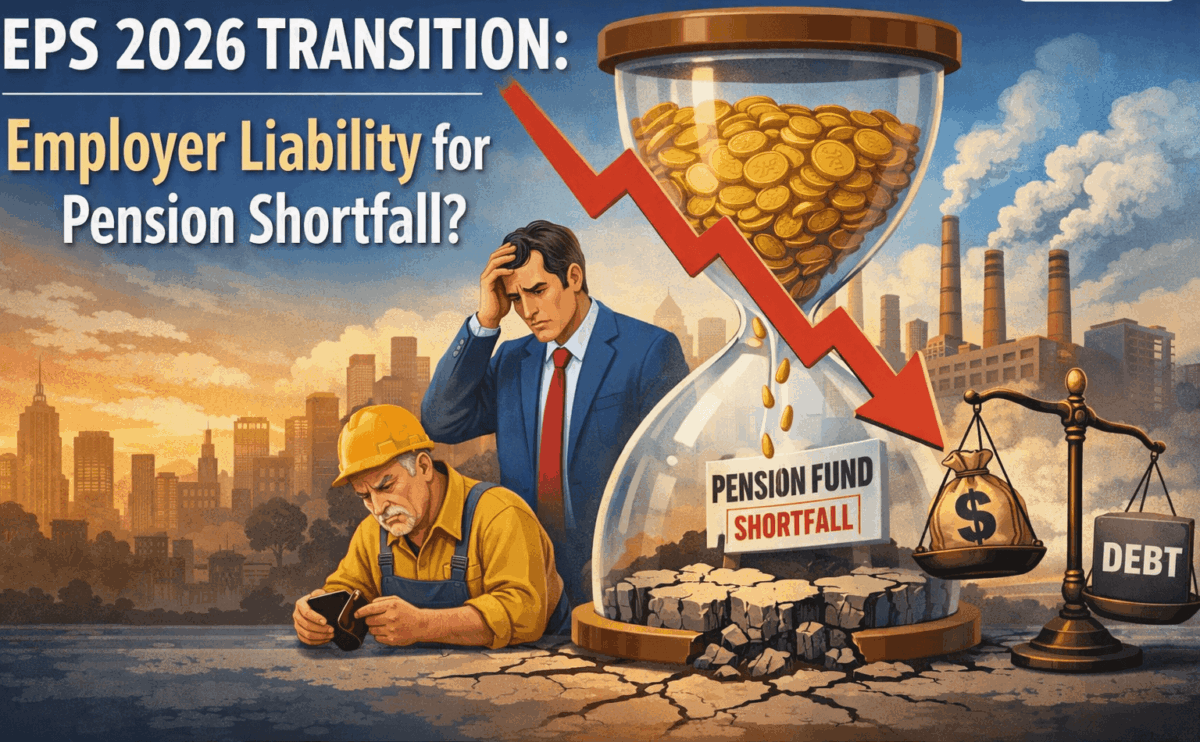
The direct answer is no. The company will not be held liable for an employee’s “entire pension corpus shortfall” due to missing the EPS 1995 to EPS 2026 transition deadline. This is because:
The transition does not create a “deadline” that can be missed. Existing EPS-1995 members are automatically migrated to EPS 2026. The scheme is a statutory continuation, not a new enrolment that requires employer action to “transition” the employee. There is no lapse or forfeiture of pension entitlements due to the scheme change.
The EPS is a defined benefit scheme, not a defined contribution scheme. There is no “pension corpus shortfall” in the same sense as a provident fund or gratuity. The pension amount is determined by a formula and paid from the pension fund administered by EPFO.
Legacy Framework vs. EPS 2026 Framework
| Parameter | EPS-1995 (Legacy) | EPS-2026 (Current) | Impact on Employer Liability |
| Scheme Transition | Not applicable; EPS-1995 was the operative scheme | Automatic migration of existing EPS-1995 members; no fresh application required | No employer action required to “transition” employees; no liability for missing a deadline. |
| Pension Calculation | Formula: (Pensionable Salary × Service) ÷ 70 | Formula unchanged | Employer liability for pension amount is unaffected. |
| Employer Contribution | 8.33% of wages (subject to wage ceiling) | 8.33% remains unchanged | Contribution obligation remains same; no “shortfall” due to contribution rates. |
| Record-Keeping Obligation | Employer must maintain Form 6A, challans, etc. | Employer’s obligation continues; digital compliance promoted | Failure to maintain records may expose employer to independent scrutiny but does not create pension shortfall liability. |
| Record Deficiency | EPFO could reject pension claims due to missing documents | EPFO must consider alternative evidence before rejecting claims | Employers are shielded from liability for employee pension denial due to record gaps. |
The Bombay High Court’s Landmark Ruling (April 2026)
The most significant legal development protecting employees from employer record lapses is the Bombay High Court judgment in Kiran Rajaram Jadhav v. EPFO (April 18, 2026). While the case dealt with higher pension claims, its principles on record verification are directly applicable to the EPS 2026 transition.
Key Rulings Protecting Employees
- Employees Cannot Be Punished for Employer Lapses: Maintaining records like Form 6A and challans is the employer’s statutory obligation. If an employer fails to maintain or produce these records, the employee cannot be penalised. To do so would unfairly shift the burden onto workers who have no control over such administrative lapses.
- EPFO Must Examine Alternative Evidence: EPFO cannot mechanically reject claims merely because employer records are missing. EPFO must rely on other available documents, including Form 3A (yearly contribution details), PF account statements, salary slips, and bank statements showing salary credits. The absence of one document, such as Form 6A or specific challans, cannot be treated as fatal.
- EPFO Cannot Insist on a Perfect Set of Documents: The Court held that EPFO cannot insist upon a perfect set of documents in every case, particularly when dealing with old records where such perfection may not be possible. The test is of satisfaction based on available material.
- Welfare Laws Must Be Interpreted Fairly: EPF laws are beneficial legislation intended to secure pensionary benefits, not to create hurdles for genuine claimants.
- EPFO Can Conduct Its Own Inquiry: If the employer does not cooperate, EPFO should make its own inquiry, including examining its internal records, rather than immediately rejecting the application. EPFO’s role shifts from passive recipient to active verifier.
Implications for Employer Liability
The Bombay High Court ruling confirms that:
- The employer’s failure to maintain records cannot be used to deny the employee’s pension claim.
- The employer does not become liable for the “pension corpus” if the employee’s claim is delayed or challenged.
- The liability, if any, falls on EPFO to verify claims using alternative evidence.
When Could Employer Liability Arise?
While the company is not liable for a pension “shortfall” due to the transition, employer liability could arise in the following limited circumstances:
Failure to Deposit Statutory Contributions: The employer is obligated to deposit 8.33% of wages (subject to wage ceiling) to the EPS fund. Failure to do so can attract interest, damages, and prosecution under Section 142 of the Code on Social Security, 2020 (penalties for non-registration or contribution defaults). However, this liability is for the unpaid contributions themselves, not for a “pension corpus shortfall.”
Failure to Cooperate with EPFO Inquiry: If an employee’s pension claim is delayed or denied because the employer fails to provide records, and EPFO cannot verify the claim through alternative evidence, the employer may face independent scrutiny. However, the Bombay High Court has directed EPFO to conduct its own inquiry using internal records before rejecting a claim.
Misclassification of Employees: If the employer wrongfully misclassifies employees to avoid EPS contributions, the employer may be liable for retrospective contributions, interest, and damages.
Employer Liability Under EPS 2026: The new scheme introduces joint and several liability for employers with trustees for losses arising from fraud, defalcation, or non-compliance with prescribed investment patterns, requiring recoupment within 2 months. This liability is separate from the pension shortfall concern.
Operational Implementation Framework for HR & Legal Teams [FREE]
Phase 1: Understand the Legal Position
- Acknowledge that no transition deadline requires employer action. Existing EPS-1995 members are automatically covered under EPS 2026.
- Recognise that the pension formula is unchanged. The pension amount is determined by (Pensionable Salary × Service) ÷ 70, not by a “corpus” accumulated in the employee’s name.
- Understand that the employer’s record-keeping obligation continues. Maintain Form 6A, challans, and other statutory records.
Phase 2: Manage Employee Queries
- Communicate clearly to employees: The EPS 2026 transition is automatic. There is no loss of benefits. The pension formula and minimum pension remain unchanged.
- Educate employees on service record preservation: Employees who leave jobs should apply for a Scheme Certificate (Form 10C) or transfer service through Form 13 to protect their pensionable service.
- Provide records promptly when requested: If an employee applies for a pension, furnish the required records promptly. Failure to cooperate may expose the employer to independent scrutiny.
Phase 3: Compliance Workflow
- Ensure timely deposit of EPS contributions: Employers must continue to deposit 8.33% of wages to the EPS fund.
- Maintain accurate records: Keep Form 6A, challans, and other statutory records. The employer’s failure to maintain records can trigger independent liability but cannot be used to prejudice the employee’s pension claim.
- File returns electronically: Under EPS 2026, employers are required to file returns and maintain records through designated digital platforms.
Strategic Advisory & Edge Cases
The “No Deadline” Reality
The transition from EPS-1995 to EPS-2026 has been misconstrued as a one-time event requiring employer action. The legal position is that members are automatically covered. The focus is not on a “transition deadline” but on the employer’s obligation to maintain accurate records and deposit contributions.
Scheme Certificate: The Safer Option
Members leaving employment before pension eligibility must wait 36 months to withdraw benefits; opting for a Scheme Certificate remains the safer option to preserve service. This is a critical advisory for both employers and employees.
Employer Liability Scope Under EPS 2026
Employer liability under EPS 2026 is confined to contribution compliance and record maintenance; pension entitlements are protected by statute.
Disclaimer: This guide constitutes statutory commentary and operational analysis based on notifications, rules, and judicial precedents published up to the current date in 2026. The information provided is for general informational purposes only and does not constitute formal legal advice or create a lawyer-client relationship. Social security laws are subject to frequent amendments and differing interpretations. You are strongly advised to consult a qualified legal or financial professional to obtain advice specific to your factual circumstances before implementing any of the compliance strategies discussed herein. The authors and publishers assume no liability for any actions taken or not taken based on the contents of this publication.