 Total Visitors
  Online Users
  Today
Today  Yesterday

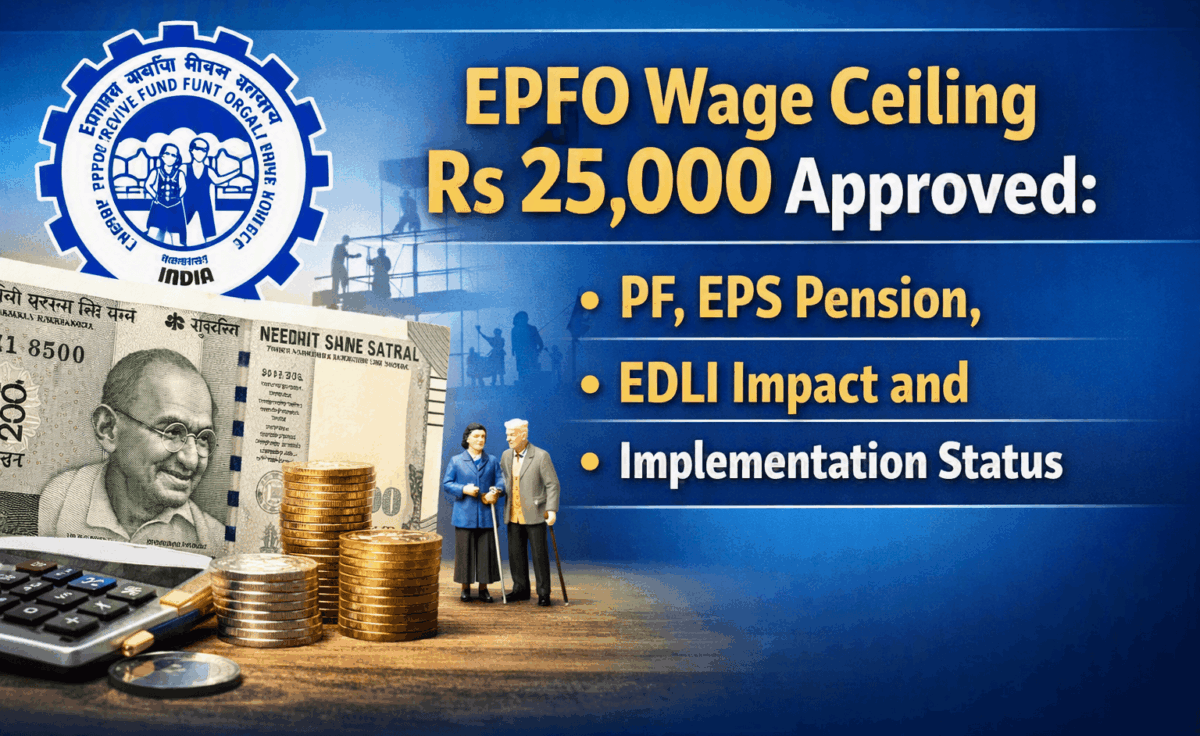
The Union Cabinet has approved a long-overdue revision to the EPFO wage ceiling, raising it from Rs 15,000 to Rs 25,000 per month. This is the first hike in 12 years, and the government estimates that over 51 lakh additional employees will come under mandatory social security coverage .
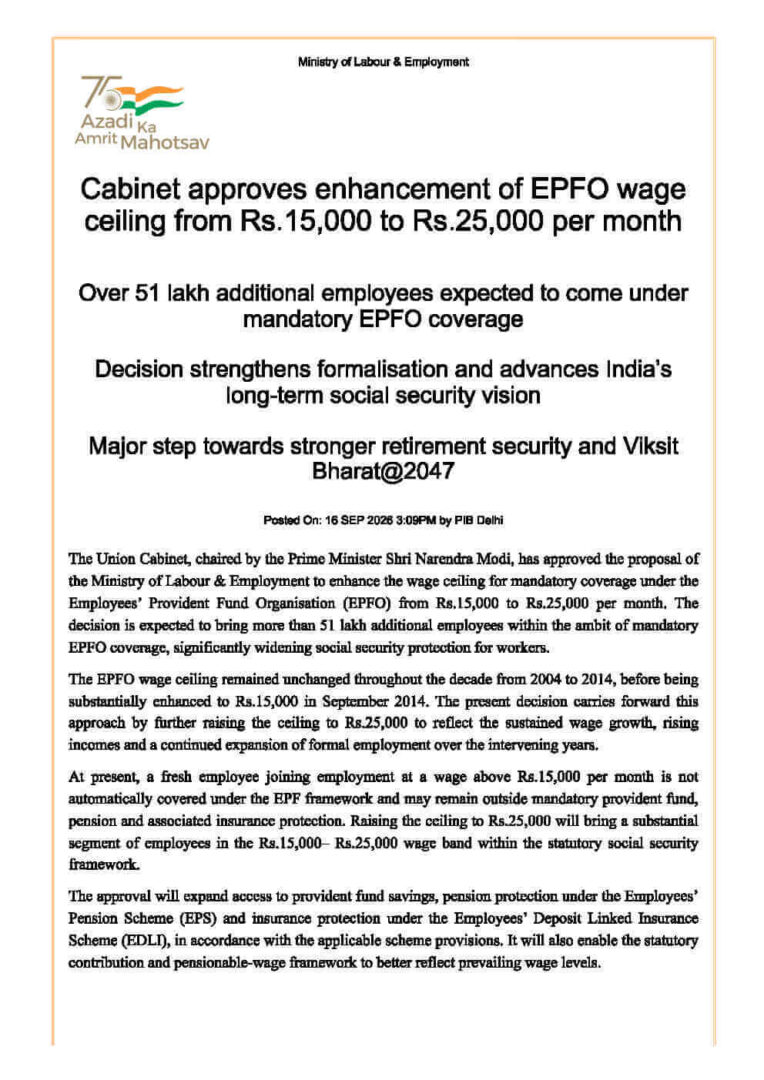
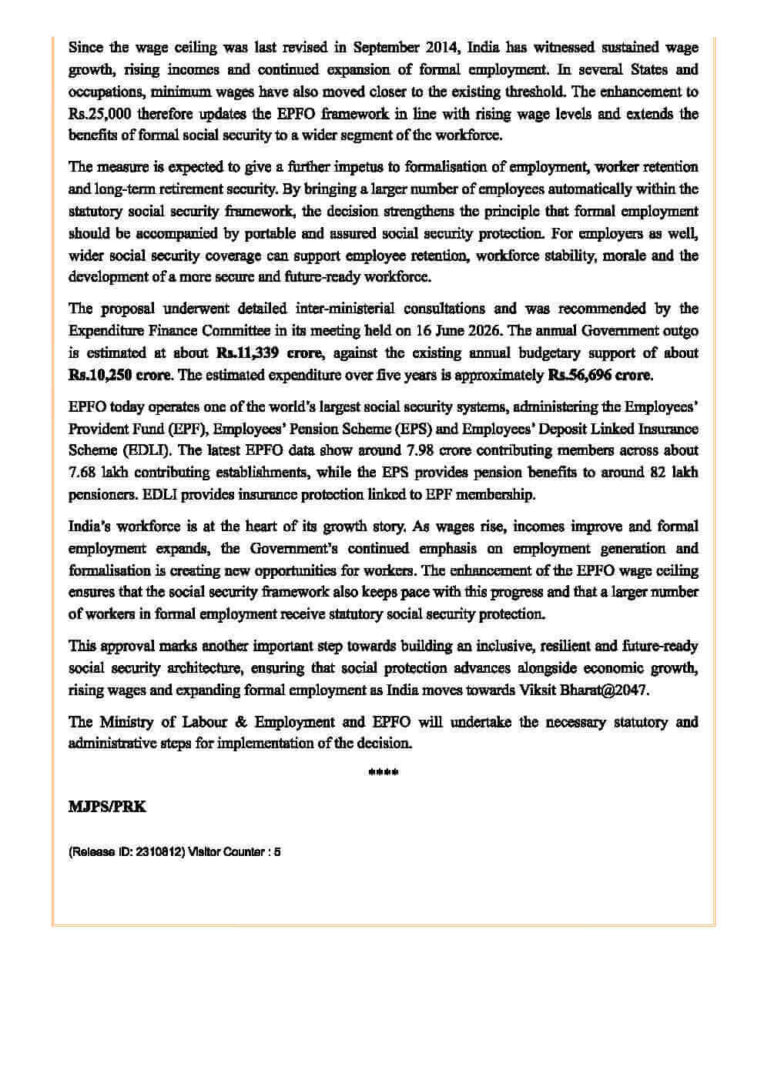
But before you rush to check your next payslip, here is the critical point: this is a Cabinet approval, not a notification. The implementation date has not yet been notified. The Ministry of Labour and Employment and EPFO will undertake the necessary statutory and administrative steps for implementation of the decision . Until that formal notification arrives, the old Rs 15,000 ceiling continues to apply for compliance purposes.
Here is a clear breakdown of what the EPFO wage ceiling hike means for employees at every income level, what employers need to watch out for and why the timing matters.
What Is the EPFO Wage Ceiling and Why Does It Matter?
The EPFO wage ceiling is the monthly salary threshold up to which an employee is mandatorily covered under the Employees’ Provident Fund Organisation. Until now, a fresh employee joining a job with wages above Rs 15,000 per month was not automatically enrolled in the EPF framework. They could remain outside mandatory provident fund savings, pension protection under the Employees’ Pension Scheme and insurance cover under the Employees’ Deposit Linked Insurance Scheme.
With the ceiling now approved at Rs 25,000, employees earning up to that amount will fall within the statutory social security system once the notification is issued. The EPFO wage ceiling remained unchanged from 2004 to 2014 and was enhanced to Rs 15,000 in September 2014. The present decision reflects sustained wage growth, rising incomes and the continued expansion of formal employment over the intervening years .
Who Benefits from the EPFO Wage Ceiling Increase?
The primary beneficiaries are workers in the Rs 15,000 to Rs 25,000 monthly wage band across sectors such as retail, logistics, hospitality, small manufacturing, IT services and education. More than 51 lakh additional employees are expected to come under mandatory EPFO coverage .
Union Minister Ashwini Vaishnaw noted during the Cabinet briefing that minimum wages for unskilled workers have already crossed Rs 15,000 in several states, which made the case for an upward revision difficult to resist .
What Changes for Employees Earning Between Rs 15,000 and Rs 25,000?
For employees who were previously outside mandatory coverage, the change brings both immediate deductions and long-term benefits, once the notification takes effect.
Your employee contribution to EPF is 12% of basic wages (plus dearness allowance). On the old ceiling of Rs 15,000, that contribution was capped at Rs 1,800 per month. Under the new ceiling of Rs 25,000, it rises to Rs 3,000 per month. That means a reduction of up to Rs 1,200 in monthly take-home pay for those newly covered.
This is not a loss in the true sense. It is a transfer from present consumption to protected retirement savings, with tax benefits under the relevant provisions and a matching employer contribution that also increases. Your retirement corpus grows faster, and your pensionable salary for EPS rises, which will eventually translate into a higher monthly pension.
The Missing Caveat: What If You Already Contribute on Actuals?
This is where the EPFO wage ceiling hike gets interesting for existing EPF members whose basic pay already exceeds Rs 15,000 and who contribute on their full basic salary.
For these employees, their take-home pay will not change. But the internal diversion of their employer’s 12% contribution will shift.
Here is how it works. Out of the employer’s 12% contribution, 8.33% of basic wages goes into the EPS pension bucket, and the balance goes into the EPF lump-sum corpus. Under the old ceiling of Rs 15,000, the maximum EPS diversion was 8.33% of Rs 15,000, which equals Rs 1,250 per month .
Under the new ceiling of Rs 25,000, that EPS diversion will be capped at 8.33% of Rs 25,000, which equals approximately Rs 2,083 per month.
What does this mean for you? Nearly Rs 833 extra per month will now be diverted away from your withdrawable, interest-earning PF corpus and locked into the EPS pension scheme. EPS does not earn annual interest and does not maintain an individual account balance. Contributions are pooled into a common pension fund from which monthly pensions are paid .
So your EPF passbook will look different once the change kicks in, with a smaller share of the employer contribution flowing into your PF balance and a larger share going toward pension. The trade-off is a higher pensionable salary and therefore a higher monthly pension at retirement.
Impact on Employer Costs and Payroll Compliance
Employers face a corresponding increase in statutory contributions. For each employee whose contributions were previously capped at the Rs 15,000 ceiling, the employer’s 12% share also rises. Government estimates put the average additional outgo for employers at roughly Rs 600 per worker per month.
For companies with a large workforce concentrated in the Rs 15,000 to Rs 25,000 salary bracket, this is a material increase in payroll costs. Human resources and finance teams will need to update payroll systems, revise CTC structures and communicate the changes to employees clearly.
That said, the government frames this as a workforce stability measure. Wider social security coverage can improve employee retention and morale, particularly in sectors with high attrition.
The EDLI Insurance Bonus Most People Miss
The wage ceiling also dictates the EDLI premium and the insurance payout available to an employee’s family in the event of death in service.
Employers contribute 0.5% of each employee’s PF wages, up to a maximum of Rs 75 per month, to enrol them under EDLI. Employees pay nothing for this cover .
The EDLI payout is calculated as 30 times the average monthly salary of the last 12 months, subject to the wage ceiling, plus a bonus. With the ceiling raised to Rs 25,000, the statutory life insurance payout available to a deceased member’s family increases accordingly .
The minimum benefit is Rs 2.5 lakh, and the maximum is capped at Rs 7 lakh including the 20% enhancement .
What This Means for Pension Under EPS
The pension calculation under EPS uses pensionable salary, which is subject to the wage ceiling. A higher ceiling means a higher pensionable salary for eligible members, which can meaningfully increase the monthly pension at retirement.
To illustrate: a member with 35 years of pensionable service would previously calculate pension at a maximum pensionable salary of Rs 15,000, yielding Rs 7,500 per month. With the new Rs 25,000 ceiling, the same service period yields Rs 12,500 per month, a gain of Rs 5,000.
The impact is more pronounced for younger employees with long residual service. Those close to superannuation will see a more modest effect because pensionable salary is computed segment-wise for each period of service.
A Word of Caution for Employers: You Cannot Restructure Around This
One important legal point that often gets overlooked during such transitions: employers cannot simply restructure salaries to avoid the new ceiling by artificially splitting a Rs 25,000 salary into Rs 5,000 basic and Rs 20,000 allowances.
The Supreme Court in the Vivekananda Vidyamandir case laid down clear principles on what constitutes basic wages for PF purposes. Payments that are universally, necessarily and ordinarily paid across the board to all employees in a category fall within basic wages. Only variable payments linked to individual incentive or productivity can be excluded .
The EPFO has issued circulars instructing field officers to enforce this interpretation. Employers should review their compensation structures carefully to ensure they are not creating PF liability exposure through aggressive salary splitting.
Financial Outlay and Implementation Timeline
The annual government outgo from this decision is estimated at approximately Rs 11,339 crore, compared with the existing budgetary support of around Rs 10,250 crore. Over five years, the estimated expenditure is about Rs 56,696 crore .
The proposal underwent inter-ministerial consultations and was recommended by the Expenditure Finance Committee in June 2026. The Ministry of Labour and Employment and EPFO will now undertake the necessary statutory and administrative steps for implementation .
This is where readers need to be careful. The Cabinet approval is a policy decision. It is not the same as a notified amendment to the EPF Scheme or the EPS Scheme. The actual change in contribution rates, ceiling applicability and payroll treatment will take effect only from the date specified in the formal notification. Until then, employers should continue to comply with the existing Rs 15,000 ceiling unless and until the government issues specific directions.
Employees and employers should watch for the formal notification, as implementation provisions may clarify details such as whether the higher ceiling applies uniformly or with transitional arrangements, and whether there will be any prospective or retrospective effect.
The Bottom Line
The EPFO wage ceiling hike to Rs 25,000 is a structural expansion of India’s social security net. It brings lakhs of formal sector workers into a framework they should arguably have been part of already, given wage growth since 2014.
For newly covered employees, the trade-off is real: lower immediate take-home pay in exchange for retirement savings, pension protection and insurance coverage. For existing members contributing on actuals, the change is subtler but significant: more of your employer’s contribution shifts to pension, growing your eventual monthly payout while reducing your PF corpus accumulation.
But none of this happens automatically on the date of the Cabinet decision. The implementation date is yet to be notified. Keep an eye on the official EPFO circulars and the Ministry of Labour and Employment notifications. That is when the real change begins.
If you fall in the affected salary bracket, check with your employer about how and when the change will be implemented in your payroll. If you are an employer, begin reviewing your cost structures and salary structures now so the transition is smooth and compliant once the notification arrives.
Disclaimer: This article is for informational purposes only and does not constitute financial, tax, legal or professional advice. The EPFO wage ceiling revision has been approved by the Union Cabinet but is subject to formal notification and implementation by the Ministry of Labour and Employment and EPFO. The implementation date has not been notified as of the date of this article. Readers should consult a qualified financial advisor or legal professional before making any decisions based on this information. The author and publisher disclaim any liability arising from reliance on the contents of this article.