 Total Visitors
  Online Users
  Today
Today  Yesterday

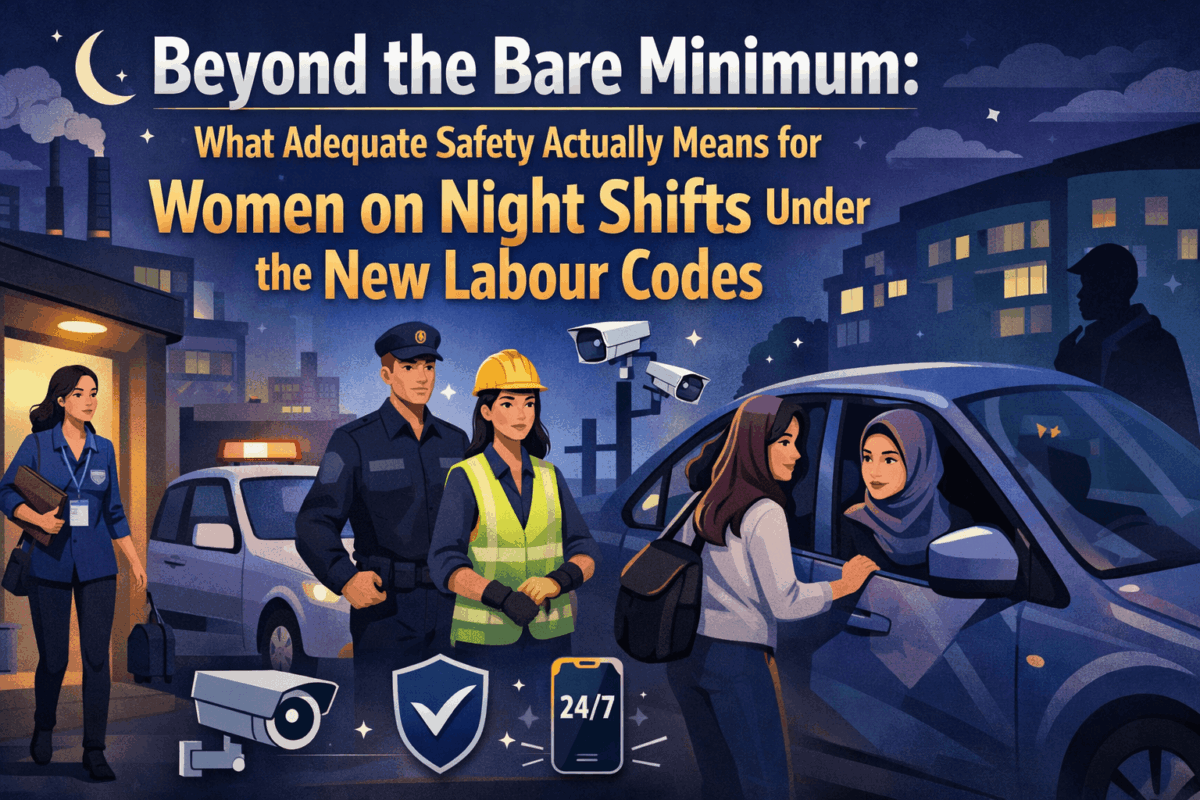
Imagine it is 10:00 PM at an office or industrial hub. You look up from your desk, pack your bag, and prepare to head out. As you look around, you notice a single, blinking CCTV camera near the entrance and an elderly security guard stationed at the main gate.
Your manager smiles and says, “See? We have full security here for your night shifts!”
But as you look out toward a dark, unlit corporate parking lot or think about navigating the commute home alone, a valid question stops you in your tracks: Is a single camera and a guard truly what the law means by “adequate safety”? Can you legally demand more; like verified point-to-point transport, female escorts, and well-lit pathways?
For decades, Indian labour laws heavily restricted women from working late hours, masking a lack of workplace security as “protection”. The rollout of India’s 4 New Labour Codes changes this narrative completely. The glass ceiling has been removed, but it has been replaced by a strict, non-negotiable legal framework for workplace safety.
Let’s dive into the OSHWC Code women night shift safety measures, dismantle the bare-minimum myth, and analyse exactly what the new laws and pending central rules say about your rights.
The Legal Shift: From Workplace Restriction to Mandated Safety
Under legacy frameworks like the Factories Act, 1948, women were generally prohibited from working night shifts unless specific, highly restricted state-level exemptions were granted.
The Occupational Safety, Health and Working Conditions (OSHWC) Code, 2020 turns this old paradigm on its head. Section 43 of the Code explicitly grants women the right to be employed in all establishments for all types of work, including night shifts between 7:00 PM and 6:00 AM.
However, the law makes it clear that this freedom is not a free pass for employers to cut corners. The law shifts the burden entirely onto the company, moving from a model of “protection through restriction” to “empowerment through mandated safety”.
The 2026 Reality Check: A CCTV and a Guard Is Not Enough
To answer the core question directly: No, a simple camera and a general security guard do not fulfill an employer’s statutory obligations.
On November 21, 2025, all four Labour Codes including the OSHWC Code were formally notified. Then, on December 30, 2025, the Ministry of Labour and Employment published the Draft Occupational Safety, Health and Working Conditions (Central) Rules, 2025, inviting public objections and suggestions within 45 days.
Additionally, several states have moved ahead with their own rules. Here is the exact breakdown of the employer responsibilities female night shift India mandates that you can legally demand right now:
1. The Non-Negotiable Gatekeeper: Prior Written Consent
An employer cannot simply schedule you for a night shift on a whim. The 2026 guidelines state that women night shift written consent must be obtained voluntarily and documented digitally or on paper before any late-hour allocation.
Furthermore, you have the right to withdraw your consent at any time without facing any corporate discrimination, career penalties, or termination threats. Employers cannot make night shift work a mandatory condition of employment.
2. Mandatory, Point-to-Point Transport
Providing security inside the office is pointless if the commute home is dangerous. Mandatory transport for female employees night shift is a strict baseline requirement under both the draft central rules and state-level amendments.
As per the draft central rules, employers must provide safe pick-up and drop services. Per existing compliance standards (including state rules from Haryana, Delhi, and Maharashtra), these vehicles must feature active GPS tracking accessible by a centralized corporate control room, functioning SOS/panic buttons, and interior lighting. Drivers must undergo rigorous background and license verification.
Crucially, if the travel route involves only one or two female passengers, a security guard or a female escort must accompany the vehicle during those drop-off patterns.
3. Illumination Beyond the Desk
The 2026 framework explicitly notes that safety does not stop at the office door. Employers are required to ensure that all entry points, exit gates, corridors, common areas, and parking facilities are brightly and reliably lit throughout the night hours.
CCTV surveillance cannot just be a single camera at the reception desk; it must actively cover perimeters, entry/exit pathways, and parking structures, with video footage securely stored for a minimum of 45 days for statutory audit access (as per specific state rules like Maharashtra’s draft notification).
4. Female Security Personnel and Welfare Facilities
A general male guard at the front gate is insufficient. The draft central rules state that establishments deploying women at night should ensure the availability of female security guards and supervisors on the premises.
Employers must also provide designated, secure, and clean restrooms and separate waiting or resting areas equipped with basic privacy arrangements (like cots or privacy curtains) for authorized break periods.
The Structural Backbone: POSH Act Night Shift Compliance
A critical component reinforcing the OSHWC Code is its mandatory integration with the Sexual Harassment of Women at Workplace (POSH) Act, 2013.
Under the legal definition of a workplace, the boundaries extend far beyond your cubicle. Any transportation vehicle provided by your company is legally considered an “extended workplace”. Therefore, the company’s Internal Committee (IC) must be fully functional, clearly publicized, and easily accessible for night shift employees to log any grievances or safety deviations immediately.
Emergency contact numbers must be prominently displayed inside both the office floor and all tracking transport vehicles.
How to Handle This with Your HR Department – FREE
If your employer is falling short of these standards, remember that the law gives you the leverage to ask for adequate safeguards women workplace protocols. You can approach your HR or compliance team with a collaborative, factual perspective:
- Request the Night Shift Policy Document: Under the 2026 compliance landscape, every covered establishment must maintain a centralized, documented night shift safety policy. Ask to review it.
- Highlight the Draft Central and State Rules: Remind them gently that the Draft Occupational Safety, Health and Working Conditions (Central) Rules, 2025 (issued December 30, 2025) require safe point-to-point transportation, verified routing, and external parking illumination. If you are in a state that has advanced its own rules (like Maharashtra, Haryana, or Delhi), you can reference those specific requirements.
- Frame it as Compliance Risk Management: Non-compliance under the new unified code carries steep escalating fines. Companies that fail to protect their workforce risk losing their licenses or facing direct inspections from an Inspector-cum-Facilitator.
The Verdict
The New Labour Codes are designed to help you thrive in your career at any hour of the day but never at the expense of your basic safety.
A single CCTV camera and a guard at the front gate form just a fraction of your employer’s legal obligations. You are entirely within your legal rights to demand secure, GPS-tracked transportation, escorts for lonely routes, and properly illuminated parking lots.
The law has built the safety net; do not hesitate to make sure your workplace deploys it perfectly.
Quick Action Checklist for Night Shift Workers – FREE
| Step | Action |
| 1 | Provide written consent before any night shift assignment |
| 2 | Verify your employer’s GPS-tracked transport is available for every night shift commute |
| 3 | Check that well-lit pathways, parking lots, and restrooms are provided |
| 4 | Confirm female security guards are deployed during your night shift hours |
| 5 | Ensure the Internal Committee (IC) under the POSH Act is fully functional and accessible |
| 6 | Keep emergency contact numbers (local police, hospital, IC) handy at all times |
Disclaimer – This article is for general informational purposes only and does not constitute legal advice. You should consult the specific notified rules of your state or seek independent legal counsel before relying on any information herein. The author and publisher disclaim all liability for any actions taken or not taken based on this content.