 Total Visitors
  Online Users
  Today
Today  Yesterday

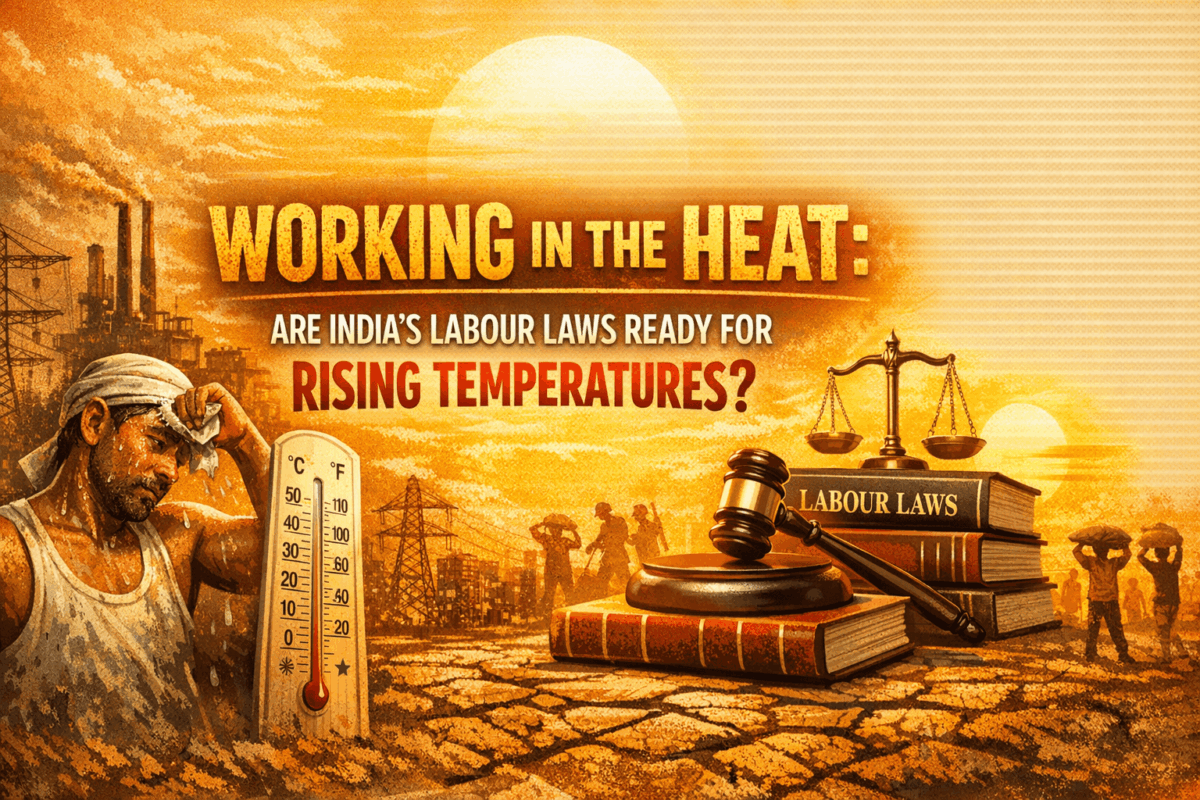
As India faces increasingly intense summer cycles, the issue of heat stress is emerging as a critical occupational safety challenge. For millions of workers in construction, agriculture, and gig delivery, rising temperatures are not just a seasonal discomfort but a daily risk to health and productivity. The country’s labour laws are now being tested against the realities of record-breaking heat in 2026.
In a Nutshell
Rising temperatures are transforming heat into a significant occupational hazard. Experts emphasize the need to integrate comprehensive Heat Action Plans (HAPs) into workplace safety compliance, ensuring that legal protections translate into practical safeguards for workers.
The Breakdown
- The Silent Hazard: Heat stress occurs when the body cannot regulate its temperature under extreme conditions. For workers engaged in heavy labour outdoors, this can lead to exhaustion or heatstroke, posing serious health risks.
- The Legal Gap: India’s Occupational Safety, Health and Working Conditions (OSH) Code, 2020 references ventilation and temperature but does not specify enforceable thresholds; such as maximum permissible outdoor work temperatures. While states like Kerala have issued advisories urging outdoor workers to avoid peak sun hours (11 AM to 3 PM), there is no uniform national mandate specifying enforceable heat thresholds or mandatory rest breaks.
- Economic Impact: A 2019 International Labour Organization (ILO) report projected that by 2030, India could lose the equivalent of 34 million full-time jobs due to heat-related productivity declines. While a projection, the figure remains the most authoritative estimate of the potential economic scale of the issue, highlighting workplace adaptation as a strategic priority.
Compliance Lens: Strategic Challenges
Legal and professional observers highlight several areas for improvement:
- Lack of Uniform Standards: The absence of a Wet Bulb Globe Temperature (WBGT) benchmark in the OSH Code leaves employers without clear, legally enforceable thresholds for halting work during extreme heat. While the Bureau of Indian Standards (BIS) has published IS 16559:2019, which provides a methodology for assessing heat stress using WBGT, this standard is not explicitly referenced or made mandatory under the OSH Code. In India, BIS standards become legally enforceable only when specifically cited in legislation or through a Quality Control Order (QCO); no such order exists for workplace heat stress. Consequently, an employer is not legally required to use WBGT or to halt outdoor work at any specific heat index; a gap that experts argue needs urgent legislative attention.
- Informal Sector Hurdle: While large construction sites may provide hydration stations or shaded rest areas, millions of informal workers lack access to basic cooling infrastructure. Bridging this gap remains a major challenge for local authorities.
- Infrastructure Adaptation: Moving from reactive advisories to proactive Heat Action Plans is essential. Measures such as cool roofs, shaded rest areas, and workplace-level emergency protocols are increasingly seen as necessary compliance tools.
Legal Context
- OSH Code, 2020 – Section 23: Provides general provisions on ventilation, temperature, and humidity but lacks specific heat thresholds for outdoor work.
- Factories Act, 1948 (legacy provisions): Mentions temperature control in indoor workplaces but does not address outdoor labour.
- Constitutional Mandate (Articles 39(e), 42, 43): Direct the State to secure just and humane conditions of work and a decent standard of life, which legal experts argue should extend to climate-related risks.
Outlook
India’s evolving labour framework is now intersecting with climate realities. Observers note that integrating heat stress standards, expanding protections to informal workers, and adopting workplace-level Heat Action Plans will be central to safeguarding both worker health and industrial productivity in the years ahead.
Disclaimer: This post is for informational purposes only and does not constitute legal advice. Laws and regulations are subject to change. Readers should consult a qualified legal professional for advice on their specific circumstances.