 Total Visitors
  Online Users
  Today
Today  Yesterday

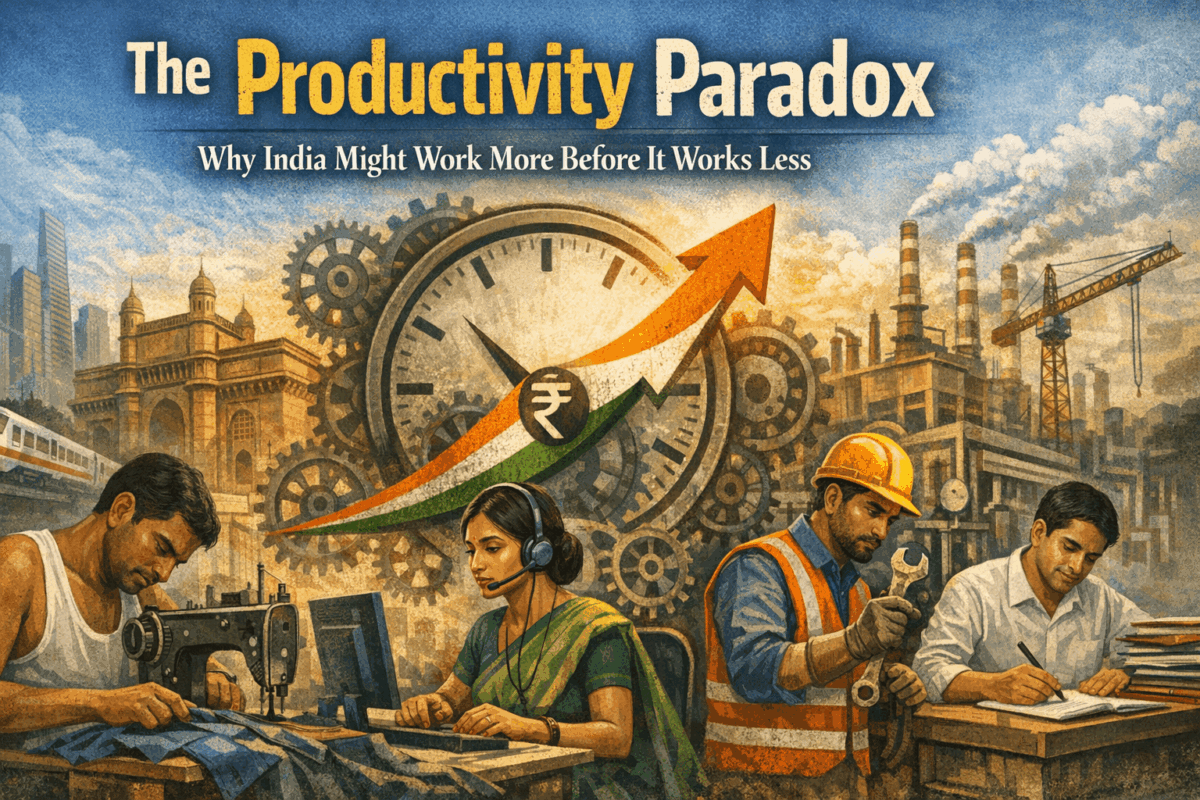
As conversations around work-life balance gain traction, India faces a unique paradox. While global trends suggest that rising productivity eventually leads to shorter working hours, current economic and labour data indicate that India may see longer hours before reductions become feasible.
The Global Trend
Historical patterns show that as nations grow wealthier and more productive, average working hours decline. In the 1970s, Europeans worked longer than Americans, but stronger labour laws and social safety nets later enabled shorter weeks and greater leisure time.
The “Necessity” Gap
In India, nearly 85% of the workforce is in the informal sector, without contracts or fixed hours. For many, extended workdays are a necessity rather than a choice. Unlike Europe or the United States, India’s institutional frameworks such as universal healthcare and strong collective bargaining are still developing, making it harder to separate livelihood from long hours.
Inequality and the Hustle
Research suggests that in highly unequal economies, even higher-income earners work longer hours to maintain competitiveness. India’s aspirational “hustle culture” and drive to close wealth gaps mean that rising incomes may initially encourage more work, not less.
The Path to Shorter Weeks
Experts note that achieving shorter work weeks will require two major shifts:
- Formalization of Employment: Expanding contracts and legal protections to cover the majority of workers.
- Productivity Gains: Leveraging technology and efficiency improvements to enable more output in less hours.
Until these conditions are met, the culture of long hours is likely to persist.
Compliance Lens
Legal and professional observers highlight several challenges:
- Formalization Hurdles: With most workers lacking formal documentation, enforcing maximum work-hour limits across the economy remains difficult.
- Weak Bargaining Power: Limited union strength reduces workers’ ability to demand shorter shifts or “right to disconnect” policies.
- Social Security Linkage: Building a robust, employer-independent social security system is essential to give workers flexibility in choosing fewer hours.
Legal Context
- Factories Act, 1948 / Occupational Safety Code, 2020: Establishes maximum working hours and overtime rules, but enforcement is limited in informal sectors.
- Industrial Relations Code, 2020: Provides a framework for collective bargaining, though union coverage remains uneven.
- Directive Principles (Article 43): Calls for securing living wages and humane working conditions.
Outlook
India’s journey toward shorter work weeks is closely tied to its progress in formalizing employment and boosting productivity. Observers note that while aspirations for European-style work-life balance are rising, structural reforms and stronger social protections will be critical before reduced working hours become a widespread reality.
Disclaimer: This content is provided for informational purposes only and does not constitute legal, financial, or professional advice. Work-life balance and labour regulations are subject to individual company policies and evolving state-specific laws. Readers should consult with official government sources or HR experts regarding specific employment terms.