 Total Visitors
  Online Users
  Today
Today  Yesterday

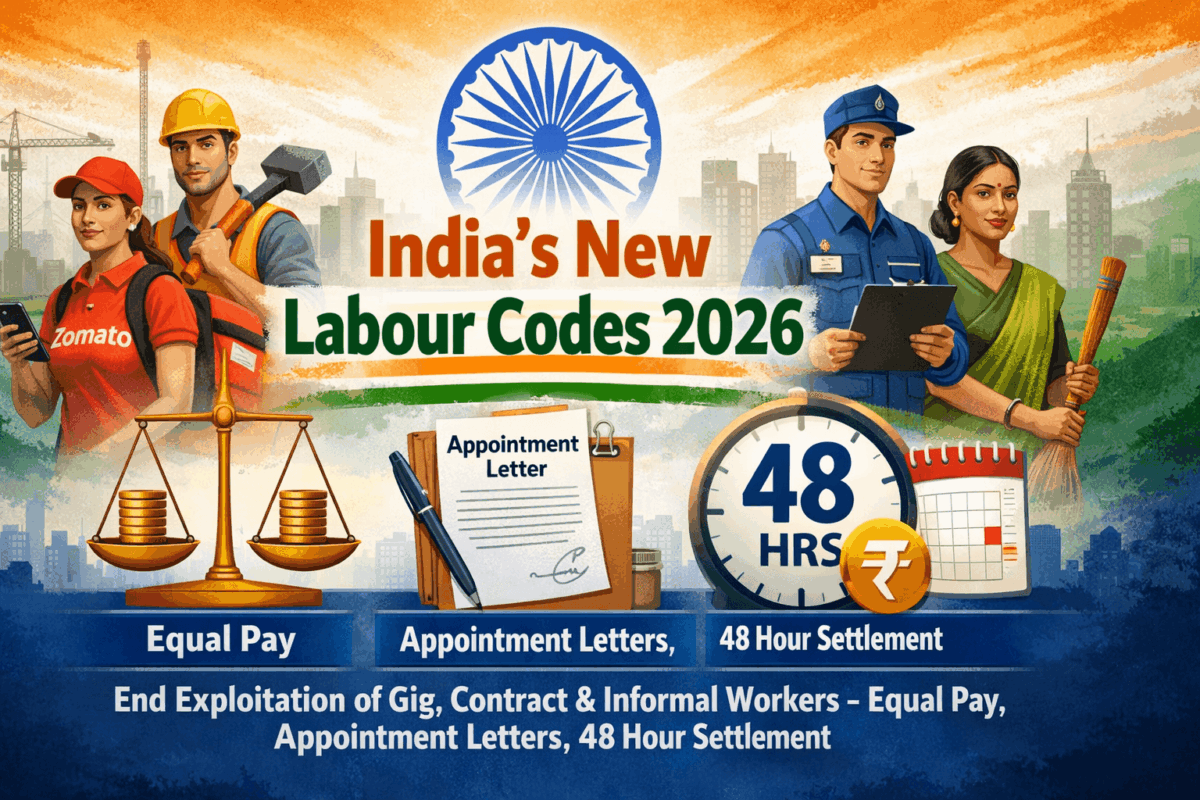
India’s four new Labour Codes mark a structural reform intended to eliminate workplace exploitation by formalizing the rights of gig, contract, and informal workers. The framework ensures that millions of previously “invisible” employees gain legal access to timely wages, appointment letters, and essential health benefits.
In a Nutshell
The codes mandate documentation, equal pay, health protections, and prompt financial settlements, creating a stronger legal shield for workers across sectors.
The Breakdown
- A Shield Against Informal Exploitation: Historically, informal workers often lacked documentation, making it difficult to claim wages or rights. The new codes mandate appointment letters from day one, ensuring every worker has a documented employer-employee relationship.
- The “Equal Pay” Mandate: The principle of Equal Pay for Equal Work is strictly enforced. Employers cannot differentiate wages based on gender or employment status (contract vs. permanent) when job responsibilities are identical.
- Health and Safety as a Right: The Occupational Safety, Health and Working Conditions (OSH) Code, 2020 introduces mandatory free health check-ups for workers aged 40 and above. Safety standards are universal, and even establishments with a single worker engaged in hazardous activity must provide social security coverage.
- Prompt Financial Settlements: Employers must complete Full and Final (F&F) settlements—including salary, leave encashment, and bonuses within 48 hours of an employee’s exit. This provision prevents workers from being left in financial uncertainty.
Compliance Lens
Legal and professional experts highlight several challenges:
- Standardizing State Rules: Labour being a concurrent subject requires states to notify rules aligned with the central framework. Inconsistencies could weaken protections for workers moving across state borders.
- Digital Monitoring of Settlements: Meeting the 48-hour settlement requirement is operationally demanding. Automated payroll systems are essential to process complex exit dues in real time.
- Gig Worker Verification: While inclusion of gig and platform workers is a major step, ensuring universal e-Shram registration remains an ongoing challenge to make benefits fully accessible.
Legal Context
- Code on Wages, 2019: Establishes wage definitions and mandates equal pay.
- Code on Social Security, 2020: Extends coverage to gig, platform, and informal workers.
- Industrial Relations Code, 2020: Provides frameworks for dispute resolution and worker rights.
- OSH Code, 2020: Standardizes workplace safety and introduces mandatory health check-ups.
Outlook
The Labour Codes represent India’s most comprehensive attempt to formalize worker protections. Observers note that while the policy intent is strong i.e. ending exploitation through documentation, equal pay, and safety but the success of the transition will depend on harmonizing state rules, upgrading digital payroll systems, and ensuring full registration of gig and informal workers.
Disclaimer: This content is provided for informational purposes only and does not constitute legal, financial, or professional advice. Labour laws and the implementation timelines for the four codes are subject to government notifications and judicial review. Readers should consult official government portals or qualified legal experts regarding statutory compliance.