 Total Visitors
  Online Users
  Today
Today  Yesterday

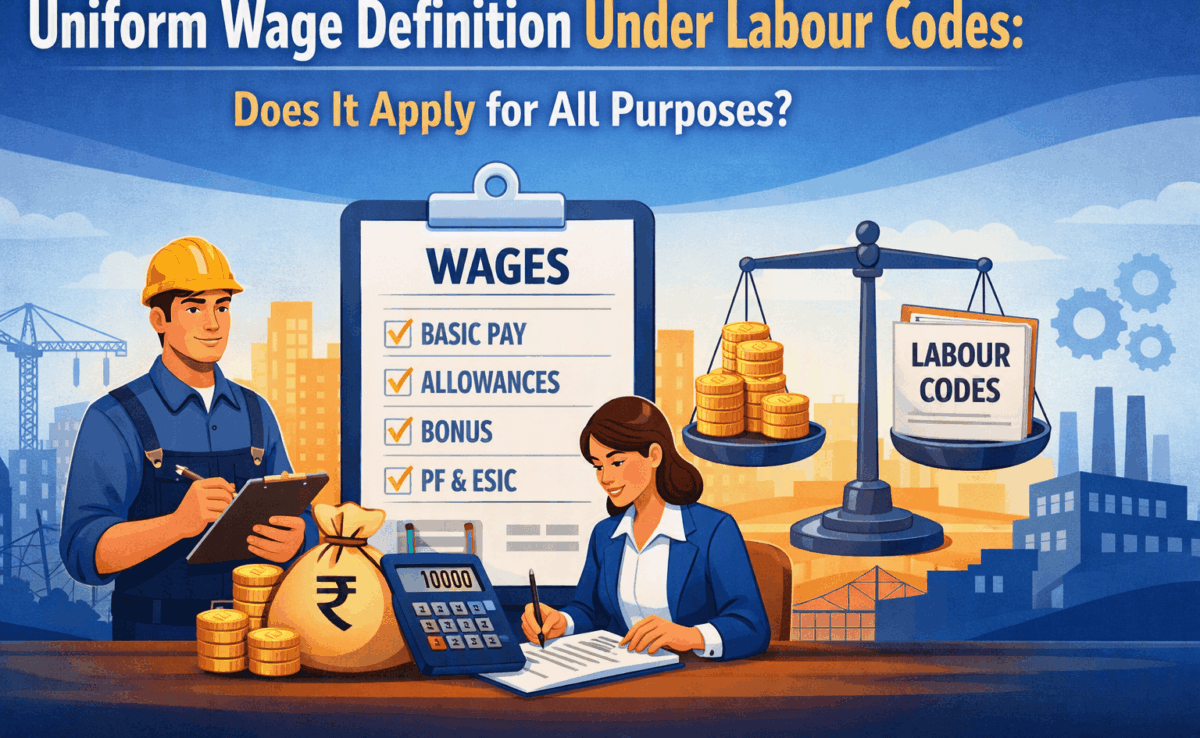
A question I hear frequently from HR teams and finance leaders: “The Code provides a uniform definition of wages for statutory benefits like PF, gratuity, and bonus. But does the same definition apply for minimum wage compliance, overtime calculations, and payment of wages? Or are there subtle differences across sections?”
The short answer is nuanced. While the Code on Wages creates a single, unified definition under Section 2(y) that serves as the foundation for most wage-related calculations, there are contextual differences in how this definition applies across different purposes. Let me break down exactly where the definition is uniform, where it differs, and what this means for your compliance strategy.
The Unified Definition: Section 2(y) of the Code on Wages
Section 2(y) of the Code on Wages, 2019 introduces a uniform definition of “wages” that applies across all four Labour Codes. This is one of the most significant changes in the new framework .
What is included in wages:
The definition includes all remuneration paid to an employee, including basic pay, dearness allowance, and retaining allowance .
What is excluded from wages:
- Bonus (payable under any law)
- House rent allowance
- Conveyance allowance
- Overtime allowance
- Employer’s contribution to PF/pension
- Gratuity payable on termination
- Retrenchment compensation
- Commission
- Value of house accommodation and utilities
The critical proviso (the 50% rule):
If the excluded components (except gratuity and retrenchment compensation) exceed 50% of the total remuneration, the excess is deemed to be “wages”.
The Key Distinction: Wages Definition Across Purposes
While Section 2(y) provides the foundational definition, its application varies across different statutory purposes. Here is where the definition is uniform and where differences emerge:
1. For PF, ESI, Gratuity, and Bonus Calculations
The definition is uniform and directly applicable.
Section 2(y) of the Code on Wages is cross-referenced by the Code on Social Security, 2020. PF, ESI, gratuity, maternity benefits, and compensation are all calculated on “wages” as defined under the new framework. The 50% threshold rule cascades across every social security obligation.
For example, an employer whose CTC structure has basic pay below 50% of total remuneration will find that the “deemed wage” (the excess exclusion amount) becomes the base for calculating PF contributions, gratuity, ESI, and bonus.
2. For Minimum Wage Compliance
The definition differs. Minimum wages are a floor, not the full wage definition.
Under the Code on Wages, minimum wages are fixed by the appropriate Government based on criteria separately notified through special or general orders. The manner of calculation is prescribed under the Code on Wages (Central) Rules, 2026: when the rate of wages for a day is fixed, it is divided by 8 for hourly rates and multiplied by 26 for monthly rates.
Minimum wages are notified by the appropriate government and must meet or exceed the national floor wage; they operate independently of the Section 2(y) wage definition.
The important distinction: minimum wage compliance uses the notified minimum rate, not the full Section 2(y) definition. The Code also introduces a national floor wage under Section 9, below which no state may set its minimum wage. Employers must pay at least the minimum wage, regardless of how compensation is structured.
3. For Overtime Calculations
The definition has subtle differences.
Overtime wages under the Code are calculated at “twice the normal rate of wages” under Section 14. The Code on Wages (Central) Rules, 2026 operationalizes this through the 8-hour workday and 48-hour work week framework.
Overtime is calculated at twice the normal rate of wages, which excludes overtime allowance itself but includes basic, DA, and other wage components.
Here’s the nuance: Overtime allowance itself is one of the exclusions from the definition of wages under Section 2(y) . However, the rate at which overtime is paid is calculated based on the “normal rate of wages” – which is generally the wages defined under Section 2(y) for that purpose.
4. For Payment of Wages
The definition applies but with specific operational rules.
The Code on Wages mandates that wages be paid on or before the 7th day of the succeeding month, with full and final settlement in case of termination or resignation to be cleared within 2 working days.
For deductions from wages, Rule 13 of the Code on Wages (Central) Rules, 2026 states that total deductions cannot exceed 50% of the wages of an employee, and any excess must be carried forward.
The nuance: The “wages” for payment purposes is the gross amount payable, not the computed wage base for statutory contributions.
5. For Remuneration in Kind
This is a specific carve-out.
If an employer provides remuneration in kind (such as meals, accommodation, or amenities) to an employee, such remuneration is deemed to form part of wages up to 15% of the total wages. Remuneration in kind is capped at 15% of wages; excess cannot substitute cash wage obligations. This is a specific provision under the Code that operates within the broader wage definition.
Comparative Table: Application of Wage Definition Across Purposes
| Purpose | Definition Applied | Key Difference |
| PF, ESI, Gratuity, Bonus | Section 2(y) with 50% rule | Cross-referenced by Social Security Code; deemed wage concept applies directly |
| Minimum Wage Compliance | Notified minimum wage rates | Uses floor rates set by Government, not full Section 2(y) definition |
| Overtime Calculations | Normal rate of wages | Overtime allowance itself is excluded; calculation uses “normal rate” |
| Payment of Wages | Gross wages payable | Deductions capped at 50% of wages; full and final within 2 days |
| Remuneration in Kind | 15% of wages | Specific carve-out; excess cannot substitute cash wage obligations |
The “Inclusive” Nature of the Definition
One critical nuance is that the definition of wages under Section 2(y) is inclusive, not exhaustive. This means:
- What is not excluded is included. Any allowance or payment which does not fall within the list of exclusions will form part of wages.
- Nomenclature does not matter. Merely naming something an “allowance” does not take it outside the definition of wages. The substance and nature of the payment matter.
For example, uniform allowance, mobile allowance, internet allowance, and attendance or shift allowance are not in the exclusion list. If they are fixed monthly payments and not genuine reimbursements of actual expenses, they will be treated as wages.
What This Means for Your Compliance Strategy [FREE]
For HR and Management
| Action Item | Why It Matters |
| Review all salary components against the exclusion list | What is not excluded is included as wages |
| Ensure exclusions don’t exceed 50% of total remuneration | Excess is deemed wages for PF, ESI, gratuity, and bonus |
| Calculate minimum wages based on notified rates | Not the same as the Section 2(y) wage definition |
| Track overtime payments separately | Overtime allowance is excluded but the rate calculation uses normal wages |
| Check remuneration in kind | Value of amenities up to 15% of wages is deemed part of wages |
Practical Example
Consider an employee earning ₹1,00,000 per month with the following structure:
- Basic Pay: ₹30,000
- DA: ₹5,000
- HRA: ₹25,000
- Conveyance: ₹10,000
- Special Allowance: ₹20,000
- Other Allowances: ₹10,000
Compliance check:
- Total exclusions = ₹25,000 + ₹10,000 + ₹20,000 + ₹10,000 = ₹65,000 (65% of CTC)
- Exclusions exceed the 50% cap by ₹15,000
- ₹15,000 is deemed wages for PF, ESI, gratuity, and bonus calculations
For each purpose:
- PF/ESI/Gratuity/Bonus: Wage base = ₹35,000 + ₹15,000 = ₹50,000
- Minimum Wage: Check if ₹35,000 (or the deemed wage base) meets notified minimum
- Overtime: Calculated at twice the “normal rate” of wages (₹50,000 for the wage base)
- Payment of Wages: ₹1,00,000 is the gross payable (subject to deductions capped at 50%)
The Bottom Line
The Code on Wages provides a unified definition of wages under Section 2(y), but its application is not identical across all purposes.
For PF, ESI, gratuity, and bonus, the Section 2(y) definition applies directly with the 50% rule. This is where the “deemed wage” concept matters most.
For minimum wage compliance, the definition differs. Employers must pay the notified minimum rates, which are separate from the Section 2(y) computation.
For overtime calculations, the definition applies to determine the “normal rate of wages,” but overtime allowance itself is excluded from the wage definition.
For payment of wages, the definition is operationalized through specific rules on timing, deductions, and full and final settlement.
Employers must apply the correct contextual definition for each compliance obligation, even though Section 2(y) provides the uniform foundation.
The key takeaway: while Section 2(y) provides a uniform foundational definition, its application varies based on the statutory purpose. Employers must apply the correct definition for each compliance obligation rather than assuming a single, monolithic application.
Disclaimer: This content is for educational and informational purposes only and is based on available statutory provisions and judicial pronouncements as of the publication date. The Labour Codes and their interpretation are subject to ongoing judicial developments and state-specific notifications. This does not constitute formal legal counsel. Organizations should consult qualified legal professionals for advice specific to their circumstances, including jurisdiction-specific applicability and compliance obligations.