 Total Visitors
  Online Users
  Today
Today  Yesterday

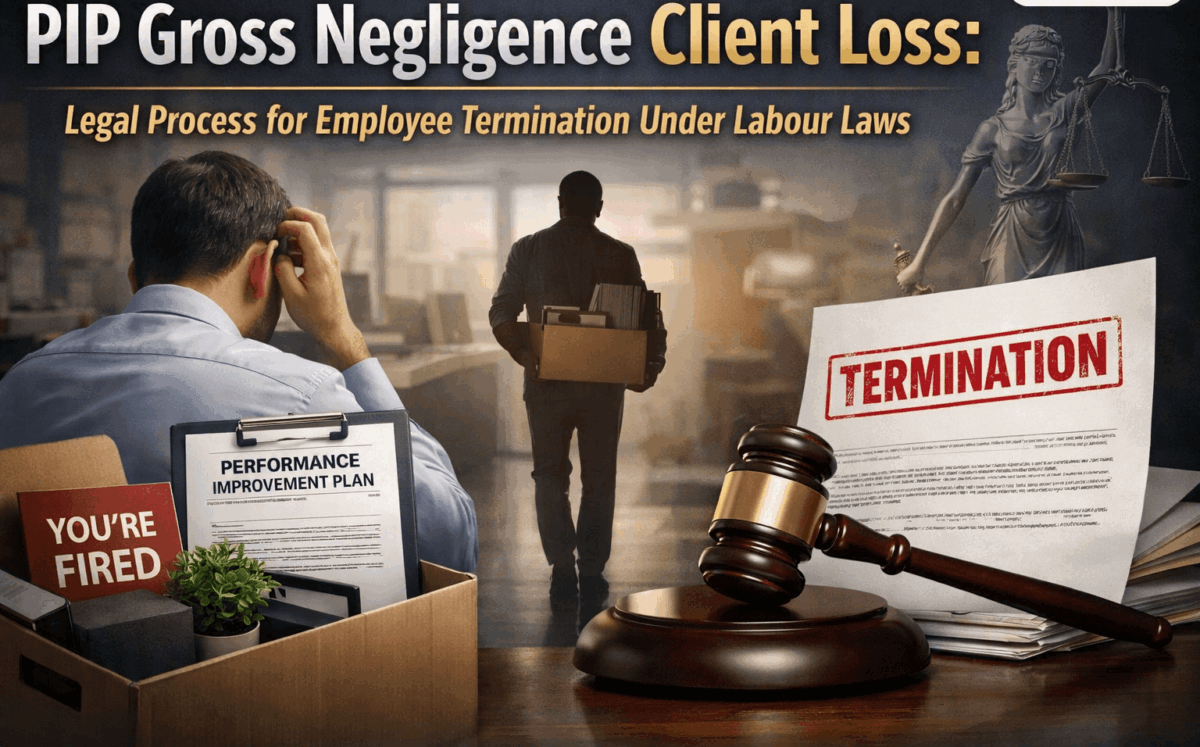
Performance Improvement Plans have become a standard corporate tool, but a fundamental question often gets overlooked in the rush to manage underperformers. The law does not recognise PIPs. The concept appears nowhere in Indian labour legislation or model standing orders that guide companies on policy making. Courts have acknowledged PIPs, but strictly regulate their application to prevent arbitrary or irrational terminations.
The scenario you have described involves an employee placed on PIP after a client-facing error, a company failing to document disciplinary proceedings, and then a verbal instruction to resign following a second blunder. This is not merely a performance management issue. It is a legal compliance challenge that requires careful handling.
Understanding Gross Negligence Under Indian Labour Jurisprudence
The distinction between simple negligence and gross negligence is critical. Courts have traditionally held that acts of negligence, judgment errors, or innocent mistakes are not legally considered misconduct. Misconduct typically involves actions stemming from improper motives or wilful disregard of duties.
Gross negligence, however, occupies a different space in legal interpretation. When an act is likely to result in serious damage, it assumes the character of gross negligence. The degree of grossness increases directly with the extent of damage caused or anticipated. If an employee is handling a client matter worth substantial value and the negligence results in loss to the client, the act may well fall within the ambit of gross negligence.
The test is not whether the mistake happened. It is whether the employee demonstrated such a careless regard for the employer’s interests that the conduct amounts to neglect justifying serious action. Forgetting to do an important thing that, if left undone, causes considerable damage, may constitute serious neglect.
A single act of client loss could amount to gross negligence if the circumstances warrant that classification. The key factors include the value of the client engagement, the foreseeability of the loss, and the employee’s degree of carelessness. There is no fixed rule on how many times a person must forget before the conduct amounts to neglect deserving dismissal. The question depends upon the particular circumstances of each case.
The PIP Trap: When Performance Management Becomes Legal Exposure
Companies use PIPs to manage performance deficiencies, not misconduct. The distinction matters significantly. Courts generally define misconduct as actions stemming from ill motives. When an employee makes a genuine error, even one that costs the company a client, that error does not automatically transform into misconduct warranting termination.
If the PIP addresses genuine performance issues, the employer must provide the employee a reasonable opportunity to improve, typically 30 to 90 days, with realistic goals and adequate assistance. If the employee improves, termination is not warranted. If the employee fails to meet the standards despite genuine effort, the employer may terminate, but such termination must not be for wilful neglect or insubordination.
The problem arises when companies blur the line between performance improvement and disciplinary action. Placing an employee on PIP for what is actually misconduct without following proper disciplinary procedures exposes the company to legal challenges. If the PIP termination occurs due to alleged neglect rather than proven misconduct, the termination could be considered illegal.
The Legal Mandate: Domestic Inquiry Before Disciplinary Action
There is no statutory list of what constitutes serious or gross misconduct warranting summary dismissal. The determination depends on factors such as whether the alleged act affects discipline in the organisation, whether the act is backed by an improper motive, and whether condoning the act would send the wrong message to others.
Termination on account of misconduct must be preceded by a domestic inquiry conducted in accordance with the principles of natural justice. The employee must be given a fair opportunity to present their case and defend themselves against the charges. To initiate the domestic inquiry, the employer must share a chargesheet or serve a show cause notice so the employee is aware of the charges and can prepare their defence.
The process requires allowing the parties to present evidence and witnesses and to cross examine the witnesses presented by the other party. Following the inquiry, the findings must be recorded and communicated to the employee.
Courts have consistently held that failure to conduct a proper inquiry renders the termination illegal. The Gujarat High Court in Minakshiben Laxmanbhai Paraliya v. State of Gujarat (2022) ruled that termination orders founded on allegations of misconduct without holding any inquiry, even for temporary employees, amount to stigmatic termination and must be set aside.
There are limited exceptions where a disciplinary inquiry may be dispensed with. These include cases where the misconduct is so apparent that an inquiry is not required, or where the act constituting misconduct has been unconditionally admitted by the employee.
The Coerced Resignation Problem
Employers cannot ordinarily force an employee to resign through verbal instructions or pressure over telephone calls. Any resignation, to be legally valid, must be a voluntary act. If an employee is coerced into resigning, the resignation can be avoided.
When an employer pressures an employee to resign while making it appear as if the resignation was voluntary, the employer is engaging in constructive dismissal. Under Indian labour law, this behaviour is not allowed.
If the employee submits a resignation under coercion, the law allows them to retract it before it becomes effective. Until the resignation becomes effective on the terms of the letter read with the governing regulations, it is open to the employee to withdraw their resignation. This principle has been affirmed by the Supreme Court in cases involving public sector employees.
Submitting a resignation via phone call or oral communication is problematic from a legal standpoint. To ensure clarity and evidence, the employee should email both the line manager and HR, stating that they received a phone call concerning resignation, that they did not resign, and that they wish to continue working.
What Should the Company Have Done Differently
The company in this scenario made three critical errors.
First, placing an employee on PIP without treating the client error as a disciplinary matter may have been appropriate if the error was genuinely a performance issue. However, if the error amounted to gross negligence, the company should have initiated formal disciplinary proceedings rather than using a PIP.
Second, the company failed to document the gross negligence disciplinary proceedings. Documentation is the foundation of any defensible disciplinary action. Without a proper chargesheet, inquiry, recorded findings, and opportunity for the employee to respond, the company has no legal basis to treat the incident as misconduct. The Supreme Court in Delhi Cloth and General Mills Co. v. Ludh Budh Singh (1972) established that if a domestic inquiry is defective or none was held, the employer must prove misconduct before the tribunal, losing the benefit of inquiry findings as prima facie proof.
Third, the verbal instruction to resign following the second blunder was procedurally flawed. A forced resignation, even if the employee complies, exposes the company to claims of constructive dismissal. The employee could later challenge the resignation and seek reinstatement or compensation.
The Correct Legal Process
When an employer believes an employee has committed gross negligence, the correct approach is to initiate formal disciplinary proceedings. This requires drafting a clear chargesheet specifying the allegations and the rule or policy violated. The chargesheet must be communicated to the employee with sufficient time to respond.
The employer must conduct a domestic inquiry with an unbiased inquiry officer. The employee must be given the opportunity to present their case, call witnesses, and cross examine the employer’s witnesses. The inquiry officer must prepare a detailed report documenting the evidence and findings.
Following the inquiry, the disciplinary authority must assess whether the proven misconduct warrants the proposed punishment. The Supreme Court has emphasised that dismissal is the severest penalty and must ordinarily be reserved for cases involving misconduct of the gravest nature. Factors such as the employee’s length of service, past record, and the presence or absence of financial loss must be considered.
The disciplinary authority must document why a lesser penalty would be inadequate before resorting to dismissal. The punishment must be proportionate to the misconduct. Disproportionate punishment can be struck down by courts.
If the company wishes to avoid formal disciplinary action and instead seek the employee’s resignation, the resignation must be genuinely voluntary. The company can discuss the situation with the employee and present options, but cannot coerce or pressure the employee to resign.
The Current Legal Framework
The Industrial Relations Code, 2020 has consolidated and updated the legal framework governing disciplinary matters. Under the Code, employers of industrial establishments with 50 or more workers must have certified standing orders that specify the acts constituting misconduct. These standing orders must be made accessible to all employees.
The Code prohibits unfair labour practices, which include coercing workers to resign or discriminating against workers for exercising their rights. Employers who contravene the provisions of the Code face substantial penalties. For breach of certified standing orders, the fine ranges from rupees one lakh to two lakhs for a first offence, escalating to rupees two lakhs to four lakhs and potential imprisonment for repeat offences.
State Shops and Establishments Acts also protect employees from arbitrary termination. These Acts require employers to follow prescribed procedures and provide notice periods based on the employee’s length of service.
Practical Steps for Employers
Employers should ensure their standing orders clearly define what constitutes misconduct and gross negligence. The definition should be specific enough to provide employees with clear notice of prohibited conduct.
Before initiating any disciplinary action, conduct a preliminary investigation to determine whether there is a prima facie case of misconduct. If the matter involves negligence rather than misconduct, consider whether a PIP or informal counselling is more appropriate.
If formal disciplinary action is warranted, follow the prescribed procedure meticulously. Issue a proper chargesheet, conduct a fair domestic inquiry, maintain complete documentation, and ensure the punishment is proportionate to the misconduct.
Document every step of the process. Courts require evidence that the principles of natural justice were followed. Without proper documentation, even a justified termination can be struck down.
When seeking a resignation, ensure it is genuinely voluntary. Avoid any appearance of coercion or constructive dismissal. If the employee agrees to resign, document the resignation clearly and ensure the employee understands the consequences.
The Core Takeaway
A single act of client loss can constitute gross negligence if the circumstances support that classification. However, the legal process demands more than just a belief of negligence. Employers must follow proper disciplinary procedures, including a domestic inquiry, and cannot bypass these requirements through PIPs or coerced resignations.
The company that fails to document disciplinary proceedings and then instructs an employee to resign verbally has created significant legal exposure. The employee could challenge the resignation as coerced and claim constructive dismissal. The lack of documentation on the earlier PIP and alleged negligence weakens the company’s defence.
The correct approach is to treat serious mistakes as potential misconduct, follow the disciplinary process, document everything, and ensure any separation is procedurally compliant. The law does not forgive procedural shortcuts, no matter how serious the underlying conduct.
Disclaimer: This content is for educational and informational purposes only, based on available Central and State notifications as of August 2026. Labour law is a concurrent subject, and state-specific rules may vary. This does not constitute formal legal counsel. Employers should consult with qualified legal professionals for advice specific to their circumstances and locations.