

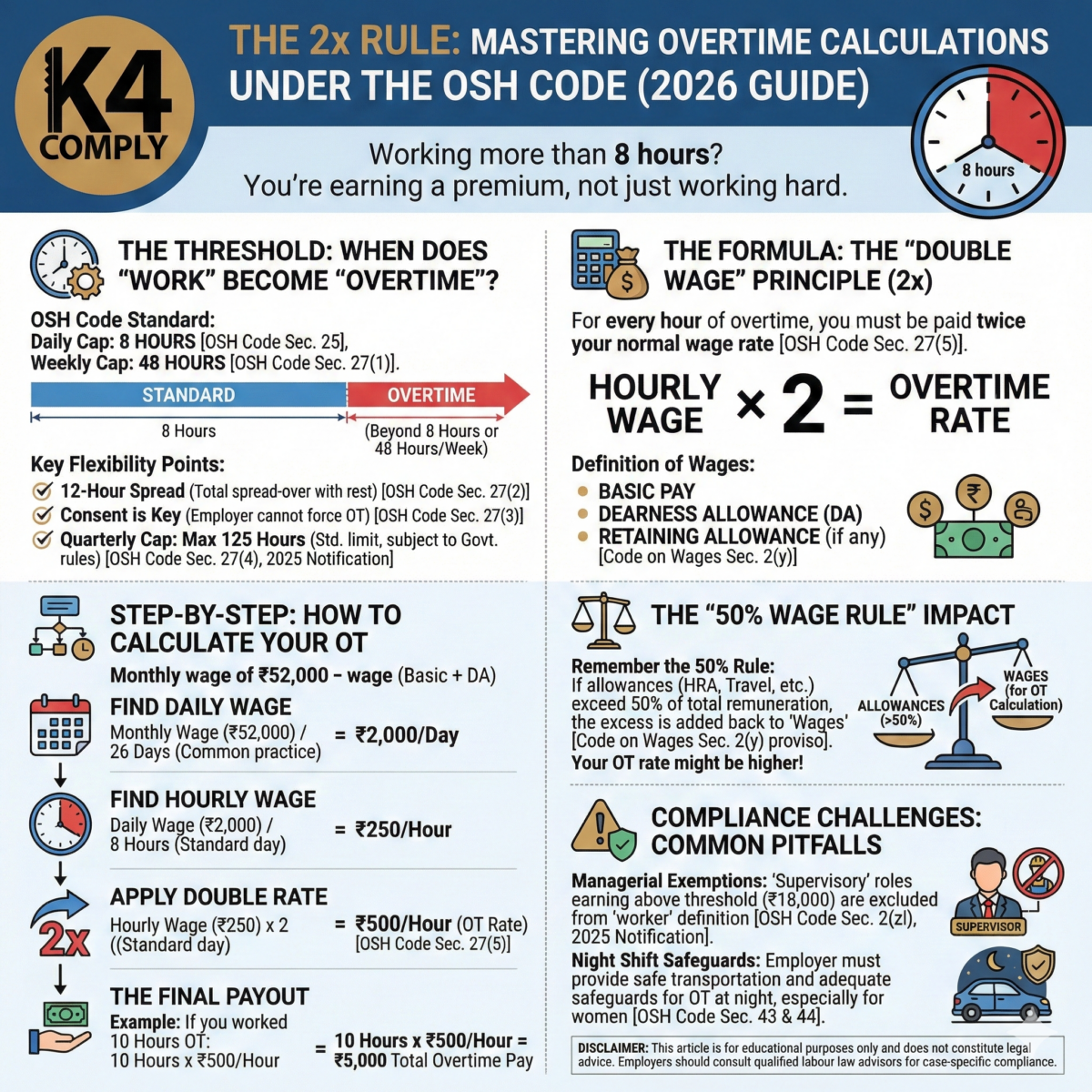
Working late at the office or on the factory floor is often seen as a sign of dedication, but in the eyes of the law, it’s a transaction. If you’re giving more than your standard 8 hours to your employer, you aren’t just “working hard”—you’re earning a premium.
As we move through 2026, the Occupational Safety, Health and Working Conditions Code (OSH Code), 2020—which officially took effect in late 2025—has modernized how we view these extra hours. The question I hear most from employees today isn’t just “How much do I get?” but “How do I calculate it accurately under the new rules?”
1. The Threshold: When Does “Work” Become “Overtime”?
Under the OSH Code, the standard workday is capped at 8 hours【OSH Code Sec. 25】. Any work beyond this—or beyond 48 hours in a week【OSH Code Sec. 27(1)】—is legally classified as overtime.
However, the 2026 landscape introduces some flexibility:
- The 12-Hour Spread: Your total “spread-over” (including rest intervals) can go up to 12 hours【OSH Code Sec. 27(2)】.
- Consent is Key: Your employer cannot force you into overtime; it must be based on your consent【OSH Code Sec. 27(3)】.
- The Quarterly Cap: While the government has the power to fix limits, the standard remains at a maximum of 125 hours of overtime per quarter【OSH Code Sec. 27(4), Central Govt. Notification 2025】.
2. The Formula: The “Double Wage” Principle
The law is very clear: for every hour of overtime, you must be paid twice the rate of your normal wages【OSH Code Sec. 27(5)】.
But wait—what counts as “wages”? This is where most people get tripped up. Under the Code on Wages, 2019, your overtime is calculated based on:
- Basic Pay
- Dearness Allowance (DA)
- Retaining Allowance (if any)【Code on Wages Sec. 2(y)】
3. Step-by-Step: How to Calculate Your OT
Let’s look at a real-world example for a professional earning a monthly “Wage” (Basic + DA) of ₹52,000.
- Step 1: Find your Daily Wage
In practice, payroll systems often treat a month as 26 working days (not a statutory mandate, but a convention). - Step 2: Find your Hourly Wage
Assuming a standard 8-hour workday. - Step 3: Apply the Double Rate
The OSH Code mandates 2x pay for overtime【OSH Code Sec. 27(5)】. - Step 4: The Final Payout
If you worked 10 hours of overtime this month, apply the formula.
4. The “50% Wage Rule” Impact
In 2026, you must remember the 50% Rule. If your allowances (like HRA or Travel) exceed 50% of your total remuneration, the excess amount is added back to your “Wages” for calculation【Code on Wages Sec. 2(y) proviso】. This means your overtime rate might actually be higher than you think!
5. Compliance Challenges: Common Pitfalls
- Managerial Exemptions: Those in “supervisory” roles earning above the government-notified threshold (₹18,000 at present) are excluded from the definition of a “worker”【OSH Code Sec. 2(zl), Notification 2025】.
- Night Shift Safeguards: If you are working overtime at night, your employer is legally required to provide safe transportation and adequate safeguards, especially for women workers【OSH Code Sec. 43 & 44】.
Disclaimer
This article is for educational purposes only and does not constitute legal advice. Employers should consult qualified labour law advisors for case-specific compliance.