 Total Visitors
  Online Users
  Today
Today  Yesterday

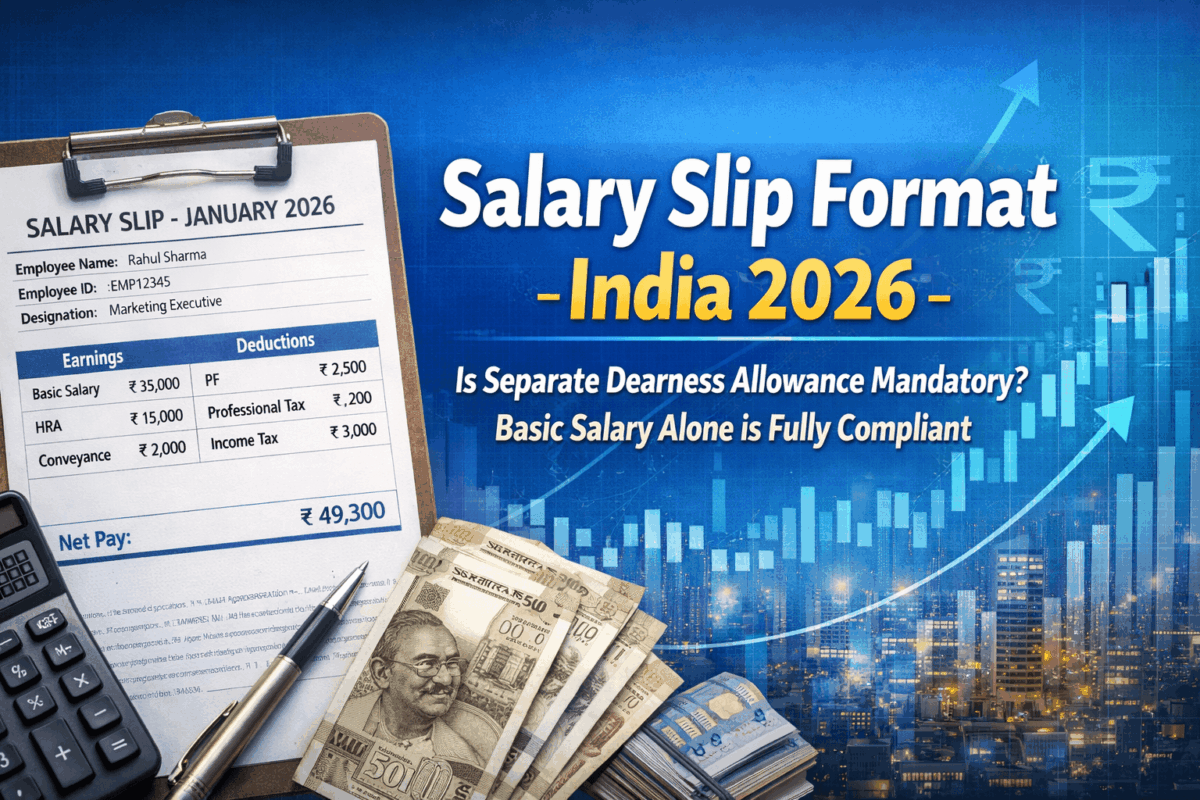
Many private‑sector employees notice that their salary slip shows only a single “Basic Salary” column, with no separate “Dearness Allowance (DA).” Since PF, gratuity, and minimum wage discussions often reference “Basic + DA,” it’s natural to ask: Is a separate DA line legally required?
The Legal Reality: Is a Separate DA Mandatory?
No. Employers are not legally required to show DA separately, provided the consolidated Basic Salary meets or exceeds the statutory minimum wage for the role, skill level, and region.
Minimum Wage Structures (Section 7, Code on Wages, 2019)
The law explicitly permits minimum wages to be fixed in three ways:
- (a) Basic rate + Cost of Living Allowance (VDA) – the traditional bifurcated structure.
- (b) Basic rate with or without Cost of Living Allowance – flexible approach.
- (c) An all‑inclusive rate – a single consolidated wage figure that combines basic rate, cost of living allowance, and cash value of any concessions.
If your Basic Salary alone is higher than the combined minimum wage + DA, your employer is fully compliant. The absence of a DA column is not a breach; it’s simply a unified pay structure under Section 7(1)(c).
What the Courts Have Said
| Court | Ruling | Key Takeaway |
| Supreme Court – Airfreight v. State of Karnataka | DA need not be mandatory, provided the aggregate of Basic + other permissible components equals or exceeds the notified minimum wage. | Consolidated Basic is valid. |
| Bombay High Court – M/s Polypharma Pvt. Ltd. v. Shri Rangnath S. Iyer (2017 LLR 343) | Special Allowance is not mandatory for minimum wage compliance; total qualifying wages are what matter. | No need for a separate DA column. |
These rulings collectively affirm that a consolidated salary slip with only a Basic column is legally permissible.
Legacy Laws vs. New Labour Codes
- Minimum Wages Act, 1948: Courts consistently upheld consolidated pay slips. As long as the total wage met or exceeded statutory minimums, employers could not be penalized for not splitting Basic and DA.
- Code on Wages, 2019 – Section 2(y): Defines “wages” as Basic Pay + Dearness Allowance + Retaining Allowance. This definition is for computing statutory payments (PF, gratuity), but it does not require that DA be displayed separately on the salary slip.
- Code on Social Security, 2020 – Section 2(88): Similarly defines wages for social security purposes (PF, ESI, etc.) as Basic + DA + Retaining Allowance. Again, no separate display mandate.
The two definitions are complementary; both treat Basic and DA together for compliance purposes. Whether shown separately or merged, statutory calculations remain identical.
Financial Impact: PF, Gratuity, and Taxes
- PF Contributions:
EPF = 12% of wages (Basic + DA). Consolidated Basic ensures full PF allocation.- Split Example: Basic ₹30,000 + DA ₹10,000 → PF base ₹40,000 → PF deduction ₹4,800
- Consolidated Example: Basic ₹40,000 → PF base ₹40,000 → PF deduction ₹4,800
→ No difference.
- Gratuity:
Calculated on last drawn wages (Basic + DA). A consolidated higher Basic strengthens gratuity payouts. - Taxes:
Both Basic and DA are fully taxable. Splitting them offers no tax advantage. Consolidation simply simplifies tax filing.
Important: The Salary Slip Must Still Contain Required Details
While a separate DA column is not mandatory, every employer must issue a wage slip (payslip) to each employee for every pay period. Under Section 50 of the Code on Wages, 2019, failure to maintain proper wage slips can attract a fine of up to ₹50,000.
The wage slip must typically include:
- Name and attendance period
- Rate of wages
- Deductions (PF, ESI, professional tax, etc.)
- Net wages paid
- Employer’s contributions
- Any other prescribed details (state rules may vary)
A consolidated Basic figure alone, without any breakup, may not satisfy these requirements if state rules mandate component‑wise disclosure. However, many states accept a consolidated Basic column provided the total wages are clearly stated. Employers should check their applicable state Shops and Establishments Act or central rules.
Employee Protection Under the 50% Rule
Under the Code on Social Security, 2020, Section 124 protects employees from wage reduction merely because the employer’s statutory liabilities increase. Additionally, under the Code on Wages, 2019, the 50% rule requires that Basic (or Basic + DA) must constitute ≥ 50% of total remuneration. This ensures that consolidation does not erode the employee’s core wage base.
Checklist for Employees – FREE
- Minimum Wage Compliance: Ensure Basic (or Basic + DA) ≥ statutory minimum wage for your category.
- 50% Rule: Basic + DA must be ≥ 50% of total remuneration under Labour Codes.
- PF Accuracy: Confirm PF deduction = 12% of total wages (Basic + DA), subject to the ₹15,000 cap where applicable.
- Salary Slip Completeness: Verify that your wage slip shows all mandatory components (gross, deductions, net pay).
Strategy for HR & Payroll Managers
- Simplify Payroll: Consolidated Basic reduces the need for twice‑yearly DA adjustments based on CPI.
- Ensure Compliance: Anchor PF, gratuity, and ESIC calculations to the unified wage definition (Basic + DA, whether shown separately or merged).
- Stay State‑Ready: Some states may prescribe specific salary slip formats; ensure your consolidated Basic still satisfies local rules.
- Communicate Clearly: Explain to employees that consolidation does not reduce benefits and is fully court‑approved.
The Takeaway
A separate DA column is not mandatory. Indian courts and the new Labour Codes clearly permit an all‑inclusive wage structure. As long as your consolidated Basic Salary meets minimum wage requirements and satisfies the 50% wage rule, your pay slip is legally compliant.
Consolidation simplifies payroll, strengthens statutory benefits, and keeps your compensation transparent. The absence of a “DA” row is not a legal violation—it is simply a cleaner, simpler salary slip.
Disclaimer: The information provided in this article is for educational and informational purposes only and does not constitute formal legal advice. While every effort has been made to ensure the accuracy of the legal provisions discussed under Indian Labour Laws and the Code on Wages, readers are advised to consult a certified payroll auditor, labour law consultant, or legal professional regarding specific corporate salary architectures and compliance concerns.