 Total Visitors
  Online Users
  Today
Today  Yesterday

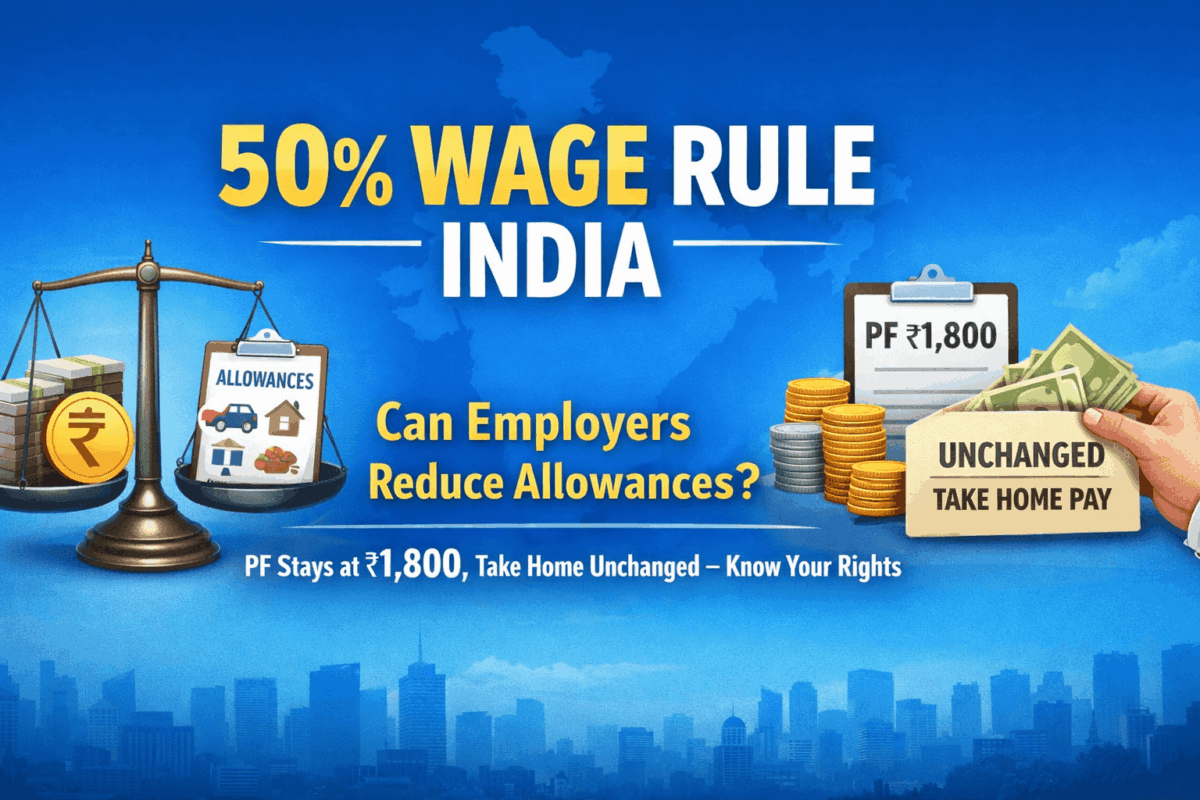
Have you checked your salary slip recently and noticed something unusual? Your total Cost to Company (CTC) remains the same, but your “Special Allowance” or “HRA” has shrunk, while your “Basic Salary” has suddenly shot up.
If this sounds familiar, you aren’t alone. Employers across India are restructuring pay slips to comply with the 50% wage rule under the new Labour Codes. Let’s break down what the law actually permits, what it prohibits, and how your take‑home pay may or may not change.
The Legal Blueprint: What is the 50% Wage Rule?
- Legacy Practice: Under older laws, employers often kept Basic Salary low (30–40% of CTC) and inflated allowances. Since PF and Gratuity are calculated on Basic, this reduced employer liabilities.
- New Framework: With the Code on Wages, 2019 and Code on Social Security, 2020, “Wages” are strictly defined.
- Core Wages = Basic + DA + Retaining Allowance must be ≥ 50% of total remuneration (CTC).
- Excluded allowances (HRA, conveyance, commissions, etc.) ≤ 50%.
- Any excess allowances are automatically added back to “wages” for statutory calculations (gratuity, bonus, compensation, etc.).
The four Labour Codes came into effect across India on 21 November 2025.
Can Employers Reduce Allowances?
Yes, but only within legal boundaries.
- Allowed: Employers may reduce allowances and increase Basic Salary to meet the 50% threshold, provided total CTC remains unchanged.
- Not Allowed: Employers cannot reduce overall CTC or cut benefits simply because PF/Gratuity liabilities rise.
The Shield: Section 124 of the Code on Social Security
This section prohibits employers from reducing wages or benefits due to increased statutory contributions. Any restructuring aimed at evading liabilities rather than aligning with the wage definition risks regulatory scrutiny.
The Critical Point: What Happens to PF Contributions?
Under EPFO rules (Paragraph 26A of the EPF Scheme, 1952), contributions are mandatory only on the first ₹15,000 of Basic + DA per month, even if the employee’s actual Basic + DA is higher.
- Monthly mandatory PF contribution (both employee & employer): 12% of ₹15,000 = ₹1,800 each.
- This ceiling applies regardless of the 50% wage rule.
- Employers are not required to compute PF on the full higher Basic salary.
Therefore, for most employees, the PF deduction does not increase merely because Basic salary is raised to meet the 50% threshold.
Immediate Impact on Take‑Home Pay: A Realistic Example
| Component | Legacy Structure | Restructured (50% Compliant) |
| Basic + DA | ₹35,000 (35% of CTC) | ₹50,000 (50% of CTC) |
| Allowances (HRA, special, etc.) | ₹65,000 | ₹50,000 |
| PF Deduction (12% of ₹15,000 ceiling) | ₹1,800 | ₹1,800 (no change) |
| Approx. Take‑Home Pay | ₹98,200 | ₹98,200 (no change) |
Conclusion: If the employer continues to cap PF at ₹15,000, the employee’s take‑home pay does not reduce solely due to the 50% wage restructuring. The only change is that the wage base for gratuity, bonus, leave encashment, and other social security benefits increases; which is a long‑term gain for the employee.
Exception: Some employers voluntarily opt to contribute PF on full Basic salary. In that rare case, PF deduction would rise and take‑home would dip. However, this is not mandatory and requires mutual agreement.
The Real Long‑Term Gains
- Gratuity Boost: Gratuity = Last Drawn Wages × (15/26) × Years of Service. With higher definition of “wages,” gratuity payouts rise by 30–40%.
- Bonus & Other Benefits: Statutory bonus (under Payment of Bonus Act, now subsumed) is also calculated on the revised wage base.
- Enhanced Social Security Base: Benefits like maternity pay and compensation for work‑related injuries are now calculated on the expanded wage definition.
Checklist for Employees – FREE
- Check Ratio: Basic + DA ≥ 50% of gross remuneration.
- Verify CTC: Ensure total CTC hasn’t been reduced.
- Review PF: Confirm PF deduction is ₹1,800 per month (unless you opted for VPF or employer follows a different policy).
- Ask HR: If you see a higher PF deduction, ask whether your employer has voluntarily chosen to contribute on full Basic and whether you agreed to it.
Strategy for HR & Employers
- Wage Audits: Identify allowance‑heavy structures and correct them.
- Transparent Communication: Explain that PF deductions remain at ₹1,800 (statutory ceiling) for most employees, so take‑home is protected.
- System Upgrades: Configure payroll software to separate included vs. excluded wage components, and apply the ₹15,000 PF ceiling correctly.
The Takeaway
Employers can restructure allowances to comply with the 50% wage rule, but they cannot reduce overall CTC or benefits. Under the standard industry practice (PF capped at ₹15,000), take‑home pay does not decline. Employees gain stronger gratuity, bonus, and social security without losing monthly liquidity.
Your allowances may be adjusted, but your financial future is significantly stronger and your take‑home stays the same.
Disclaimer: The information provided in this article is for educational and informational purposes only and does not constitute formal legal advice. While every effort has been made to ensure the accuracy of the legal provisions discussed under Indian Labour Laws, readers are advised to consult a certified labour law consultant or legal professional regarding specific payroll structures and compliance concerns.