

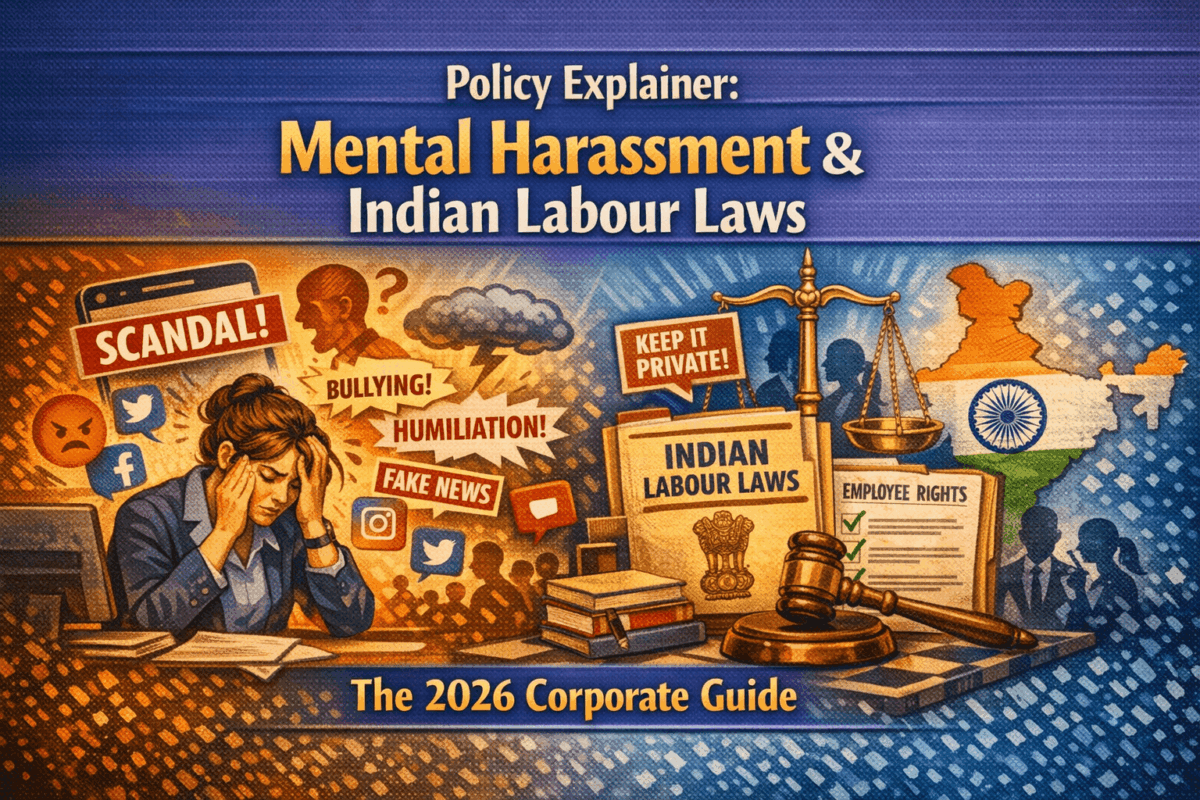
1. What is “Mental Harassment”?
- Not a standalone law: No statute defines it directly.
- Judicial interpretation: Courts recognize persistent, unwelcome behaviour that undermines dignity or psychological well-being as harassment.
- Examples: Victimization, coercive tactics, hostile work environment.
2. Legal Pillars
| Law / Code | Scope | Mental Harassment Coverage | Compliance Requirement |
| POSH Act, 2013 | Sexual harassment of women at workplace | Recognizes mental agony as part of hostile environment | Mandatory Internal Committee (IC), policy, training |
| Industrial Disputes Act, 1947 (IDA) | Workmen (non-supervisory employees) | Courts interpret “victimization” & “unfair labour practices” to include harassment | Complaint to Labour Commissioner, conciliation, adjudication |
| Occupational Safety, Health & Working Conditions Code, 2020 | All employees (once enforced) | Expands “health” to include mental well-being | Employer duty to ensure psychological safety |
3. Real-World Scenarios
| Workplace Behaviour | Possible Legal Interpretation |
| Excluding an employee from meetings/emails | Victimization / hostile environment |
| Repeated midnight work demands + threats | Coercive tactics / unfair labour practice |
| Public shaming on official channels | Hostile environment impacting dignity |
(Note: Actionability depends on severity, evidence, and context.)
4. Compliance Path for Employees
- Document Evidence
- Dates, times, screenshots, emails.
- Courts rely heavily on documented proof.
- Internal Grievance Redressal
- Use company grievance policy or POSH IC.
- Creates a formal paper trail.
- Labour Commissioner (IDA)
- Applicable if classified as “workman.”
- File complaint for victimization/unfair practices.
- Civil Remedies
- Tortious liability suits possible but rare.
- Courts prefer statutory remedies.
5. Compliance Path for Employers
- Mandatory under POSH:
- Policy, IC formation, awareness training.
- Best Practices under IDA & Labour Codes:
- Grievance redressal mechanism for all employees.
- Anti-harassment policy covering psychological safety.
- Training managers on constructive feedback vs. coercive tactics.
- Future-readiness:
- Align policies with Labour Codes’ expanded definition of “health.”
6. Conclusion
India’s labour law framework is evolving toward recognizing psychological safety as a legal obligation. Employers who proactively address mental harassment reduce litigation risk and foster trust. For HR teams, embedding grievance mechanisms and awareness training is not just compliance but it’s culture-building.
Disclaimer: This article is for educational and informational purposes only and does not constitute legal advice. Laws regarding workplace harassment in India are subject to interpretation by the courts and may vary based on specific facts and circumstances. Please consult with a qualified legal professional for advice regarding your specific situation.