 Total Visitors
  Online Users
  Today
Today  Yesterday

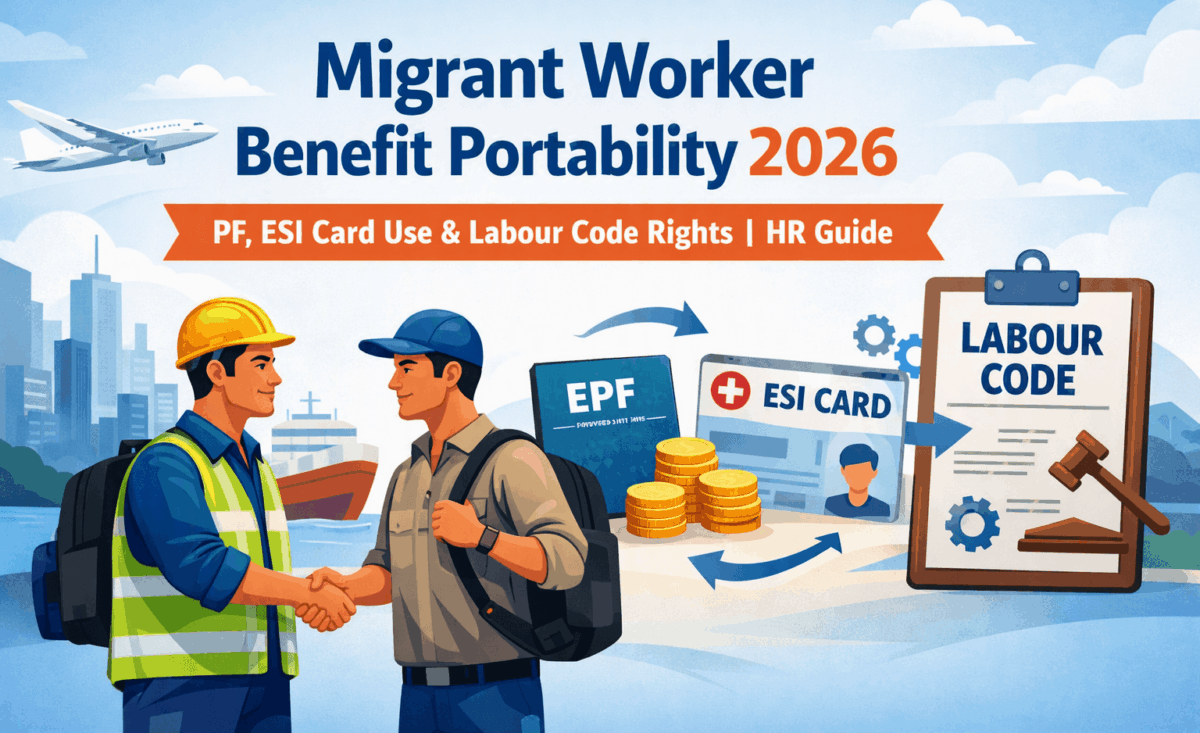
If you’re an HR leader or business owner employing inter-state migrant workers, you’ve likely wondered about the practical mechanics of benefit portability. The question is straightforward: “My worker is migrating from Uttar Pradesh to Mumbai, Maharashtra. How does their PF and ESI move with them?”
The new Labour Codes particularly the Occupational Safety, Health and Working Conditions (OSH) Code, 2020 and the Code on Social Security, 2020 have fundamentally rewired this framework. The answer is no longer tied to paper ledgers or the goodwill of a contractor. Instead, it’s tied to a digital identity that moves with the worker.
Here’s the bottom-line: PF portability is fully operational via the Universal Account Number (UAN). However, for ESI portability, while the worker’s individual card is valid nationwide, benefits can only be availed if the new employer has an active ESI sub-code for the specific location (e.g., Mumbai).
The Dual-Regime Framework: Legacy vs. New Rules
The Legacy Trap (Pre-2026)
Under the outdated Inter-State Migrant Workmen (RECS) Act, 1979, safety nets were fundamentally localized. Benefits were tied to a specific worksite and state, and the Act assumed migration was contractor-driven, leaving self-migrated workers invisible.
The Active Code Regime (OSH Code & Social Security Code)
The new framework shifts the focal point from ledgers to digital identities.
| Feature | Legacy System (1979 Act) | New Framework (Labour Codes) |
| Worker Coverage | Restricted to contractor-driven recruitments | Includes self-migrated workers up to ₹18,000/month threshold |
| Medical Access (ESI) | Bound to state of registration | Card is portable pan-India, but requires employer sub-code at the work location |
| PF Account Flow | Manual transfers | Instantly portable via lifelong Universal Account Number (UAN) |
| Ration/Food Security | Tied to home village | Portable via One Nation One Ration Card (ONORC) |
How Portability Works in Practice: From UP to Mumbai
Let’s trace the journey of a worker moving from Uttar Pradesh to a factory in Mumbai.
1. EPF / PF Portability (The UAN – Fully Operational)
The worker’s financial identity is locked into a unique, lifelong 12-digit Universal Account Number (UAN). When they join your establishment in Maharashtra, they simply provide their existing UAN. Their retirement corpus continues to grow seamlessly via an online UAN transfer request via the EPFO portal.
2. ESI / Medical Portability (The e-Pehchan Card vs. Sub-Code)
Here is the practical answer to the core question: Yes, the employee can physically use their e-Pehchan card in a Mumbai hospital. However, for the benefits to actually materialize, the employer must have a valid ESI sub-code for the Mumbai location.
There is a two-tier system at play here:
- The Employee’s Card is Portable: An employee’s e-Pehchan card is issued for life and stores their medical history. They can walk into any ESIC hospital or dispensary across India.
- The Employer’s Sub-Code is Location-Specific: This is where the clarification is critical. ESIC mandates that employers with operations across multiple states or locations must register each office under a separate sub-code. This ensures contributions are deposited into the correct regional fund and the worker is active in the system for that specific location. If the employer does not have a Mumbai sub-code, the worker cannot be covered under the system, despite possessing a valid card.
3. The New Migrant Worker Protections (Post-May 8, 2026)
The OSH&WC Rules, 2026 add new layers:
- Mandatory Appointment Letter: Must contain Aadhaar, UAN, and detailed wage breakup.
- Displacement Allowance: A lump-sum payment equal to 50% of monthly wages or ₹75, whichever is higher, payable at recruitment.
- Journey Allowance: Employers must pay actual to-and-fro travel costs to the worker’s home state at least once every 12 months.
Core Compliance Checklist: Actionable Steps for HR [FREE]
For ESI Compliance
- Obtain Main ESI Code: Register your head office first.
- Apply for Sub-Codes: Secure separate codes for all locations outside the main regional jurisdiction.
- Map Employees Correctly: Register each employee under the sub-code corresponding to their actual work location.
- File Location-Specific Returns: Contributions must be filed independently for each sub-code.
For General Compliance
- Mandatory Appointment Letter: Issue a formal letter with Aadhaar, UAN, and statutory details.
- Displacement Allowance: Pay the one-time allowance and document it.
- eShram Registration: Register the worker on the eShram portal to enable access to all social security schemes.
Financial and Operational Risk Analysis
Compliance Risks
| Risk Area | Legacy Regime | New Labour Codes | Implications |
| Missing Sub-Codes | Often ignored | Mandatory for location-specific coverage | Employees cannot access benefits; inspection-based penalties |
Financial Impact Considerations
- Displacement Allowances: Statutory cost of up to ₹9,000 per new hire.
- Compliance Automation: Investing in HRMS integration for EPFO and ESIC is now a statutory necessity.
Disclaimer: This content is provided for educational and informational purposes only and does not constitute formal legal counsel, solicitation, or lawyer-client relationship. The information herein is based on available Central and State notifications, judicial pronouncements, and statutory provisions as of July 2026. Labour being a Concurrent Subject under the Indian Constitution, State-specific rules, notifications, and judicial interpretations may introduce additional, varying, or conflicting compliance obligations not addressed herein. Statutory provisions are subject to amendment, repeal, or judicial re-interpretation without prior notice. Employers and organisations are strongly advised to consult with qualified legal professionals including advocates, labour law consultants, and compliance practitioners for advice tailored to their specific organisational structure, industry classification, operational geography, and workforce composition. The authors, publishers, and distributors expressly disclaim any liability for actions taken or not taken based on this content, and no warranty—express or implied is made regarding the accuracy, completeness, timeliness, or fitness for purpose of this information. Readers should independently verify all compliance requirements with appropriate governmental authorities and legal counsel. This content does not override or supersede any legal obligation imposed by competent statutory authorities.