 Total Visitors
  Online Users
  Today
Today  Yesterday

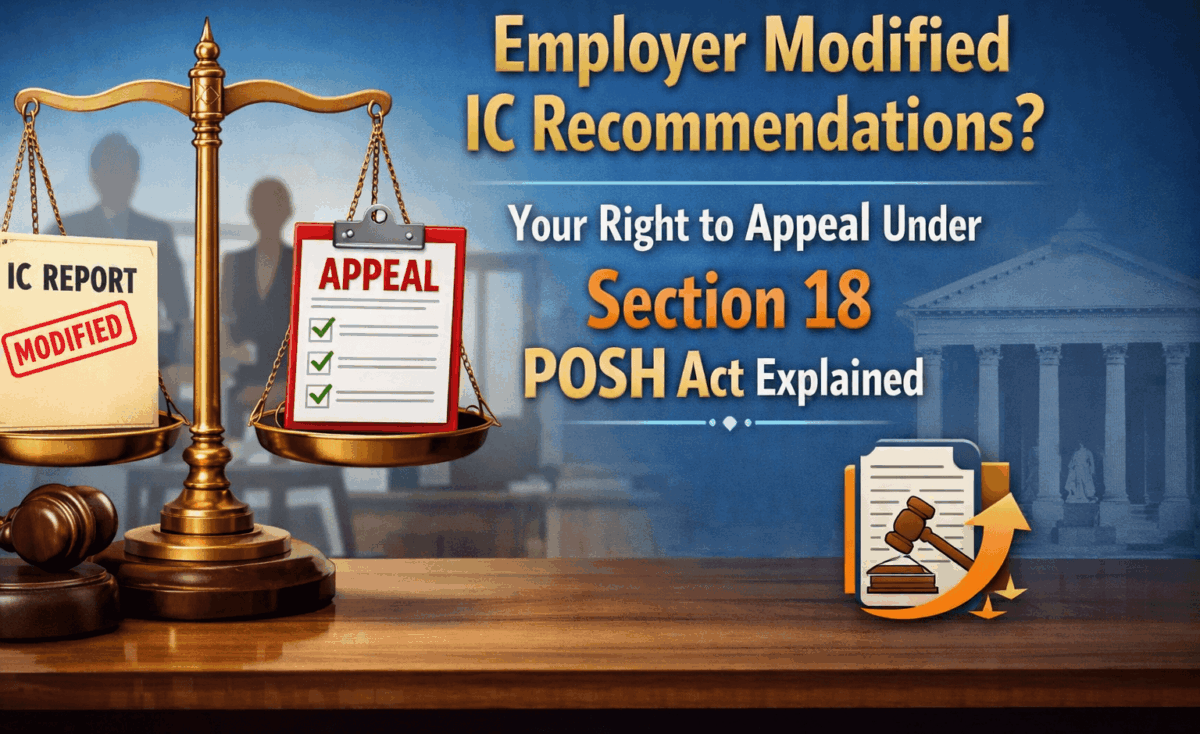
The Employer Modified the IC’s Recommendation. Now What?
Your Internal Committee conducted a full inquiry, heard both sides, and issued its recommendations. The employer then did something unexpected. They modified the penalty. Perhaps the IC recommended termination, but the employer imposed a warning instead.
Now you are wondering: can you appeal that modification?
The answer depends on what you are appealing against. That distinction is critical for your compliance strategy.
Section 18: What You Can Actually Appeal
Section 18 of the POSH Act gives any aggrieved person the right to appeal. But here is the key point. The appeal lies against the IC’s recommendations, not the employer’s implementation decision.
The IC completes its inquiry, prepares its report, and sends it to both parties and the employer. The employer then has 60 days to implement the IC’s recommendations. If either party is aggrieved by the IC’s decision, they can challenge it before the Appellate Authority through an appeal.
The statutory language is specific. The appeal is against the “recommendations” of the IC. The employer’s decision to implement, modify, or reject those recommendations is a separate administrative action. It does not create a new appealable order.
Who can appeal? Both the complainant and the respondent possess an equal right to appeal under Section 18. In a significant ruling dated April 20, 2026, the Bombay High Court held that a person whose case is closed by the ICC is nonetheless a “person aggrieved” and possesses a statutory right to appeal under Section 18. The right to appeal is not contingent upon showing “direct injury.”
What the Courts Have Said
Hon’ble Supreme Court, January 2026: In CDR Yogesh Mahla v. Union of India, the Supreme Court clarified that ICC findings are not “preliminary.” They are substantive and appealable immediately. The Court held that Section 18 of the POSH Act provides that if there is an adverse recommendation made by the Internal Complaints Committee, an appeal could be made to the court or the tribunal in terms of the service rules. The Court further observed that “holding that the appellant had no right under Section 18 of the POSH Act was not right.”
Hon’ble Bombay High Court, November 2025: In ABC v. Internal Complaints Committee, the Court reiterated that writ jurisdiction is not a substitute for the statutory appeal under Section 18, especially when the employer is a private entity. The Court noted that the POSH Act has its own internal appellate mechanism, and parties must use that route unless there is a glaring violation of natural justice. Judicial review is reserved for exceptional situations, such as when the ICC is improperly formed or the finding is so unreasonable that it borders on perversity.
Hon’ble Karnataka High Court: In Nagaraj G.K. v. Additional Labour Commissioner, the Court held that despite the absence of a specific provision in the POSH Act for granting interim orders, the Appellate Authority has the inherent power to consider interim applications, such as a stay.
The Appeal Mechanism: Where and How
Identifying the Appellate Authority:
The POSH Act does not prescribe a single appellate authority, which often creates confusion. The appeal lies to the court or tribunal as per applicable service rules, or in their absence, to the prescribed authority.
For private sector organisations without service rules, Rule 11 of the POSH Rules clarifies that the appellate authority is typically the Labour Court or Industrial Tribunal. The Himachal Pradesh High Court (March 2026) confirmed that the Industrial Tribunal-cum-Labour Court, already notified under the Industrial Employment (Standing Orders) Act, 1946, is a valid appellate authority under Section 18 of the POSH Act.
If neither service rules nor standing orders apply, the aggrieved party may challenge the IC’s decision by filing a writ petition before the jurisdictional High Court.
Timeline: The appeal must be filed within 90 days from the date of the IC’s recommendations. The clock starts ticking from the IC’s recommendations, not from the employer’s implementation decision.
What can be appealed? Under the POSH Act, an appeal can be filed against:
- Findings of no sexual harassment (Section 13(2))
- Findings of guilt and specific recommendations (Section 13(3))
- Punishment for false or malicious complaints (Section 14)
- Breach of confidentiality (Section 17)
Employer Modification: The Practical Reality
When an employer modifies the IC’s recommendation, they are exercising administrative discretion, not appellate authority. The IC’s findings of fact remain intact. The employer cannot substitute their own factual findings for the IC’s. They must accept the IC’s findings of guilt or innocence. The discretion lies only in the quantum of punishment, and departures must be reasoned and documented.
For the complainant: if the employer reduces the penalty, your primary remedy is an appeal under Section 18 against the IC’s recommendations. You cannot appeal the employer’s modification directly because it is not a separately appealable order. You must challenge the IC’s recommendations that enabled the reduction.
For the respondent: if the employer imposes a harsher penalty than the IC recommended, your appeal is similarly against the IC’s recommendations. The employer’s implementation decision does not create a new appealable order.
Grounds for Appeal
Common grounds for challenging an IC order include:
- Procedural irregularities or failure to follow natural justice principles
- Improper constitution of the IC
- Delays in the inquiry process
- Erroneous findings that ignore evidence or rely on inadmissible material
- Recommendations that are disproportionate to the findings.
The appellate authority can uphold, modify, or set aside the IC order and may direct a fresh inquiry if needed.
The Bottom Line
Your appeal right is against the IC’s recommendations, not the employer’s modification. The employer’s implementation decision is a separate administrative action that does not reset the limitation period or create a new appealable order.
The statutory appeal period begins from the IC’s recommendations. Parties must file within 90 days irrespective of the employer’s subsequent action. Do not wait for the employer to implement or modify the recommendations before filing your appeal.
For employers: the courts have made it clear. A well-run ICC with proper constitution, trained members, clear timelines, and thorough documentation is the strongest safeguard an organisation has in POSH matters. Maintain clear records, document reasons for accepting or denying procedural requests, and complete inquiries within statutory timelines.
Disclaimer: This content is for educational and informational purposes only and is based on available judicial pronouncements and statutory provisions as of the publication date. The POSH Act and its interpretation are subject to ongoing judicial developments. This does not constitute formal legal counsel. Organizations and individuals should consult qualified legal professionals for advice specific to their circumstances, including jurisdiction-specific applicability and compliance obligations.