 Total Visitors
  Online Users
  Today
Today  Yesterday

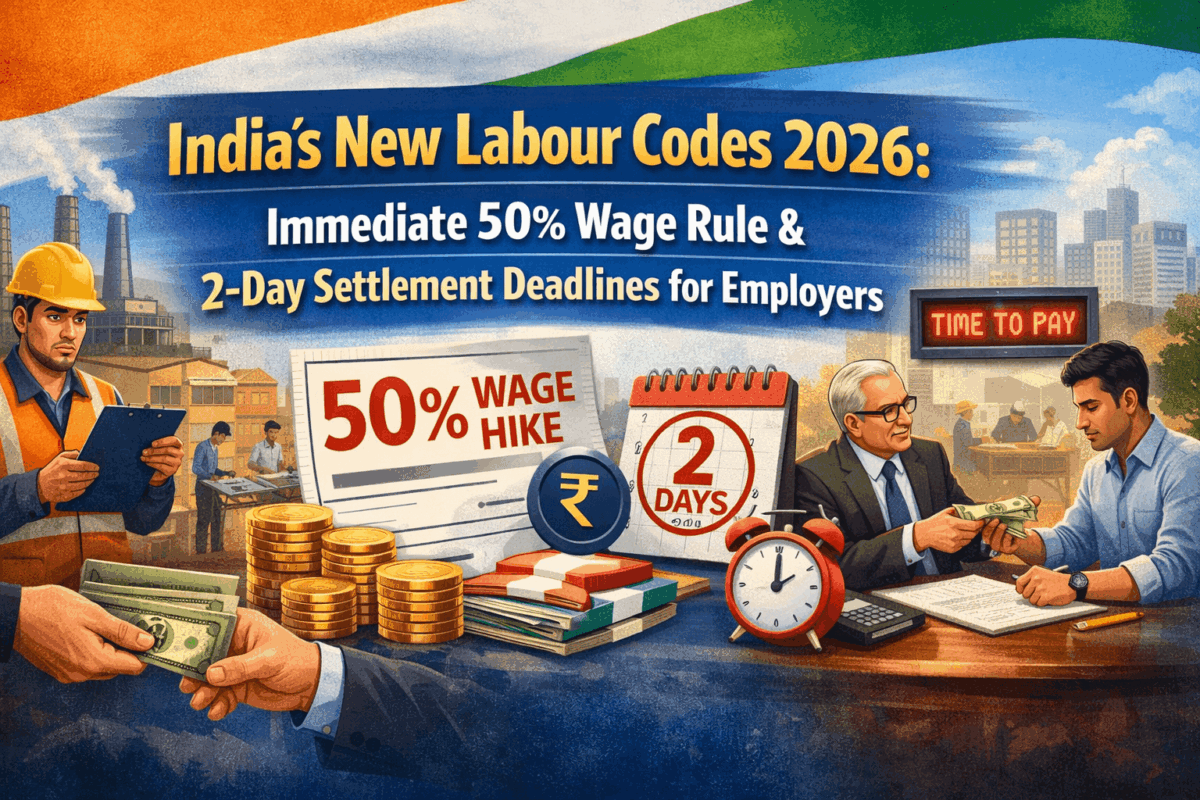
For months, many employers have been lulled into a sense of security by a single question: “Should we change our payroll and policies now, or can we wait until the last minute?”
If that question is still sitting in your boardroom minutes, you are already behind. The narrative has shifted. The Indian Labour Codes are not a future to-do list; they are a present reality. However, the complexity isn’t that everything changes at once. The real danger is that different parts of the Codes move at different speeds.
While some rules are waiting for state-level notifications, core operational compliances are already casting a long shadow over your balance sheet. Here is a practical roadmap to separate what burns immediately from what merely simmers.
The Immediate Shockwaves (Do Not Delay)
Waiting for central portals to open is a trap. Several provisions require internal system changes today because they directly impact the math behind payroll and employee exits.
1. The 50% Wage Ceiling
The most under-discussed financial risk lies in the new definition of “wages.” Under the Code on Wages, the exclusions (like HRA, conveyance, and special allowances) cannot exceed 50% of an employee’s total remuneration. If your current CTC structure hides salary in allowances to keep statutory contributions low, that excess is now legally deemed as ‘wages.’
- Action: Audit your CTC sheets immediately. If allowances exceed 50%, your PF, Bonus, and Gratuity liabilities will spike the moment the rules are enforced.
2. Gratuity for the Short-Term Employee
Gratuity is no longer a reward for a decade of service. The Social Security Code extends this benefit to fixed-term employees on a pro-rata basis. The old barrier of five continuous years is gone.
- Action: Review your hiring contracts for temporary staff. Your accounting provisions for gratuity must expand to cover workers who leave after 12 or 24 months.
3. The Unforgiving 2-Day Settlement Rule
This is the compliance nightmare waiting to happen. Section 17 of the Code on Wages mandates that full and final settlement of wages must be completed within two working days of an employee’s resignation, dismissal, or retrenchment.
- Action: Manual exit processes are now illegal. You need a system-driven, automated payout mechanism. Any HR manager asking for “10 days to process” is exposing the firm to automatic penalties.
4. The Gig Economy Data Grab
For aggregators, the era of treating gig workers as “non-employees” for compliance purposes is ending. The law envisions a contribution (1-2% of annual turnover) toward a social security fund for platform workers.
- Action: Start collating worker data, ride history, and onboarding dates now. Without historical data, you cannot calculate future contributions.
The Cross-Functional Bottlenecks (Start Now)
Some areas are not just “HR paperwork.” They require legal, safety, and operations teams to sit in the same room.
- The Standing Order Threshold: The Industrial Relations Code raises the threshold for mandatory standing orders from 100 to 300 workers. If you operate between these numbers, you may have been exempt previously—but you aren’t now.
- The Creche Mandate: The OSH Code requires a creche facility for any establishment with 50 or more workers. This isn’t just a real estate issue; it requires safety committees and welfare audits.
- Contract Labour & Migrant Workers: The rules around journey allowances for inter-state migrant workers and overtime regulations are now stricter. Your contract labor compliance must be audited for payment proof.
The “Safe to Wait” Zone (But Plan)
Some compliance items are genuinely waiting for state rule notifications or specific portal rollouts (like Shram Suvidha integration). You don’t need to file forms today, but you cannot ignore the planning. Specifically, the contribution mechanisms for gig workers require scheme-level notifications.
Conclusion: The Cost of “Final Notice”
The biggest mistake employers make is waiting for the government to publish a “final enforcement date” before starting their system overhaul. By the time that date arrives, unprepared companies will be in a chaotic scramble, facing back-pay liabilities for gratuity and wages they miscalculated for six months.
Stop asking if you should change. Start asking how fast your systems can calculate the 50% rule.
Disclaimer: This article is for general informational purposes only and does not constitute legal advice. India’s new Labour Codes are being implemented in phases, with varying adoption across states. Readers must verify current rules with the official Gazette, Ministry of Labour & Employment, and their legal counsel before acting on any information below.