 Total Visitors
  Online Users
  Today
Today  Yesterday

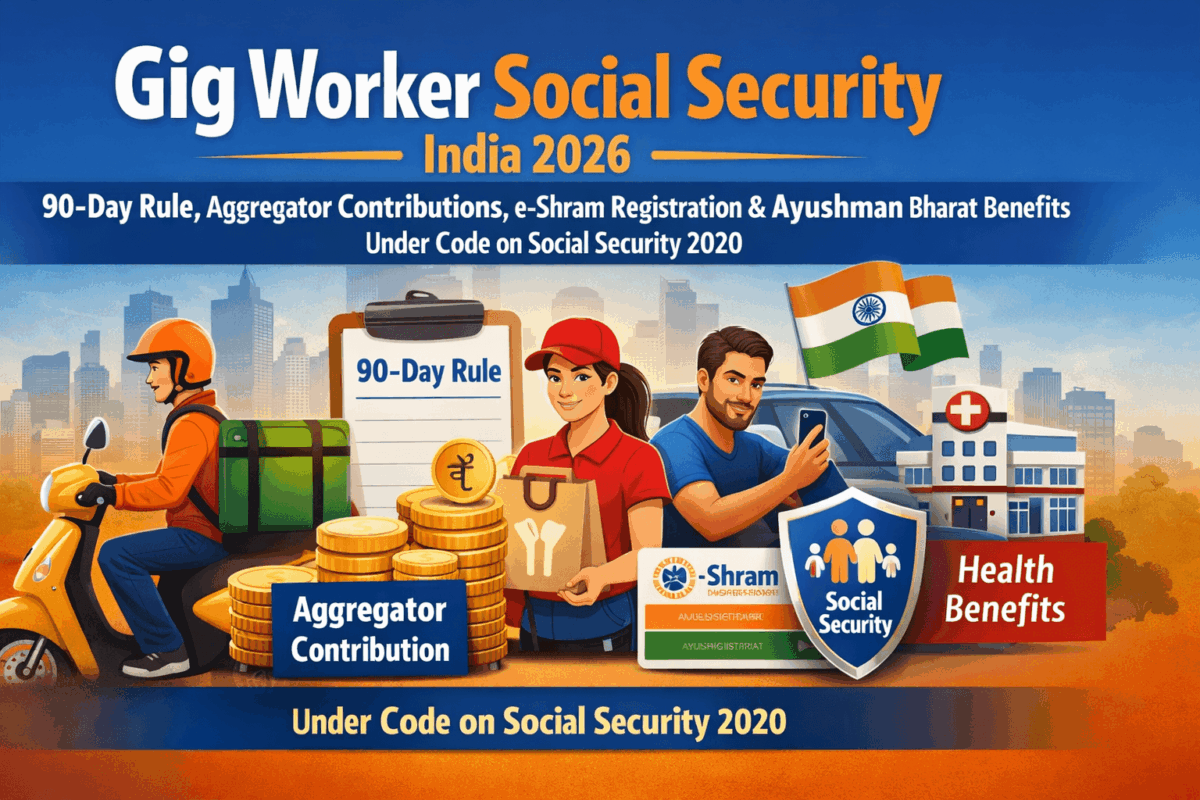
Think about your last busy week. Maybe you ordered dinner through Swiggy or Zomato, booked an Ola or Uber, or had a parcel delivered via Dunzo or Porter. The people making those seamless moments happen i.e. our gig and platform workers are the backbone of the modern Indian economy.
Yet, for years, gig workers asked: “Who delivers for us when we face a health crisis, an accident, or plan for old age?”
Historically, Indian labour laws recognized only traditional “employer–employee” relationships, excluding freelancers, delivery partners, and cab drivers from provident funds or medical insurance.
With the Code on Social Security, 2020, India has formally created a legal framework to extend social security to gig and platform workers.
The Legal Shift: Legacy Laws vs. The New Code
- Legacy Setup: Acts like the Employees’ Provident Funds Act, 1952 and Employees’ State Insurance Act, 1948 tied benefits strictly to formal employment. Gig workers were excluded.
- Code on Social Security, 2020: For the first time, defines “gig workers” (Section 2(35)) and “platform workers.” It mandates a Social Security Fund, financed by aggregator contributions (1%–2% of annual turnover, capped at 5% of payouts to workers) and government support, to provide life cover, accident insurance, health benefits, and old‑age protection.
The Code merges nine existing labour laws on provident fund, insurance, gratuity, and maternity benefits into a unified social security framework.
2026 Updates You Should Know
Several important developments have taken effect in 2026:
- Mandatory Aggregator Upload: Aggregators must now upload gig worker details to the central portal within 45 days of onboarding.
- Real‑time Recording: Aggregators must record new appointments and exits on a real‑time or daily basis.
- Quarterly Updating: Aggregators must share electronic details of gig workers every quarter; failure may result in workers being ineligible for benefits.
- Applicability to Associate Companies: Eligible gig workers include those engaged through associate companies, holding companies, subsidiaries, LLPs, or third parties.
- Interest Penalty: Failure to comply with social security contribution timelines may attract 12% annual interest on delayed payments.
- State‑Level Developments: Karnataka has passed the Karnataka Platform‑Based Gig Workers (Social Security and Welfare) Act, 2025. Telangana passed a similar Bill in April 2026.
Eligibility Rules: Proposed Minimum Work Thresholds
Important Note: The Code on Social Security, 2020 (Section 114) empowers the central government to prescribe eligibility conditions. The thresholds described below are based on the draft Code on Social Security (Central) Rules, 2025, published on December 31, 2025 for stakeholder feedback within 45 days. These thresholds are proposed and have not yet been finalised. Readers should check official notifications for the latest position.
Under the draft rules, a gig worker must meet the following to be eligible for social security benefits:
| Engagement Type | Minimum Work Threshold (in previous financial year) |
| Single Aggregator | At least 90 days of work |
| Multiple Platforms | At least 120 days cumulatively across platforms |
Work Day Calculation (as per draft rules):
- Any calendar day on which you earn any payment (regardless of amount) counts as one day.
- If you earn from multiple platforms on the same day, each platform counts separately toward your cumulative total.
This ensures that gig workers who split their time across apps (e.g., Zomato, Ola, Urban Company) are not unfairly excluded.
When Do Benefits Stop?
A gig worker ceases to be eligible for social security benefits:
- Upon attaining 60 years of age; OR
- When no longer engaged as a gig worker during the previous financial year (i.e., fails the 90/120‑day threshold).
How to Enrol and Claim Benefits
Step 1: Register on e‑Shram Portal
- Age: Must be 16+ years old.
- Requirements: Aadhaar linked to active mobile number.
- Process: Self‑registration is free.
- Outcome: Receive a Universal Account Number (UAN) and a digital ID card.
As of August 3, 2025, over 30.98 crore workers have registered on e‑Shram, including 3.37 lakh gig and platform workers.
Step 2: Aggregator Obligations
Under final rules, aggregators must:
- Upload your engagement details to the central portal within 45 days of onboarding.
- Record appointments and exits on a real‑time or daily basis.
- Share electronic details quarterly; failure may make you ineligible for benefits.
- Pay 1–2% of annual turnover (capped at 5% of payouts) into the Social Security Fund.
Step 3: Claim Benefits
- Healthcare: Integration with Ayushman Bharat (PM‑JAY) provides up to ₹5 lakh per family per year for hospitalisation (announced in Union Budget 2025‑26).
- Life & Accident Insurance: Claims filed online via e‑Shram portal or UMANG app.
- Portability: Benefits linked to your UAN, valid nationwide across platforms.
Compliance Challenges Ahead
- Data Integration: Linking aggregator logs with government databases remains a work in progress.
- Awareness: Many gig workers remain unaware of their eligibility.
- Aggregator Coverage: Ensuring smaller/local platforms comply with registration and contribution mandates.
- State‑Level Harmonisation: Labour being a concurrent subject, states must notify their own rules. Karnataka and Telangana have already enacted state‑level gig worker welfare legislation.
The Takeaway
Gig work is vital, and the law now recognizes that gig workers deserve protection. If you meet the proposed minimum work thresholds, you are legally entitled to healthcare, accident cover, and social security benefits.
Action Point: Register on the e‑Shram portal today and secure the protections you have earned.
Disclaimer
This blog explains the law as it currently stands, based on the Code on Social Security, 2020, and the draft Code on Social Security (Central) Rules, 2025. The 90‑day and 120‑day thresholds are proposed and subject to change upon final notification. Readers are advised to check official government notifications for the latest position.