 Total Visitors
  Online Users
  Today
Today  Yesterday

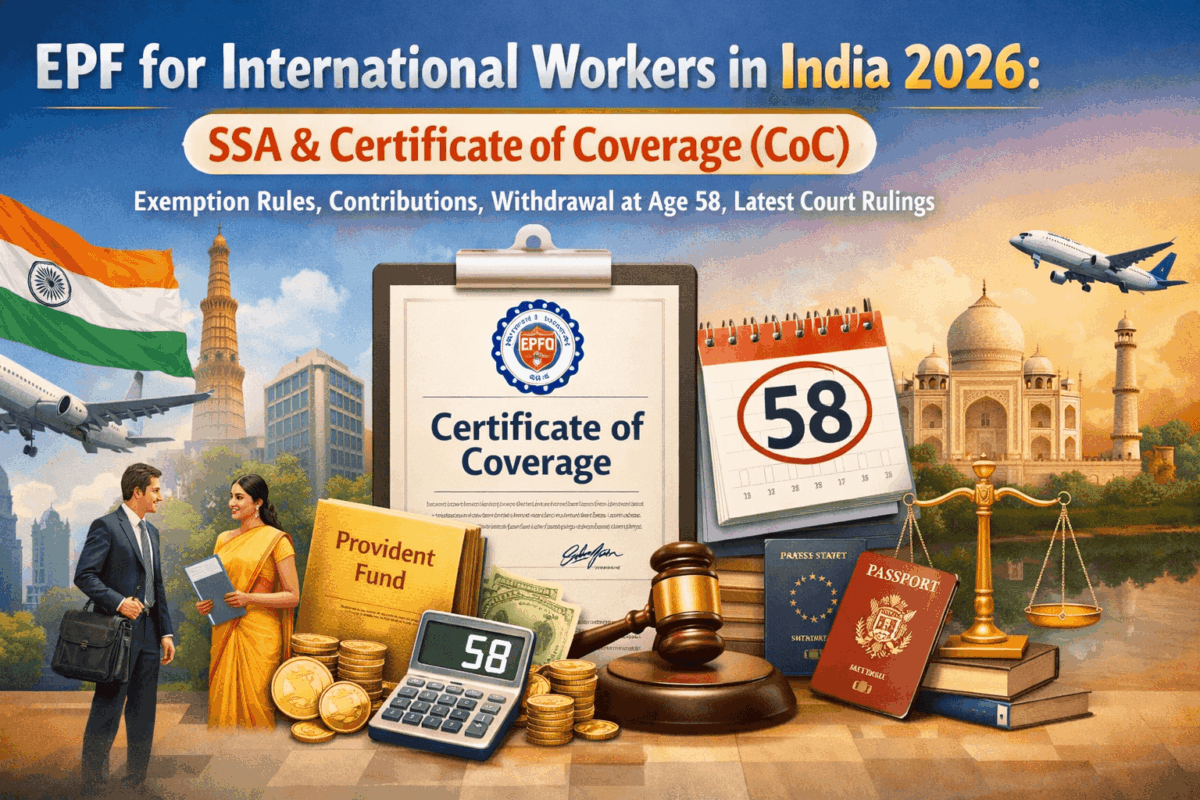
Moving to a new country for work is exciting, but it also brings complex compliance questions. If you are an expatriate working in India, one of the first surprises on your payslip may be a deduction for the Employees’ Provident Fund (EPF).
If your home country has signed a Social Security Agreement (SSA) with India, you may wonder: “Do I still need to contribute to the Indian EPF, or does the SSA exempt me?”
The Short Answer: It Depends on Your Status
- With a Certificate of Coverage (CoC): You are exempt from contributing to the Indian EPF.
- Without a CoC: You are treated as an International Worker (IW), and both you and your employer must contribute to EPF on your entire gross salary (no ₹15,000 cap applies).
2026 Update: What’s New?
Several important developments have taken place in 2026 that affect international workers and their employers:
1. India–UK Social Security Agreement Signed (February 2026)
On February 10, 2026, India and the United Kingdom signed an Agreement on Social Security relating to Social Security Contributions, aimed at avoiding double social security contributions for employees on temporary assignments in each other’s territories for periods of up to 36 months (3 years); notably shorter than the 5-year limit under most other SSAs. The agreement, which forms part of the India-UK Comprehensive Economic and Trade Agreement (CETA) signed in July 2025, is expected to benefit around 75,000 workers and more than 900 companies, resulting in estimated savings of over ₹4,000 crore. Once implemented, individuals and companies from the UK will be able to secure CoCs to avoid double social security contributions.
2. EPFO Simplifies CoC Extension Procedure (March 2026)
Following a bilateral meeting between Indian and Japanese authorities, the EPFO introduced a simplified procedure for extending Certificates of Coverage, with the procedural workflow decentralized to significantly reduce delays, authorizing Regional Offices in India to issue CoCs directly upon request. Under the new guidelines, extensions for a total duration of 5 to 8 years can now be granted without formal consultation between the two nations, provided reasons fall under specific conditions such as project delays, a child’s schooling needs, or the worker’s approaching retirement.
3. EPFO Simplifies Overseas PF Payments for International Workers (March 2026)
On March 18, 2026, the EPFO issued a circular laying down simplified and consolidated procedures for settling EPF claims directly to overseas bank accounts of international workers residing in SSA countries. Only nations with whom India has an SSA are eligible to receive such direct payments to foreign workers’ bank accounts.
4. Delhi High Court Upholds Mandatory EPF Contributions for International Workers
In a landmark judgment upholding the validity of the 2008 and 2010 notifications, the Delhi High Court ruled that international workers employed in India are mandated to become members of the EPFO and contribute to the EPF, irrespective of their income. The Court held that the classification between Indian and foreign workers is constitutionally permissible, dismissing writ petitions by SpiceJet and LG Electronics. It further clarified that non-excluded international workers may withdraw the full amount in the EPF only on retirement from services after attainment of 58 years of age or on account of permanent and total incapacity.
What is a Social Security Agreement (SSA)?
An SSA is a bilateral treaty between India and another country designed to prevent double social security contributions and protect the cross‑border rights of mobile employees.
What the Latest Statistics Say
India currently has 22 Social Security Agreements with countries across the globe; including Australia, Canada, Japan, Germany, Sweden, Brazil, Switzerland, South Korea, Finland and many others, with the UK SSA soon to become operational. Each agreement may have slightly different provisions, including varying permissible detachment periods (generally 5 years for most countries, 3 years for the UK SSA).
SSAs provide three key protections for international workers:
- Totalisation (Benefit Portability): A worker’s contribution periods can be combined across both SSA signatory countries to help meet minimum vesting periods for pension benefits, preventing years of contribution from being lost when moving between countries.
- Exportability: Benefits may be payable in the worker’s home country or in a third country, in line with bilateral SSA provisions, ensuring seamless continuation of social security coverage.
- Detachment Exemption: For employees on temporary international assignments, SSAs avoid mandatory double contributions, ensuring that employees moving between India and SSA countries pay into only one system at a time — preventing both gaps in coverage and costly double payments. Employees temporarily posted abroad can avoid dual contributions, provided they obtain a Certificate of Coverage.
The Golden Key: Certificate of Coverage (CoC)
To claim exemption from Indian EPF, you must obtain a CoC from your home country’s social security authority.
- It proves you are contributing to your home system.
- Your Indian employer must upload the CoC to the EPFO International Workers Portal.
- Once registered, you are classified as an Excluded Employee under Paragraph 83 of the EPF Scheme, and EPF deductions stop.
The EPFO is authorised to issue Certificates of Coverage to Indian nationals working in countries with SSA-compliant India agreements and, conversely, to recognise CoCs received from such partner nations.
Exemption Checklist
To legally skip Indian EPF deductions, you must meet all of these:
- Employer–Employee Relationship: You are on detachment/secondment from a foreign employer.
- Maximum Duration: Within the SSA’s specified limit (3–5 years depending on the country).
- Active CoC: Uploaded by your Indian employer to EPFO’s portal.
What If You Don’t Have a CoC?
If you are a local hire in India or from a country without an SSA (e.g., the United States), you are treated as a standard International Worker:
- No Salary Cap: Contributions are 12% of your entire basic + allowances, matched by your employer, without any earnings ceiling — unlike domestic Indian employees who have a statutory wage ceiling of ₹15,000 per month for EPF eligibility. Once an International Worker is covered, contributions must be made on actual gross earnings regardless of the amount.
- Withdrawal Restrictions: For non-SSA country international workers, funds are generally withdrawable only at age 58 or in case of permanent disability (as confirmed by the Delhi High Court’s November 2025 ruling). However, foreign nationals from SSA countries are eligible to withdraw their accumulated PF contributions on departure from India, while those from non-agreement countries face the age‑58 restriction.
- SSA Countries Without CoC: You may withdraw when leaving India, but only under SSA provisions.
How to Get Your Exemption: Step‑by‑Step
- Apply for CoC in your home country before departure.
- Receive Approved CoC from your social security authority.
- Submit CoC to Indian Employer.
- Employer Uploads CoC to EPFO International Workers Portal.
- Payroll Updates Status to “Excluded Employee.”
Transitioning to the Code on Social Security, 2020
The Code on Social Security, 2020 consolidates the EPF Act and International Worker provisions. Key updates:
- Digitalisation: Streamlined verification of CoCs and settlement of claims.
- Consistency: Reciprocal SSA protections remain intact.
- Core Principle: With a valid SSA and CoC, you are protected from dual coverage.
The EPF is now applicable to all establishments with 20 or more employees, regardless of industry category, making the framework more uniform while extending coverage.
The Latest 2026 Takeaway
If you are arriving in India from an SSA country, secure a Certificate of Coverage before your assignment begins. It is the single document that ensures your salary in India is not unnecessarily reduced by EPF deductions, while safeguarding your pension rights abroad. And if you are coming from the UK, keep a close watch — your new bilateral SSA is expected to deliver major savings, potentially of up to ₹4,000 crore across the business community!
Disclaimer: This article is for educational and informational purposes only and does not constitute formal legal or tax advice. While every effort has been made to ensure the accuracy of the information as of 2026, social security treaties, EPFO circulars, and bilateral agreements are subject to diplomatic and statutory revisions. Please consult a licensed labour law consultant, international tax advisor, or corporate legal counsel before structuring expat payroll or filing exemptions.