 Total Visitors
  Online Users
  Today
Today  Yesterday

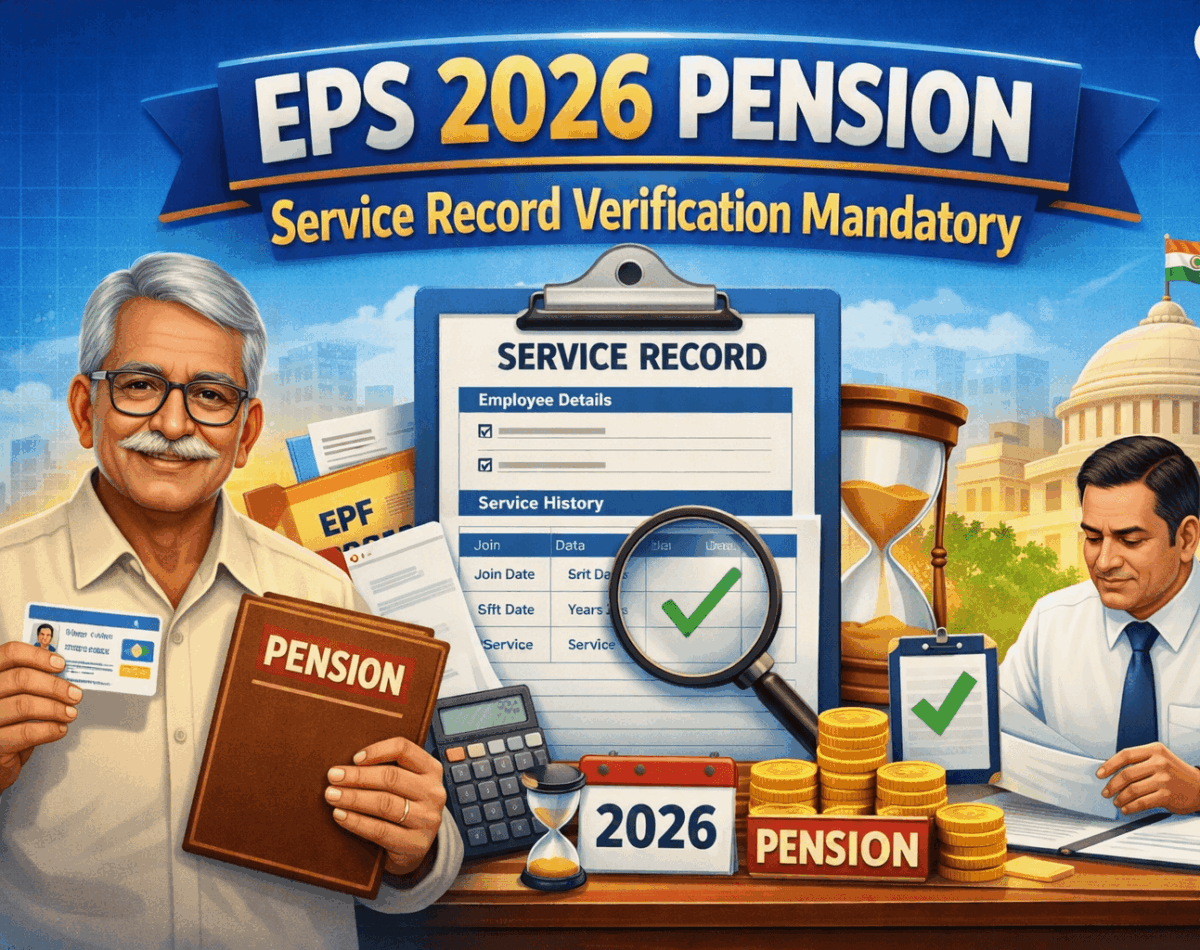
Statutory Genesis & Current Legal Posture
The Employees’ Pension Scheme (EPS) 2026 was notified by the Ministry of Labour and Employment, effective June 29, 2026, under the Code on Social Security, 2020 (G.S.R. 527(E)). This notification superseded the EPS, 1995, and the Employees’ Family Pension Scheme, 1971, but existing EPS-1995 members are automatically migrated with no fresh application required . The core pension formula remains unchanged: Monthly Pension = (Pensionable Salary × Pensionable Service) ÷ 70 .
The transition is designed for automatic migration, and the government has explicitly clarified that members’ past service records and benefits are fully protected under the new scheme. The key changes are administrative (faster digital claims, a formal 20-day claim processing timeline, and 12% annual interest on delayed settlements) rather than changes to the eligibility or calculation framework.
Physical Verification Requirement: The Clear Legal Position
The direct answer is no. No statutory provision under EPS 2026 mandates a blanket physical verification of all employees’ service records before pension application. The transition has been designed for automatic migration, and the notification does not prescribe such a verification exercise as a pre-condition for pension claims. The focus is on digital record reconciliation using the Member Service History feature on the revamped EPFO 2.01 Unified Member Portal.
However, this does not mean service records are irrelevant. The substantive requirement for accurate service history is not waived. The legal emphasis has shifted from a physical, employer-led verification process to a digital, record-based verification system. Employees should check their UAN Service History under the “Online Services” tab to verify that all previous employers, joining/exit dates, and contribution records are correctly reflected before filing a claim.
Legacy Framework vs. New EPS 2026 Framework
| Parameter | EPS-1995 (Legacy) | EPS-2026 (Current) | Practical Impact for Employers and Employees |
| Physical Verification Mandate | Often required by employers; paper-based certification of Form 3A/6A | Not mandatory for all applications. Process is digitized. Focus on electronic records. | No blanket physical audit needed. Focus shifts to digital reconciliation on the EPFO portal. |
| Record Keeping Responsibility | Employer’s primary obligation to maintain records for verification | Employer responsibility remains, but employees cannot be penalised for employer’s lapses | Employers now face independent liability for record gaps, but employees are shielded from denial due to employer non-cooperation. |
| Evidence Requirement | EPFO could reject applications for missing key documents (e.g., Form 6A) | EPFO must consider alternative evidence (Form 3A, PF statements, salary slips, bank credits) before rejection | Rejection on technical grounds is now more difficult. A more employee-friendly verification approach is mandated. |
| Claim Processing Timeline | Often protracted and paper-based | Digital claims, settlement within 20 days, with 12% annual interest on delays | Faster processing; delays due to missing records can now trigger interest liability for the responsible official. |
The Bombay High Court Landmark Ruling (April 2026)
The most significant legal development is the Bombay High Court judgment in Kiran Rajaram Jadhav v. EPFO (April 18, 2026), which directly addresses the verification burden on record-keeping .
Key Rulings on Record Verification
- Employees Cannot Be Punished for Employer Lapses: The Court placed the responsibility for maintaining statutory PF documents squarely on employers. Maintaining records like Form 6A is the employer’s statutory obligation; employees neither control nor possess such records .
- EPFO Must Examine Alternative Evidence: The Court directed EPFO not to mechanically reject claims. If employer records are missing, EPFO must rely on other available documents, including Form 3A (yearly contribution details), PF account statements (showing the running account of deposits), or any other supporting proof provided by employees .
- EPFO Cannot Insist on a Perfect Set of Documents: The Court held that the absence of one document, such as Form 6A or specific challans, cannot be treated as fatal . The test is satisfaction based on available material.
- Welfare Laws Must Be Interpreted Fairly: The Court emphasized that EPF laws are beneficial legislation intended to secure pensionary benefits, not to create hurdles for genuine claimants .
- EPFO Can Conduct Its Own Inquiry: If the employer does not cooperate, EPFO should make its own inquiry, including examining its internal records and using available evidence, rather than immediately rejecting the application .
- EPFO to Act as Active Verifier: The ruling shifts EPFO’s role from a passive recipient of documents to an active verifier of claims. EPFO must independently verify contributions using internal databases, contribution histories, and corroborative evidence .
Service Record Preservation: The Employee’s Responsibility
The law prevents employees from being penalised for employer record lapses, but employees can and should take proactive steps to ensure their own service history is complete . The Employee’s own service record is distinct from employer records like Form 6A.
The Importance of “Service History”
Pension depends on a complete, correctly-dated service history . Problems often surface only at claim or retirement time, long after the underlying error occurred . A missing service history can reduce your pension or make you ineligible for the minimum 10-year service requirement .
Critical Procedure: Transferring EPS Service History
A common and costly mistake is withdrawing the PF balance but failing to transfer the EPS service history to a new employer. Even if your PF balance is zero, the pensionable service years must be transferred separately .
| Action | Purpose | Method |
| Service History Transfer | Transfer your pensionable service years to a new employer when changing jobs, even if the PF balance is zero | File Form 13 on the EPFO portal. This transfers the EPS service history, not just the PF balance. |
| Service History Review | Ensure all employment records, joining/exit dates, and contribution records are correct | Check UAN Service History under “Online Services” on the EPFO Unified Member Portal. |
| Record Preservation | Preserve the official record of pensionable service for future use | Apply for a Scheme Certificate (Form 10C) when leaving a job, even if you withdraw the PF balance. |
Operational Implementation Framework for HR Teams [FREE]
Phase 1: Pre-Transition Data Audit
- Audit your existing employee service records to identify gaps or missing documentation. While not mandatory for every application, this proactive step will reduce friction when processing pension claims.
- Digitize legacy records to facilitate online submissions under EPS 2026.
- Educate employees on the importance of the Service History feature and Form 13 for preserving service history.
Phase 2: Process Individual Pension Applications
- Step 1: Employee Initiates Claim: The employee submits a pension claim through the EPFO member portal.
- Step 2: Employer Certification: The claim may require digital certification from the employer regarding the employee’s service and wage details.
- Step 3: Record Verification: If EPFO requests records, furnish them promptly. If records are incomplete, do not assume the application will be rejected. The EPFO is now required to verify through alternative evidence.
- Step 4: Avoid Technical Roadblocks: Do not create internal obstacles. The law is clear that employees should not suffer due to employer lapses. Failure to maintain records may expose the employer to liability, but cannot prejudice the employee’s pension claim.
Phase 3: Manage Service Record Preservation
- Assist employees in filing Form 13 and Form 10C, even if PF is withdrawn, to ensure their pensionable service is protected.
Disclaimer: This guide constitutes statutory commentary and operational analysis based on notifications, rules, and judicial precedents published up to the current date in 2026. The information provided is for general informational purposes only and does not constitute formal legal advice or create a lawyer-client relationship. Social security laws are subject to frequent amendments and differing interpretations. You are strongly advised to consult a qualified legal or financial professional to obtain advice specific to your factual circumstances before implementing any of the compliance strategies discussed herein. The authors and publishers assume no liability for any actions taken or not taken based on the contents of this publication.