 Total Visitors
  Online Users
  Today
Today  Yesterday


The notification is out. The ₹25,000 wage ceiling under Chapter III of the Code on Social Security, 2020 is now operative. But if you are reading this as a simple “limit goes up, contributions go up” story, you are missing the statutory fine print that will determine whether your compliance is clean or contentious.
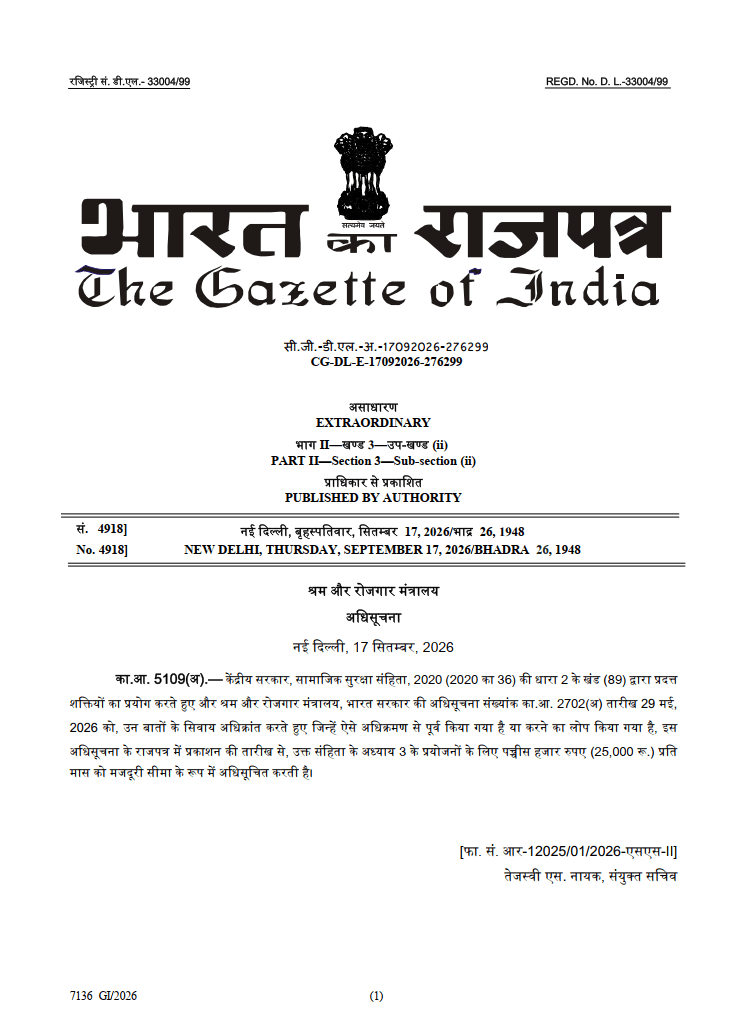

This is not the old EPF Act with a new number. The Code on Social Security, 2020 brought with it a fundamentally different definition of “wages” under Section 2(88), an anti-avoidance mechanism, and a pension formula that averages the last 60 months of service. Each of these interacts with the ₹25,000 ceiling in ways that demand attention before you finalise a single payroll cycle.
The Wages Definition Is Not Basic Pay Plus DA Anymore
The old EPF Act framed contributions around basic wages plus dearness allowance. That framing is history.
Under Section 2(88) of the Code, wages means all remuneration by way of salaries, allowances, or otherwise. It includes basic pay, dearness allowance, and retaining allowance if any. It excludes statutory bonus, house accommodation value, employer PF contributions, conveyance allowance, house rent allowance, overtime, commission, gratuity, and retrenchment benefits.
The proviso is where the trap sits. If excluded payments exceed one-half of total remuneration, the excess is deemed remuneration and added back to wages.
What this means practically: you cannot keep wages below ₹25,000 by inflating HRA or conveyance beyond 50% of the package. If excluded allowances cross that line, the excess is added back. The ₹25,000 threshold is tested against restructured wages, not the label on the salary slip.
The ESIC has already issued circulars confirming that this harmonised wages definition and the 50% add-back apply across social security contributions. Employers who built salary structures around the old definitions need to revisit them now.
Your EPS Pension Does Not Jump to ₹25,000 Immediately
The EPS formula is unchanged: Monthly Pension = (Pensionable Salary × Pensionable Service) ÷ 70.
Pensionable salary is the average monthly salary drawn in the last 60 months before exiting the pension fund. This is where expectations need managing.
The ceiling took effect on 17 September 2026. An employee retiring in late 2026 will have a pensionable salary average calculated almost entirely at the old ₹15,000 cap, with only days or weeks at the new ceiling. The blended average will not be close to ₹25,000.
The full ₹25,000 average is only realised by someone who spends the entire 60 months before retirement under the new ceiling. The earliest that becomes possible is September 2031.
The 67% pension increase figure circulating in some reports is a theoretical maximum for a full five-year service period at the new ceiling. It is not an immediate outcome for current retirees.
CTC Take-Home Shock Can Be Twice the Headline Number
The conventional math says employee contribution rises from ₹1,800 to ₹3,000 monthly, a ₹1,200 hit to take-home.
But in most private sector contracts structured on Cost-to-Company basis, the employer’s matching contribution is carved from the employee’s gross compensation basket. The CTC is fixed. The employer’s PF share comes from within it.
If the employer’s contribution also rises by ₹1,200 and is absorbed within the existing CTC, take-home can fall by up to ₹2,400 monthly. Financial advisers have flagged this explicitly: in a fixed-CTC structure, if the employer’s higher contribution is accommodated within the existing CTC, the employee’s take-home could fall by another ₹1,200.
This is not an edge case. Fixed CTC structures are standard across a large share of private sector employment. Employees in the ₹15,000 to ₹25,000 band entering mandatory coverage for the first time will feel this most acutely.
September Payroll: Process It, Document It, Adjust If Needed
The notification is effective from the date of publication, 17 September 2026. That is mid-month.
This raises an operational question. Should September contributions be calculated pro-rata, with 16 days at ₹15,000 and 14 days at ₹25,000? Or does the new ceiling apply to the full wage month, or only from October 2026?
The gazette notification does not answer this. It simply states the ceiling takes effect from the date of publication.
The practical approach is not to halt payroll. Salaries must be paid on time, and statutory dues have fixed due dates. Instead, employers should calculate September contributions on a reasonable, documented basis, keep the working papers, and be ready to adjust any difference in the following cycle once the Central Provident Fund Commissioner issues an administrative circular clarifying the method. Payroll teams should watch for that circular, as it will settle whether September is treated pro-rata or from October. Calculating on a defensible basis and documenting it is a far smaller risk than delaying salaries or remittances.
The Once-a-Member Rule: Excluded Employees Must Now Be Enrolled
Under the old framework, an employee who joined at a wage above ₹15,000 could be treated as an excluded employee, not mandatorily covered.
Those employees, now earning between ₹15,001 and ₹25,000, must be mandatorily enrolled under the new ceiling. Their exclusion status does not carry forward.
Employers need to audit their workforce for anyone in that band previously classified as excluded. For each, a Universal Account Number must be generated, and contributions must commence.
The government’s estimate of 51 lakh additional covered employees reflects this population. For employers with many workers in the ₹15,000 to ₹25,000 range, this is a structural compliance change, not a marginal adjustment.
EDLI: The Formula Works, But the Amendment Is Still Pending
The EDLI calculation under the existing framework uses 35 times the wage ceiling plus 50% of the average EPF balance over the preceding 12 months, capped at ₹1.75 lakh.
Applying that to ₹25,000 gives (₹25,000 × 35) + ₹1.75 lakh = ₹10.50 lakh.
That is the arithmetic. But the Central Government must formally notify the corresponding maximum benefit amendment in the EDLI Scheme schedule for the higher cap to become operational. The formula extrapolation is accurate, but the legal instrument making the enhanced benefit effective is still awaited.
Treat the ₹10.50 lakh figure as projected, not current, until the amendment is notified.
What Employers Should Do Now
Review CTC structures. Audit all contracts in the ₹15,000 to ₹25,000 band to determine whether the increased employer contribution is absorbed by the company or deducted from employee gross allowances. The answer shapes employee communication and potential contractual disputes.
Audit excluded employees. Identify all staff earning between ₹15,001 and ₹25,000 previously classified as excluded. Generate UANs and commence contributions without waiting for further clarification.
Process September payroll on time with documented calculations. Do not delay salaries or remittances. Calculate September contributions on a reasonable basis, retain the working papers, and adjust any difference once the CPFC circular on proration is issued.
Recheck salary structuring against Section 2(88). If excluded allowances exceed 50% of total remuneration, the add-back rule pushes wages higher than the label suggests. Test the ₹25,000 threshold against deconstructed wages, not gross salary.
Communicate the EPS reality to retiring employees. Anyone retiring in the next five years will have a blended pensionable salary average. Do not let them expect an immediate ₹25,000-based pension.
The Bottom Line
The ₹25,000 ceiling is real, and its contribution impact is immediate. But the Code’s wage definition, the EPS 60-month averaging, the CTC absorption question, and the September proration question are the details that determine whether implementation is smooth or painful.
The notification answers the what. The how is still being written. Process payroll on time, document your reasoning, and stay ready to adjust.
Disclaimer: This article is for informational and educational purposes only. It does not constitute legal advice, compliance guidance, tax advice, or financial advice. The interpretation of statutory provisions and their application to specific establishments or employees depends on individual facts and circumstances. Employers and employees should consult qualified legal, tax, or compliance professionals before taking any action based on this content. The author and publisher disclaim any liability arising from reliance on the information presented here.