 Total Visitors
  Online Users
  Today
Today  Yesterday

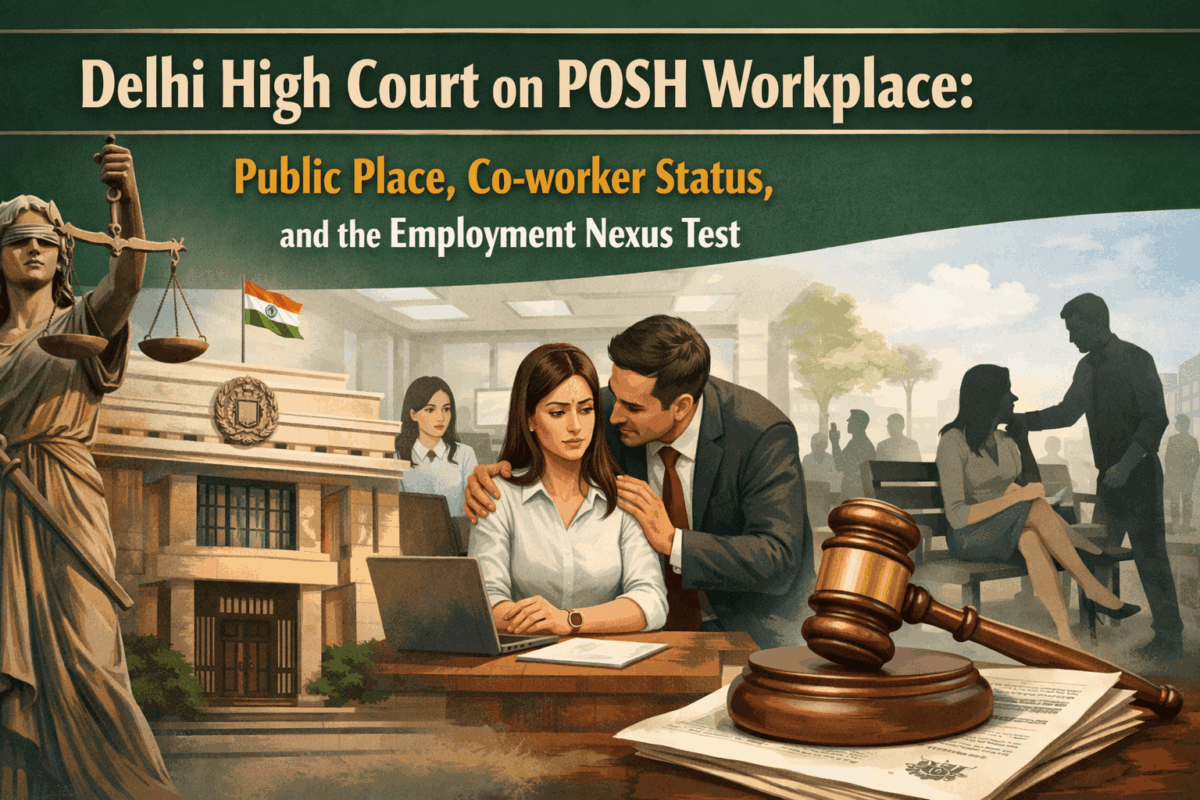
Can a public bus stand be considered a “workplace” under the POSH Act if an incident occurs before duty hours? The Delhi High Court, in a significant ruling, has clarified that a public place does not transform into a workplace merely because both individuals are co-workers. There must be a demonstrable connection between the incident and the complainant’s employment.
This blog delves into the Delhi High Court’s decision in Ms. Sunita v. Jai Prakash Narayan Apex Trauma Centre, AIIMS & Anr., exploring the critical distinction between a purely private interaction and an employment-related incident under the POSH Act.
Case Snapshot
| Particulars | Details |
| Case Name | Ms. Sunita v. Jai Prakash Narayan Apex Trauma Centre, AIIMS & Anr. |
| Court | Delhi High Court |
| Case No. | W.P.(C) 4562/2023 & CM App. 17376/2023 |
| Decision Date | 29 April 2026 |
| Judge | Hon’ble Justice Purushaindra Kumar Kaurav |
| Outcome | Writ petition dismissed |
Facts in Brief
Ms. Sunita was engaged through M/s Swati Securities Pvt. Ltd. and deployed at Jai Prakash Narayan Apex Trauma Centre, AIIMS. She was also employed by the same contractor. The alleged incident occurred on 27 May 2021, at approximately 1:45 p.m., at Safdarjung Bus Stand. Her duty was scheduled to begin at 2:00 p.m. She subsequently filed a complaint and sought a direction for the continuation of an Internal Committee under the POSH Act.
The Central Legal Issue
The core question before the Court was: Can a public bus stand be treated as a workplace under Section 2(o) of the POSH Act when the alleged incident occurred before duty hours and during a personal trip?
The Court’s Reasoning: The “POSH Workplace Nexus” Test
The Court refused to grant POSH jurisdiction, applying a test of “POSH workplace nexus”. The key factors considered were:
- Proximity to the formal workplace: The bus stand was geographically separate from the hospital.
- Control exercised by the employer: The employer had no control over the bus stand.
- Whether the place was an extension of the work environment: The bus stand failed to qualify as an extension of the workplace.
Since Ms. Sunita was not on duty at the time, was traveling for a personal purpose, and the location was not employer-controlled, the Court ruled that the POSH Act did not apply.
The Decisive Factor: Employment Nexus
The decisive factor is whether the place was visited in the course of employment or under employer control. Mere co-worker presence does not suffice. The case turned on the lack of an employment nexus; not on the complainant’s status as a contract worker.
Relevant Law: Understanding “Workplace” under the POSH Act
The definition of “workplace” under Section 2(o) of the POSH Act is expansive. It includes:
- Any department, organization, or establishment owned or controlled by the Government.
- Private sector organizations.
- Hospitals, nursing homes, and sports institutes.
- “Any place visited by the employee arising out of or during the course of employment including transportation by the employer for undertaking such journey.”
The Supreme Court has also held that the definition of “workplace” is wide and does not require the respondent to be an employee of the same workplace as the aggrieved. The critical factor is whether the place was visited in the course of employment.
What This Judgment Does Not Mean
This ruling does not imply that POSH applies only within office premises. It also does not exclude outsourced or contract workers from the Act’s purview. The judgment does not bar criminal remedies, nor does it justify arbitrary termination. It simply reinforces that the nexus to employment is paramount.
Practical HR / IC Checklist [FREE]
For Internal Committees and HR professionals, this judgment provides a clear framework for assessing POSH workplace nexus:
- Review and document the complaint: Obtain all facts in writing.
- Examine employment nexus: Determine if the incident occurred during work hours, during official travel, or at an employer-sponsored event.
- Check official purpose: Verify if the employee was on official duty or travelling for a personal reason.
- Assess employer involvement: Determine if the employer had control over the location or the circumstances.
- Avoid retaliatory action: Ensure no adverse action is taken against the complainant.
- Document reasons for declining jurisdiction: Record reasons to ensure transparency and avoid challenge.
- Provide reasoned justification: If jurisdiction is declined, issue a reasoned order.
Likely Within POSH Jurisdiction?
The following scenarios generally fall under POSH purview:
- Employer-provided transport
- Official travel or training
- Client premises during work
- Employer-sponsored office parties
Conversely, a purely private co-worker dispute in a public place, immediately before or after a shift, without any employment nexus, may not be covered.
Final Proportion
The POSH Act can follow employment beyond the physical office, but it does not follow co-workers into every purely private interaction. The decisive factor is the nexus between the alleged conduct and employment.
Disclaimer: The information provided in this article is for general informational and educational purposes only and does not constitute legal advice. While every effort has been made to ensure the accuracy of the information, the provisions of the POSH Act, 2013, and judicial interpretations are subject to official amendments and case-specific applications. Employers, institutions, and individuals are strongly advised to consult qualified legal professionals for specific guidance tailored to their circumstances. We do not accept any liability for any loss, damage, or legal consequence incurred as a result of reliance on the information contained herein.