

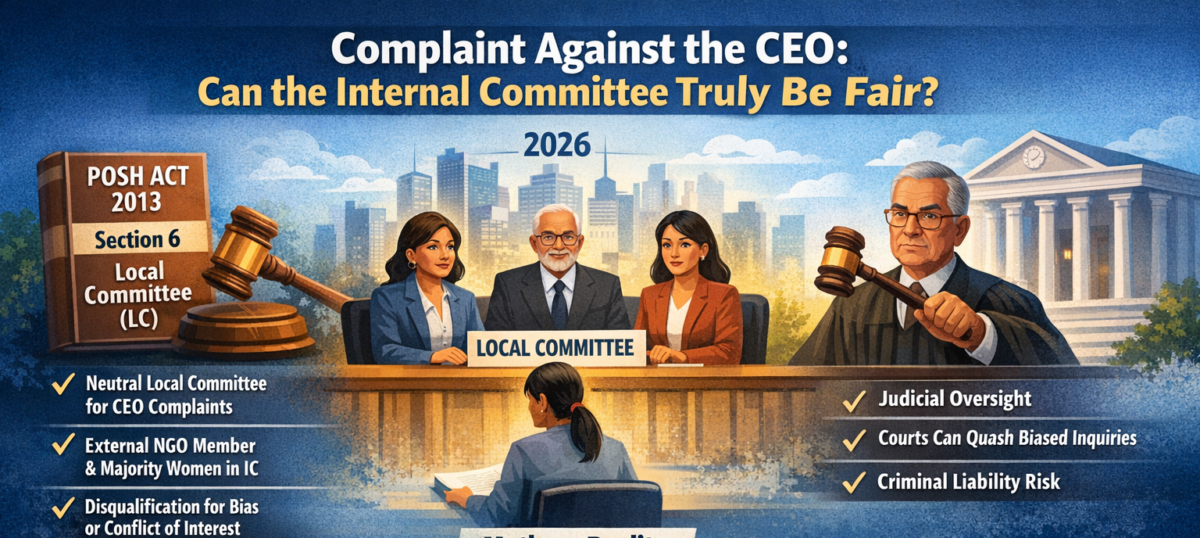
In the corporate world of 2026, where ESG and workplace culture are under scrutiny, a biased Internal Committee (IC) is not just a legal risk, it’s reputational suicide. The law provides specific safeguards and bypass mechanisms for this scenario.
1. The Legal “Escape Hatch”: The Local Committee (LC)
- POSH Act, 2013 – Section 6: If the complaint is against the “employer” (CEO, MD, or owner), jurisdiction shifts to the Local Committee (LC) constituted by the District Officer.
- Employer Definition: Courts interpret the CEO or highest-ranking official as the “employer.”
- Key Point: Employees are not forced to complain to subordinates of the accused. The LC provides an external, neutral forum.
2. Statutory Protections Against Bias in the IC
- External Member Requirement: Section 4(2)(c) mandates one NGO/association member committed to women’s causes.
- Gender Balance: Section 4(2)(b) requires the Presiding Officer and at least two members to be women.
- Removal of Members: Section 4(5) allows disqualification of IC members for bias, conflict of interest, or abuse of position.
- Safeguard: These provisions reduce executive influence, though effectiveness depends on enforcement.
3. Judicial Oversight in 2026
- Supreme Court – Aureliano Fernandes v. State of Goa (2023): IC inquiries must be independent; sham inquiries can be quashed.
- High Court Powers: Under Article 226, biased IC reports can be struck down.
- Criminal Liability: If IC findings are quashed, allegations may escalate to criminal investigation under Section 354A of the Bharatiya Nyaya Sanhita (BNS).
- Corporate Risk: For CEOs, a quashed IC report is both a legal and reputational disaster.
Myth vs Reality
| Myth | Reality |
| You must complain only to the IC. | Complaints against the employer go to the Local Committee (LC) under Section 6 POSH Act. |
| The IC is always controlled by management. | Law mandates external NGO members and majority women composition to curb bias. |
| IC members cannot be removed. | Section 4(5) allows disqualification for bias or abuse of position. |
| IC reports are final. | Courts can quash biased inquiries; criminal law may then apply. |
Legal References Appendix
| Law / Case | Section / Rule | Principle Established | Application to Blog |
| POSH Act, 2013 | Section 6 | Complaints against the employer go to the Local Committee (LC). | Employees can bypass the IC if the accused is the employer. |
| POSH Act, 2013 | Section 4(2)(b) & (c) | IC must include majority women and one external NGO member. | Ensures gender balance and external oversight. |
| POSH Act, 2013 | Section 4(5) | IC members can be disqualified for bias or abuse of position. | Provides statutory safeguard against compromised inquiries. |
| Aureliano Fernandes v. State of Goa (2023, Supreme Court) | Judicial precedent | IC inquiries must be independent; sham inquiries can be quashed. | Courts can strike down biased IC reports. |
| Bharatiya Nyaya Sanhita (BNS), 2023 | Section 75 | Defines sexual harassment as a criminal offence. | If IC reports are quashed, allegations may escalate to criminal investigation. |
FREE – Quick Compliance Checklist (Employee Guide)
When the Accused is the CEO/MD/Owner
- File with the Local Committee (LC): Submit your complaint directly to the LC under Section 6 POSH Act.
- Document Communications: Keep written records of complaints, emails, and evidence.
- Check IC Composition: Ensure the IC includes an external NGO member and majority women.
- Challenge Bias: Request disqualification of biased IC members under Section 4(5).
- Judicial Oversight: Approach the High Court under Article 226 if the IC inquiry is compromised.
- Escalation to Criminal Law: Be prepared for parallel criminal proceedings under Section 75 BNS if IC reports are quashed.
Bottom Line
- POSH Act provides a bypass: Complaints against CEOs/MDs can go directly to the LC.
- IC safeguards exist: External NGO member, majority women, and disqualification provisions reduce bias.
- Judicial oversight is strong: Sham inquiries can be quashed, escalating matters to criminal law.
- Corporate governance risk: A biased IC is not just illegal—it’s reputational suicide in the ESG era.
Disclaimer:
This content is for educational and informational purposes only and does not constitute legal advice. POSH proceedings are highly sensitive and case-specific. For guidance on a specific matter, please consult a POSH-certified legal practitioner or an Advocate.