 Total Visitors
  Online Users
  Today
Today  Yesterday

The Context
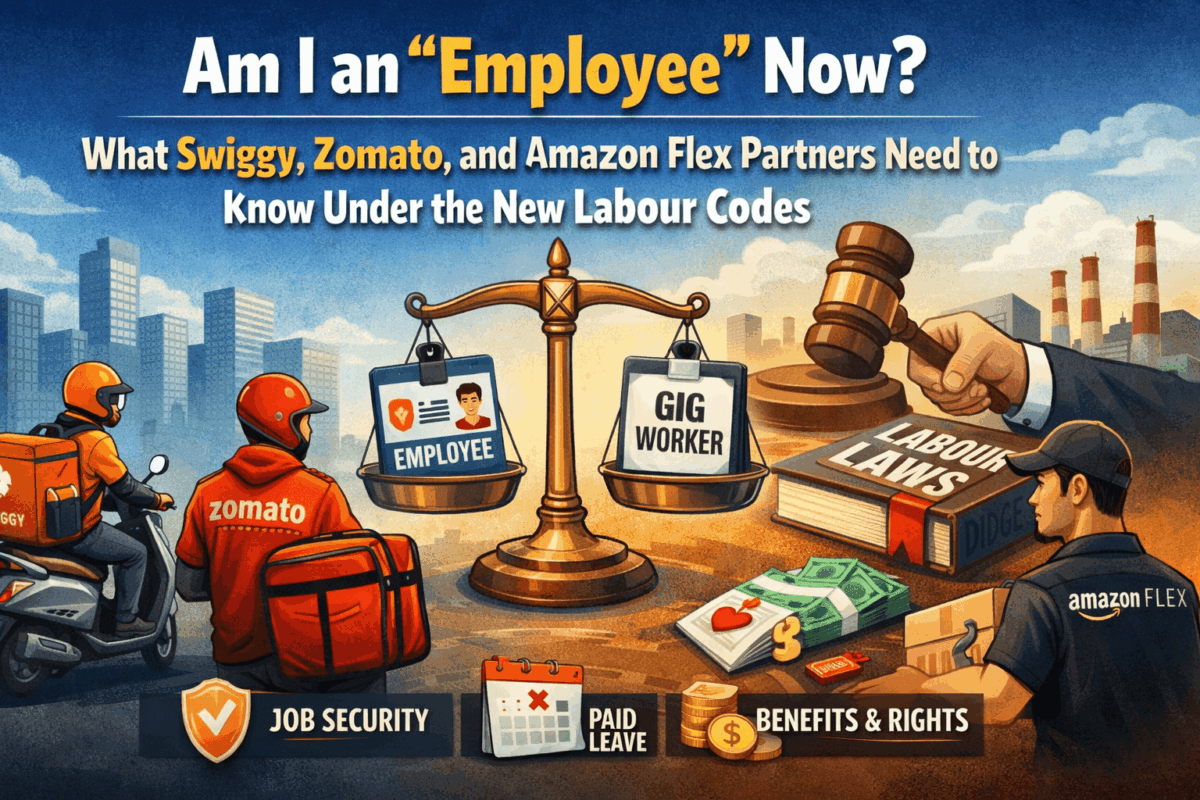
Delivery partners and freelancers have long operated outside India’s formal labour law framework without health insurance, accident cover, or pension benefits. With the Code on Social Security, 2020 (effective 21 November 2025), gig and platform workers are formally recognised for the first time.
The key question, however, remains: does this new recognition make gig workers “employees”?
1. The Legal Verdict: Employee vs. Gig Worker
Answer: No — gig workers are NOT classified as traditional employees.
The Code deliberately creates a distinct legal category to preserve flexibility while extending protections.
| Employee | Gig / Platform Worker | |
| Definition under Code | Someone in a direct employer‑employee relationship with fixed hours, wages, and restrictions on outside work | A person who earns from work arrangements outside a traditional employment relationship, typically through digital platforms or aggregators |
| Legal Source | Traditional labour statutes | Section 2(35) and Section 2(61) of the Code on Social Security, 2020 |
| Key distinction | Employer exercises control over how, when, and where work is performed | Worker retains flexibility to choose assignments and work across multiple platforms |
India has joined a small but growing group of nations including Spain, Portugal, and Canada that have created a “third category” of worker, distinct from both traditional employees and independent contractors.
2. What Gig Workers Actually Get
The Code mandates social security benefits funded by aggregators (Swiggy, Zomato, Amazon, Uber, Ola, etc.). These provisions are now backed by final, enforceable central rules notified in May 2026.
The Aggregator Contribution Fund (Section 114)
Aggregators must contribute to a Social Security Fund:
| Component | Details |
| Contribution rate | Between 1% and 2% of annual turnover |
| Capped at | 5% of the total amount paid or payable to gig and platform workers in that financial year |
| Effective contribution | The lower of the two calculations applies |
Important ambiguity: The Code does not currently define what constitutes “turnover” whether Gross Merchandise Value (GMV), net realised value, or recognised revenue; creating a live compliance challenge for aggregators.
Benefits covered include:
- Life and disability cover
- Accident insurance
- Health and maternity benefits
- Old‑age protection schemes
- Access to Ayushman Bharat‑PMJAY healthcare benefits (announced in Budget 2025-26)
3. The Final Eligibility Rules
Eligibility is now final under the central rules notified in the first week of May 2026.
| Eligibility Criteria | Details |
| Minimum age | At least 16 years |
| Maximum age | Eligibility ceases at 60 years or when no longer engaged as a gig/platform worker |
| Single aggregator | Worked for not less than 90 days in the previous financial year |
| Multiple aggregators | Not less than 120 days cumulatively across all platforms in the previous financial year |
| Definition of “day” | Counts if any income was earned on that platform within a 24‑hour period |
| Counting multiple aggregators on the same day | Work done for more than one aggregator on the same day counts as multiple working days |
Important: If a worker does not meet the minimum days requirement in a financial year, they cease to be eligible for social security benefits for the subsequent period.
4. Registration: e‑Shram Portal with UAN
All gig and platform workers must register on the e‑Shram portal (eshram.gov.in), which provides a Universal Account Number (UAN) linked to Aadhaar.
Key developments:
| Aspect | Details |
| Aggregator module | Launched on 12 December 2024 for registration of aggregators and platform workers |
| Aggregators onboarded (12 major platforms) | Zomato, Blinkit, Uncle Delivery, Urban Company, Uber, Amazon, Ola, Swiggy, Ecom Express, Rapido, Zepto, Porter |
| Registration status | Workers can self‑register; benefits are portable across platforms |
| Interoperability | Integration with Ayushman Bharat‑PMJAY for healthcare benefits |
5. Compliance Challenges for Aggregators (May 2026 Final Rules)
Deadlines & Penalties
| Requirement | Details | Source |
| 45‑day upload deadline | All aggregators must upload details of every gig worker engaged with them onto the central government portal within 45 days of the May 2026 notification | Central Rules (May 2026) |
| Real‑time / daily registration | New appointments and exits must be recorded on a real‑time or daily basis (not quarterly) | Central Rules (May 2026) |
| 12% annual interest penalty | 1% per month on any delayed social security contribution, accruing from the due date until actual payment | Section 114(4) read with final rules |
Additional Compliance Obligations
- Real‑time data reporting to government systems for benefit eligibility tracking.
- Deduction of contributions from annual turnover — though “turnover” remains undefined, creating ambiguity.
- Liaison with the National Social Security Board for scheme rollout.
- Extending coverage to all gig workers engaged directly or through associate companies, holding companies, subsidiaries, LLPs, or third parties.
Employers that fail to pay contributions on time face 1% monthly interest until the full amount is paid; which can quickly escalate into significant financial liability.
6. Karnataka’s Parallel State Law (For Aggregators Operating in Karnataka)
Aggregators operating in Karnataka face an additional compliance layer. The Karnataka Platform‑Based Gig Workers (Social Security and Welfare) Act, 2025, notified in October 2025, mandates:
| Provision | Details |
| Welfare fee | 1% to 5% of each transaction payout to gig workers, payable by aggregators |
| Welfare Board | A dedicated Board to govern implementation |
| Social Security and Welfare Fund | Separately financed from the central fund |
Aggregators operating in Karnataka must comply with both the central rules under the Code on Social Security, 2020 and the state‑specific Karnataka Act, potentially facing dual contribution obligations.
7. Enforcement & Penalties Beyond Interest
Under Section 113(5) of the Code, aggregators failing to register workers or make required contributions may face:
- Fines for first‑time contraventions
- In serious or repeat cases, cancellation of their operating licence
The Code also establishes graded penalties for failures such as non‑registration, non‑payment of contributions, incorrect statements, obstruction of inspectors, and misuse of funds.
Final Thoughts
Gig and platform workers in India are not employees under the new Labour Codes but they are no longer invisible.
For the first time, India has created a formal legal framework recognising gig work as a distinct category, with:
- Mandatory social security contributions from aggregators (1‑2% of turnover, capped at 5% of payouts)
- Final eligibility thresholds (90 days single aggregator / 120 days multiple aggregators)
- Portable benefits via e‑Shram UAN
- Enforceable compliance deadlines — 45‑day upload window, real‑time registration, 12% annual interest penalty for delays
The central rules notified in May 2026 have now given legal teeth to a framework that was, for years, only a proposal. Aggregators must act immediately; the 45‑day deadline is already running, and non‑compliance carries significant financial penalties.
- For Aggregators: Audit your gig worker database, integrate real‑time reporting systems, and calculate your contribution liability (1‑2% of turnover vs. 5% of payouts — whichever is lower).
- For Gig Workers: Register on the e‑Shram portal to obtain your UAN. Track your working days carefully — eligibility for benefits depends on meeting the 90‑day / 120‑day thresholds each financial year.
Disclaimer: This article is for informational purposes only and does not constitute legal advice. State laws (including the Karnataka Gig Workers Act) may impose additional obligations. Aggregators and workers should consult a qualified legal professional for specific compliance or enforcement matters.