 Total Visitors
  Online Users
  Today
Today  Yesterday

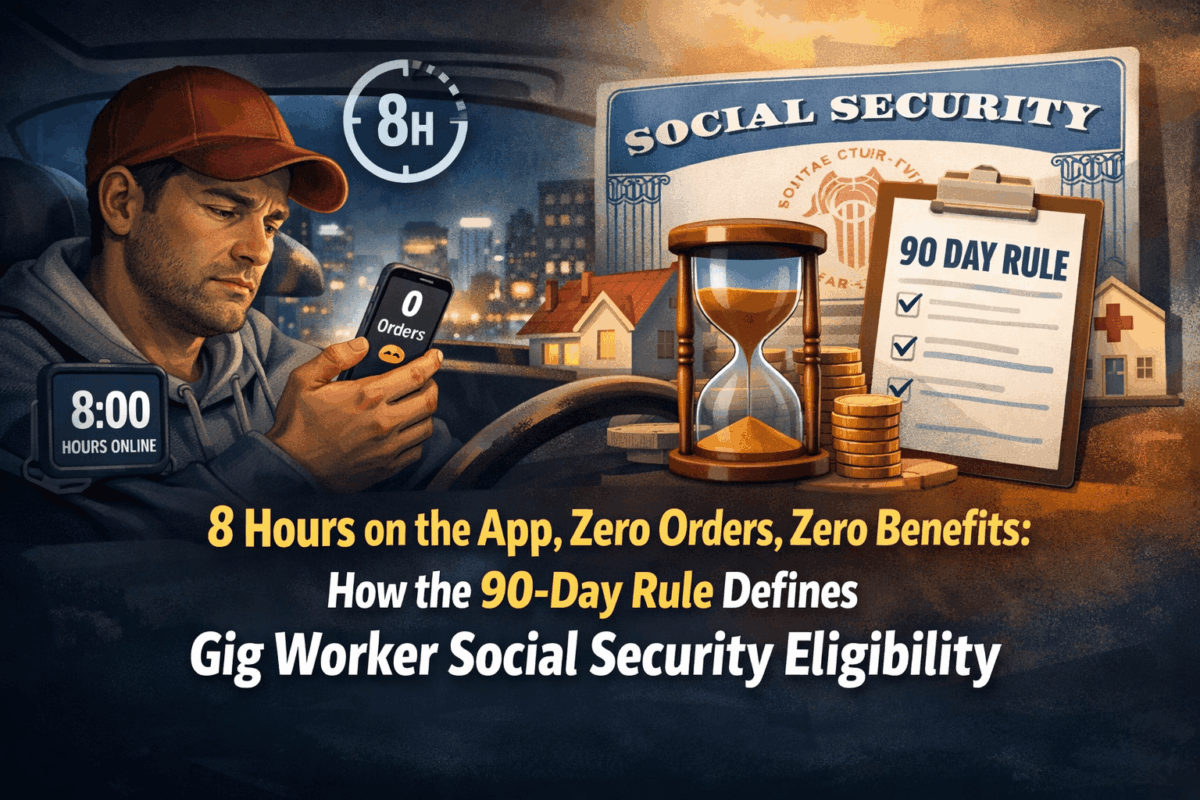
You logged into Swiggy at 7 AM. You drove around, parked near busy restaurants, kept the app active, waited for pings. At 3 PM, you gave up. Zero orders. Zero earnings.
Under the newly notified rules of the Code on Social Security, 2020, that day never happened. Not for your eligibility count. Not for your social security.
The government has finally brought gig and platform workers into India’s social security framework. The Code on Social Security, 2020, was notified on November 21, 2025. The draft rules were pre-published on December 31, 2025. Aggregators like Swiggy, Zomato, Uber, Ola, and Flipkart are now required to contribute 1-2 percent of annual turnover towards a welfare fund.
But there is a catch. A big one.
To qualify for benefits viz. accident insurance, health cover, disability protection, old-age security; you need to complete at least 90 days of engagement with a single aggregator in a financial year. If you work across multiple platforms, the threshold rises to 120 days cumulatively.
The problem is how the rules define “engagement.”
What Counts as a Day of Engagement?
The draft rules are brutally clear. A gig worker or platform worker is considered “engaged” on any calendar day only if they earn income on that day, irrespective of the amount.
Not if you logged in. Not if you waited for eight hours. Not if you were available. Only if you earned something.
If a worker is associated with multiple aggregators, the days are added cumulatively. Engage with three platforms on the same day and earn income on all three? That counts as three days.
The rule uses the word “engaged” deliberately. Ashima Sharma, assistant professor at the School of Law, BML Munjal University, explains: “A worker can be treated as engaged on any calendar day if they can earn any amount on the said day, irrespective of the number of orders or rides they complete. Therefore, on days where a worker is not able to earn any amount of money, that day is not counted towards the ninety days, even if they log into an aggregator’s application and keep waiting for a task or ride.”
This is the exact scenario you described. Eight hours logged in. Zero orders. Zero income. Zero counting.
The Algorithm Problem
Here is where the system starts to feel rigged.
Platform earnings depend on algorithmic allocation, demand patterns, and platform-side controls. A worker may be logged in for several hours, waiting for an assignment, but receive very few active gigs because the algorithm favours someone else. The worker is available. The worker is ready. The worker is just not “engaged” in the eyes of the law.
Ajay Trehan, founder and CEO of AuthBridge, puts it honestly: “A worker may be logged in for several hours, waiting for an assignment, but may receive very few active gigs because of algorithmic allocation, demand patterns, or platform-side controls. If only completed tasks are counted, the burden shifts unfairly to the worker for factors entirely outside their control.“
Seasonal workers, casual workers, and women taking maternity breaks or balancing caregiving responsibilities are disproportionately affected. A woman who takes two months off for childbirth may struggle to hit 90 days. A student who works during holidays may fall short. A worker who falls ill for a week loses those days permanently.
The rules also create practical verification problems. Debjani Aich, partner at CMS INDUSLAW, points to “the absence of a central recording module for capturing days worked with different aggregators.” If you work for Swiggy, Zomato, and Uber in the same week, who tracks your cumulative days? How do you prove you crossed 120 days across platforms when each aggregator maintains its own records?
The Aggregator Obligation
Under the rules, every aggregator must electronically share details of engaged gig workers on the designated central portal either quarterly or at such other periodicity as specified. In the absence of such updation, a gig worker may not be eligible to avail benefits.
The government directed platforms to register their gig workforce on the e-Shram portal, with a June 21, 2026 deadline. Major aggregators including Swiggy, Zomato, Uber, Ola, Rapido, Blinkit, and Zepto have been directed to complete their e-Shram portal onboarding and API integration. Several major platform operators have already completed the process. Aggregators who failed to meet the deadline face penal action under Section 133 of the Social Security Code.
But registration alone doesn’t guarantee eligibility. You still need the 90 days.
The 90-Day Math
Let us do the math for a typical Swiggy delivery partner.
Assume you work 6 days a week. You need 90 earning days in a financial year. That means you need to earn something on 90 separate calendar days. A single rupee counts. The amount doesn’t matter. But you must earn something.
If you have a slow week for e.g. three days with zero orders then those three days disappear from your count. You now need to make up those days elsewhere. If demand dips during certain months, your count stalls.
If you work across multiple platforms, you need 120 earning days cumulatively. Work one day for Swiggy, one day for Zomato, one day for Uber? That is three days toward your 120.
The rules also clarify that if a worker is engaged with three aggregators on a particular calendar day, this counts as three days. This creates an incentive to multi-home, but also increases the administrative burden of tracking.
The Welfare Fund and What You Actually Get
Aggregators must contribute 1-2 percent of annual turnover to a welfare fund. The fund supports life and disability cover, accident insurance, health and maternity benefits, and old-age protection.
The government is also setting up a Social Security Fund for formulating schemes for unorganised workers, gig workers, and platform workers.
But here is the uncomfortable question. If the 90-day threshold excludes a large number of workers, who actually benefits? Experts describe the framework as “an important first step” but acknowledge “major gaps around eligibility, income protection, and arbitrary account deactivation that could keep a large section of workers outside the system.”
What This Means for Workers
If you logged into Swiggy for 8 hours and received no orders, that day does not count toward your 90-day eligibility. Period.
The rule does not care about availability. It does not care about effort. It does not care about algorithmic unfairness. It cares about one thing: did you earn income on that calendar day?
This creates a fundamental unfairness. Workers are penalised for factors entirely outside their control. Low demand, algorithmic allocation, platform-side decisions; none of these are the worker’s fault. Yet the worker bears the cost in lost eligibility days.
The rules also require Aadhaar-based registration for all gig workers who have completed 16 years of age. Without registration on the designated portal, you cannot access benefits even if you hit the 90-day threshold.
What Needs to Change
Legal experts and worker unions have raised concerns. The Indian Federation of App-Based Transport Workers (IFAT) has called for aggregators to act responsibly and comply with the law without further delays. Unions have warned that the draft rules may exclude the majority of gig workers.
The government has invited objections and suggestions from stakeholders for a period of 30 to 45 days. These inputs will be reviewed before the rules are finalised.
Some have suggested that “engagement” should be redefined to include active login hours, not just earning days. Others have proposed a lower threshold or a pro-rata system that credits partial days for waiting time.
For now, the rule stands. No income, no engagement. No engagement, no benefits.
Your Checklist [FREE]
If you are a gig worker or platform worker:
- Register on the e-Shram portal with Aadhaar
- Track every day you earn income, no matter how small
- If you work across multiple platforms, track cumulative days across all aggregators
- Ensure your aggregator updates your details on the central portal quarterly
- Check your eligibility before the end of the financial year.
If you are an aggregator:
- Complete e-Shram portal onboarding (deadline was June 21, 2026)
- Share worker details electronically on the designated portal quarterly
- Report all new onboardings and exits on a real-time or daily basis
- Contribute 1-2 percent of annual turnover to the welfare fund
- Failure to comply invites penal action under the Social Security Code.
The Bottom Line
The Social Security Code, 2020, is a historic step. For the first time, India has assigned aggregators financial responsibility for worker welfare. But the eligibility rules create a new problem. Workers who are available but not earning are invisible to the system.
Eight hours logged in, waiting for orders, with nothing to show for it. That day does not count. That effort does not count. That worker does not qualify.
The framework is a foundation, not a culmination. The question is whether the foundation will be broad enough to include the workers it was meant to protect.
Disclaimer: This content is provided for educational and informational purposes only. It is based on available Central notifications, rules, and draft rules as of July 2026, including the Code on Social Security, 2020 (notified 21 November 2025), the Code on Social Security (Central) Rules, 2025 (pre-published 31 December 2025), and subsequent media reports including Forbes India (18 May 2026). Expert quotes are attributed to their respective sources and are reproduced accurately from public reports. The draft rules are subject to stakeholder consultation and may be modified before final notification. Labour being a concurrent subject under the Indian Constitution, State-specific rules and notifications may impose additional or different obligations. This material does not constitute formal legal advice, nor does it create a lawyer-client relationship. Readers are strongly advised to consult qualified legal counsel for advice tailored to their specific factual circumstances. Laws, rules, and judicial interpretations are subject to change, and the information herein should not be relied upon as a substitute for professional legal guidance.