 Total Visitors
  Online Users
  Today
Today  Yesterday

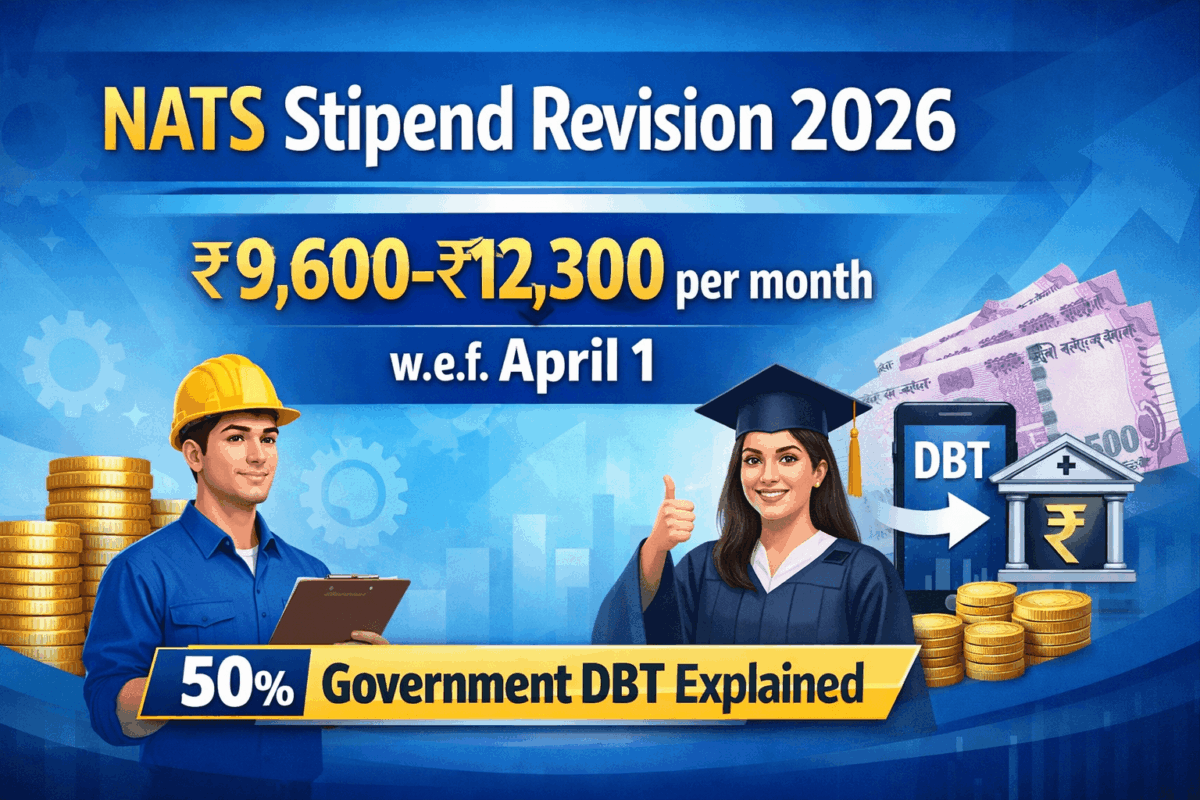
The Board of Apprenticeship Training (Western Region), Mumbai, has issued a crucial circular (No. BOAT WR/2026/529 dated May 13, 2026) implementing revised minimum prescribed stipend rates under the National Apprenticeship Training Scheme (NATS). The revision takes effect retrospectively from April 1, 2026.
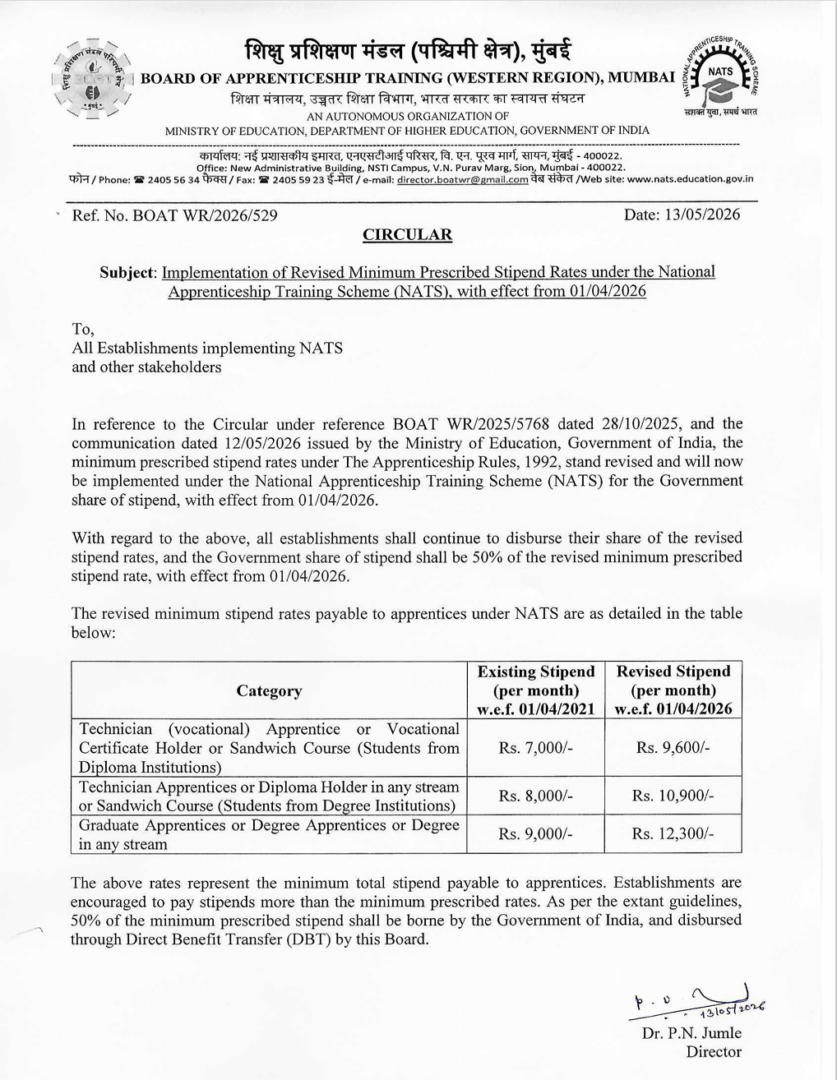
This update directly impacts all establishments hiring apprentices under NATS, as well as the stipend amounts that graduate, diploma, and vocational certificate holders will receive. Below, we break down the new rates, the government’s 50% share via Direct Benefit Transfer (DBT), and what employers must do to stay compliant.
Part 1: What Has Changed – The New Stipend Rates
The circular supersedes the previous rates effective from April 1, 2021. The revised minimum total stipend payable per month (establishment + government share) is:
| Category | Existing Stipend (₹/month) w.e.f. 01/04/2021 | Revised Stipend (₹/month) w.e.f. 01/04/2026 |
| Technician (Vocational) Apprentice – Vocational Certificate Holder or Sandwich Course (students from Diploma Institutions) | ₹7,000 | ₹9,600 |
| Technician Apprentice – Diploma Holder in any stream or Sandwich Course (students from Degree Institutions) | ₹8,000 | ₹10,900 |
| Graduate Apprentice – Degree Apprentice or Degree in any stream | ₹9,000 | ₹12,300 |
Key observations:
- The increase ranges from ₹2,600 to ₹3,300 per month depending on the category.
- The rates are minimum prescribed amounts. Establishments are encouraged to pay stipends higher than these minima.
Part 2: How the Stipend Is Split – 50% Government DBT
Under the existing NATS guidelines, the total minimum stipend is shared equally:
- 50% borne by the Government of India (disbursed through Direct Benefit Transfer – DBT by the Board).
- 50% borne by the establishment (employer).
The circular explicitly states that establishments shall continue to disburse their share of the revised stipend rates, while the government share (50% of the revised minimum prescribed rate) will be credited directly to apprentices’ bank accounts via DBT.
Example for a Graduate Apprentice:
- Total revised minimum stipend: ₹12,300/month
- Employer’s share (50%): ₹6,150/month
- Government’s DBT share (50%): ₹6,150/month
Part 3: Legal Basis – Apprenticeship Rules, 1992 & NATS
The revision is issued under The Apprenticeship Rules, 1992, which govern the National Apprenticeship Training Scheme. The circular references:
- Previous circular BOAT WR/2025/5768 dated October 28, 2025.
- A communication dated May 12, 2026, from the Ministry of Education, Department of Higher Education, Government of India.
The stipend revision is effective from April 1, 2026, meaning any apprenticeship agreement entered into or ongoing from that date must comply with the new minimum rates.
Part 4: Employer Compliance Obligations
All establishments implementing NATS must take the following steps immediately:
- Update stipend payout structures for all existing and new apprentices effective April 1, 2026. Arrears for the period April 1, 2026, to the date of implementation must be calculated and paid.
- Continue to pay your 50% share of the revised minimum stipend. The government’s DBT portion does not reduce your obligation – it only reimburses the government’s contribution directly to the apprentice.
- Ensure your establishment’s share is disbursed on time (monthly, as per apprenticeship agreement). Delays can attract penalties under the Apprenticeship Rules.
- Verify DBT linkage – apprentices must have active, Aadhaar‑seeded bank accounts to receive the government’s 50% share. The Board will disburse via DBT; employers should facilitate account verification.
- Document the higher stipend if you choose to pay above the minimum – this is permitted and encouraged, but ensure clarity in the apprenticeship contract.
Part 5: Impact on Apprentices – Higher Take‑Home & DBT Benefits
For apprentices, the revision brings:
- Immediate increase of 26% to 37% depending on category.
- Direct Benefit Transfer ensures the government’s share reaches their bank account without intermediary delays.
- Encouragement for establishments to offer above‑minimum stipends in competitive sectors (IT, engineering, manufacturing).
Apprentices should verify with their employer that the revised rates are applied from April 1, 2026, and ensure their bank account details are updated with the Board for DBT.
Part 6: Comparison with Previous Revision (2021 vs 2026)
| Category | 2021 Rate | 2026 Rate | Increase | % Increase |
| Technician (Vocational) | ₹7,000 | ₹9,600 | ₹2,600 | 37.1% |
| Technician (Diploma) | ₹8,000 | ₹10,900 | ₹2,900 | 36.3% |
| Graduate | ₹9,000 | ₹12,300 | ₹3,300 | 36.7% |
The uniform ~36‑37% increase reflects the government’s push to make apprenticeships more attractive and align with rising living costs.
Part 7: Potential Penalties for Non‑Compliance
Employers who fail to pay the revised minimum stipend (their 50% share) from April 1, 2026, may face:
- Disqualification from NATS registration.
- Recovery proceedings under the Apprenticeship Act, 1961.
- Blacklisting from future government apprenticeship schemes.
- Legal action by apprentices or the Board.
The circular is a mandatory directive. “Lack of awareness” will not be a defence.
Part 8: Action Plan for Employers
- Issue an internal circular updating stipend amounts for all NATS apprentices effective April 1, 2026.
- Calculate arrears (April 1, 2026 to date of implementation) and disburse within 30 days.
- Update apprenticeship contracts for new hires with the revised rates.
- Coordinate with the Board for DBT reconciliation – ensure government share is claimed correctly.
- Train payroll/HR teams on the new split (50% employer, 50% government DBT).
Disclaimer: This post is for general informational purposes only and does not constitute legal advice or an lawyer‑client relationship. The stipend rates, effective date (April 1, 2026), DBT mechanism, and employer obligations described herein are based on Circular No. BOAT WR/2026/529 dated May 13, 2026, issued by the Board of Apprenticeship Training (Western Region), Mumbai, and the Apprenticeship Rules, 1992. Employers and apprentices must verify the applicability of these rates to their specific establishment, region, and apprenticeship category. State‑specific rules or subsequent amendments may modify these provisions. Professional legal or compliance advice is strongly recommended before implementing any changes.