 Total Visitors
  Online Users
  Today
Today  Yesterday

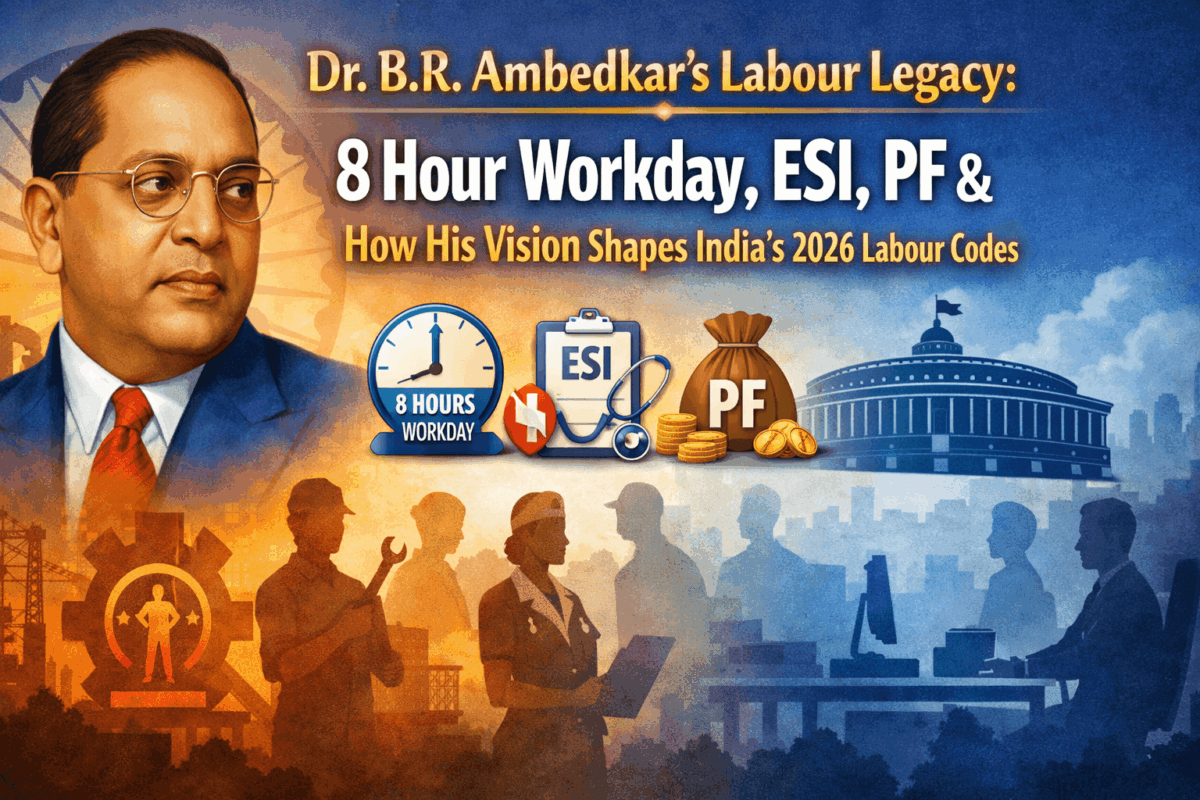
Hon’ble Dr. B.R. Ambedkar’s contributions to labour welfare laid the foundation for India’s modern workplace protections. His reforms ranging from the 8-hour workday to the creation of social insurance schemes continue to resonate in the 2026 Labour Codes, underscoring his vision of dignity and statutory rights for every worker.
In a Nutshell
Hon’ble Ambedkar’s labour reforms transformed unregulated toil into structured employment governed by law. His pioneering ideas on working hours, social security, and worker empowerment remain embedded in India’s labour framework today.
The Breakdown
- Defining the Workday: As Labour Member of the Viceroy’s Executive Council (1942–1946), Hon’ble Ambedkar advocated reducing the standard workday from 12 to 8 hours, establishing rest as a legal right.
- The Safety Net Foundations: He conceptualized social security in India, paving the way for the Employees’ State Insurance (ESI) and Provident Fund (PF), ensuring protection against sickness, disability, and retirement insecurity.
- Empowerment through Legislation: Hon’ble Ambedkar advanced worker rights through measures such as the Indian Trade Unions (Amendment) Bill and the Maternity Benefit Act, recognizing the need for protections for women and organized labour.
- National Resource Management: His vision extended beyond factories to infrastructure. He was instrumental in establishing the Central Waterways, Irrigation and Navigation Commission and the Central Technical Power Board, linking industrial growth with empowered labour.
Compliance Lens
Legal and professional experts highlight several challenges in the 2026 transition:
- Evolution of the 8-Hour Standard: While Hon’ble Ambedkar codified the 8-hour day, the OSH Code, 2020 permits a 12-hour spread-over for compressed workweeks. Strict monitoring of rest intervals is essential to prevent overwork.
- Inclusivity Gaps: Workers in the domestic and agricultural sectors are still not fully included in the strong social security protections that Hon’ble Ambedkar had envisioned for all labourers. Expanding these benefits to cover them as well is an important area where future laws can improve.
- Statutory Awareness: Many workers lack awareness of their rights. Employers can strengthen compliance by providing accessible digital “Know Your Rights” handbooks to promote workplace harmony.
Legal Context
- Factories Act, 1948: Codified the 8-hour workday principle.
- Employees’ State Insurance Act, 1948 & EPF Act, 1952: Institutionalized Ambedkar’s vision of social security.
- Maternity Benefit Act, 1961: Extended protections for women workers.
- Labour Codes, 2020 (effective 2026): Consolidate Ambedkar’s foundational principles into a modern framework.
Outlook
Hon’ble Dr. Ambedkar’s labour welfare legacy continues to shape India’s evolving workplace. Observers note that while his reforms established the foundation of worker dignity, the 2026 Labour Codes must address inclusivity gaps and modern compliance challenges to fully realize his vision of equitable and secure employment.
Disclaimer: This content is provided for informational purposes only and does not constitute legal, financial, or professional advice. Historical perspectives on labour law are intended to provide context and do not supersede current statutory requirements or government notifications. Readers should consult with official government sources or qualified legal consultants regarding current compliance obligations.