 Total Visitors
  Online Users
  Today
Today  Yesterday

In a Nutshell
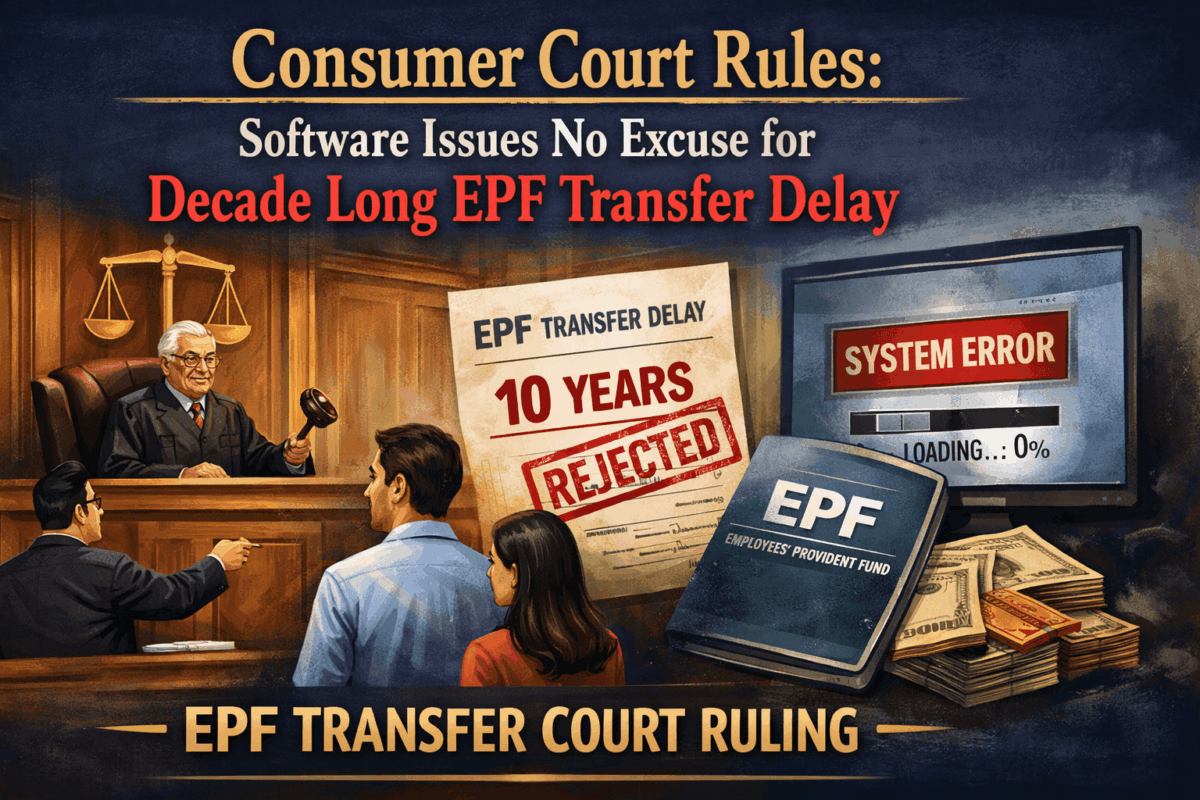
The District Consumer Disputes Redressal Commission, Chandigarh, has directed the Employees’ Provident Fund Organisation (EPFO) to pay ₹50,000 in compensation to a subscriber after a ten‑year delay in transferring provident fund balances. The Commission held that internal technical or systemic challenges cannot justify prolonged delays in delivering statutory social security services.
The Breakdown
- The Core Dispute: An employee changed jobs and requested transfer of accumulated provident fund balances into the new employer’s account. The request was formally routed through the subsequent employer as per procedure.
- The Systemic Gap: Despite repeated clarifications and administrative follow‑ups, the transfer was executed only after nearly a decade. During this period, certain interest calculations were complicated by historical account classifications.
- The Legal Outcome: Citing deficiency in service under the Consumer Protection Act, 2019, the subscriber approached the District Consumer Disputes Redressal Commission in Chandigarh. During proceedings, EPFO reconciled and credited all outstanding balances along with applicable interest.
- The Final Judgment: The Commission noted that while dues and interest were eventually settled, the prolonged delay constituted deficiency in service. Accordingly, compensation of ₹50,000 was awarded to cover litigation expenses and inconvenience caused to the subscriber.
The Compliance Lens
This ruling underscores key compliance lessons for institutional operations:
- Infrastructure Reliability: Core processing systems must include fallback protocols. Internal software errors or technical transitions cannot be allowed to delay statutory benefit transfers.
- Proactive Grievance Management: Automated escalation mechanisms should be embedded in tracking systems to flag stagnant applications before they escalate into disputes.
- Administrative Transparency: Clear, subscriber‑friendly updates on account status and classifications help build trust and reduce compliance friction.
Disclaimer: This article is for general informational and educational purposes only. It does not constitute legal, financial, or statutory professional advice. Readers should consult a qualified legal professional or authorised labour law consultant for specific guidance on provident fund matters.