 Total Visitors
  Online Users
  Today
Today  Yesterday

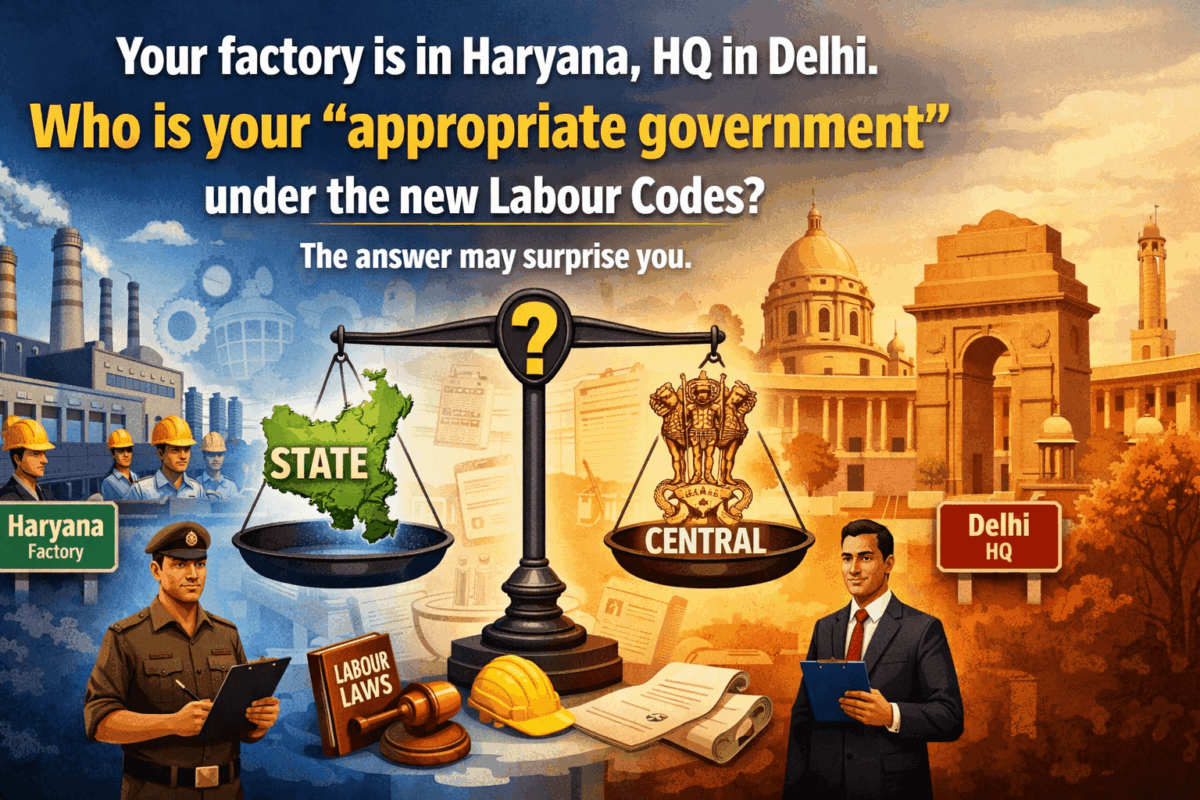
Let me cut straight to the chase. You operate a factory in Haryana. Your corporate headquarters sit in Delhi. Under the Occupational Safety, Health and Working Conditions (OSH) Code, 2020, the State Government is the appropriate government for factories. Under the Industrial Relations (IR) Code, 2020, the position is more layered but the jurisdictional anchor remains the location of the industrial establishment, not the corporate office.
This is one of the most frequently misunderstood aspects of the new labour law framework. Many HR heads and business owners assume that because their registered office or HQ is in one state, that state’s labour department has jurisdiction over all compliance matters. That assumption can land you in serious trouble.
Let me walk you through the exact legal position, the operational implications, and what you need to do right now to stay compliant.
The one question that determines everything
Before we get into the statutory nitty-gritty, understand this: the “appropriate government” is not a bureaucratic formality. It determines which labour department you report to, which certifying officer approves your standing orders, which authority has jurisdiction over retrenchment approvals, and where your workers need to file grievances.
Get this wrong, and you could be filing returns with the wrong authority, seeking approvals from the wrong officer, and exposing your company to penalties for non-compliance; even if you thought you were doing everything right.
Where the OSH Code stands: crystal clear
Under Section 2(1)(d)(ii) of the OSH Code, 2020, the “appropriate Government” in relation to a factory, motor transport undertaking, plantation, newspaper establishment, and establishments relating to beedi and cigar is the concerned State Government where it is situated. The Code explicitly clarifies that “State Government shall be the appropriate Government in respect of occupational safety, health and working conditions in a factory situated in that State”.
In easy understanding: For all OSH Code compliance – factory registration, safety committees, hazardous process approvals, medical examinations, working hours, and welfare provisions; your appropriate government is Haryana. Delhi has no role to play here, regardless of where your headquarters are located.
This position was reinforced when the Ministry of Labour and Employment notified the Central OSH Rules on May 8, 2026, and Haryana issued its draft OSH Rules on May 4, 2026. The Haryana government has also moved to streamline compliance by allowing establishments in the state to register solely under the OSH Code framework, exempting them from separate Shop and Establishment registration.
The IR Code: where it gets interesting
The IR Code, 2020, defines “appropriate Government” in Section 2(b). The Central Government is the appropriate government for establishments carried on by or under the authority of the Central Government, including railways, mines, oil fields, major ports, air transport, telecommunications, banking, and insurance companies.
For all other industrial establishments and your factory in Haryana falls squarely in this category – the State Government is the appropriate government.
This means:
Standing Orders: Under Section 29 of the IR Code, every industrial establishment employing 300 or more workers must prepare and submit draft standing orders. The certifying officer who will review and certify these standing orders is the one appointed by the Haryana government, not Delhi. On May 8, 2026, the Central Government notified the Model Standing Orders, 2026, for the manufacturing, mining, and services sectors. While these model standing orders are centrally framed, the certifying officer for your factory will be the Haryana-appointed officer, and you will need to adopt the model standing orders or get your certified standing orders approved through the Haryana machinery.
Grievance Redressal Committees: The IR Code mandates the constitution of Grievance Redressal Committees in industrial establishments. The appropriate government again, Haryana will prescribe the procedural framework, the composition requirements, and the appellate mechanism.
Retrenchment: This is where the stakes are highest. Under the IR Code, establishments with 300 or more workers require prior government permission for retrenchment and closure. The “appropriate Government” that grants this permission is the State Government Haryana in your case. You cannot approach the Delhi government for retrenchment approvals simply because your HQ is there. The Delhi labour department has no jurisdiction over industrial actions at your Haryana factory.
The Social Security Code exception: a different rule altogether
Here is where many companies get tripped up. Under the Code on Social Security, 2020, the Central Government is designated as the appropriate government for establishments operating in more than one State. This means that for social security compliance viz. Provident Fund, ESI, gratuity, and other welfare measure the Central Social Security Rules, 2026, will apply to your organisation since you have presence in both Haryana and Delhi.
But note: this is a specific exception carved out for the Social Security Code. It does not extend to the OSH Code or the IR Code. For safety, health, working conditions, industrial relations, standing orders, and retrenchment, the jurisdictional anchor remains the location of the establishment.
The concurrent framework reality
Labour is a Concurrent Subject under the Indian Constitution. Both the Central Government and State Governments have the power to enact labour legislation. The Central Rules notified on May 8, 2026, provide the procedural framework for establishments where the Central Government is the appropriate government. For your factory in Haryana, you will need to refer to the Haryana State Rules under the OSH Code and the IR Code.
Haryana has already issued draft OSH Rules on May 4, 2026. The state is expected to finalise these rules soon, and they will prescribe the detailed compliance requirements for factories in the state. You should be tracking these developments closely.
What this means for your compliance strategy
Let me break this down into actionable steps.
OSH Code compliance: Register your factory with the Haryana Labour Department. File your annual returns with Haryana authorities. Ensure your safety committees, welfare provisions, and working hour compliances are aligned with Haryana rules. Delhi has no jurisdiction here.
Standing Orders: If your factory employs 300 or more workers, prepare and submit your draft standing orders to the certifying officer appointed by the Haryana government. The Model Standing Orders, 2026, provide the template, but the certification happens at the state level.
Grievance Redressal: Constitute your Grievance Redressal Committee as per the IR Code and the Haryana rules. The appellate authority will be the Haryana labour department.
Retrenchment: If you ever need to retrench workers or close down operations at your Haryana factory, the permission must come from the Haryana government. Do not approach Delhi authorities for this.
Social Security: For PF, ESI, and gratuity, follow the Central Social Security Rules, 2026, since your organisation operates in more than one state.
The operational challenges you need to watch for
Transitional friction is real. Many companies are still navigating the shift from the legacy regime viz. the Factories Act, 1948, and the Industrial Disputes Act, 1947 to the new Codes. The Central Rules were only notified on May 8, 2026, and many states are yet to finalise their state rules.
For your factory in Haryana, the state has taken a proactive approach. The draft Haryana OSH Rules are already out, and the state has exempted OSH-registered establishments from separate Shop Act registration. This is a positive development, but it also means you need to stay on top of the final rules when they are notified.
The bottom line
Your appropriate government for OSH Code and IR Code compliance is Haryana; the state where your factory is situated. Delhi has jurisdiction only over your corporate office functions, not over factory operations, standing orders, grievance redressal, or retrenchment at your manufacturing facility.
The Social Security Code is the only exception, where the Central Government steps in because you operate across multiple states.
Get your filings right. Get your approvals from the right authorities. And if you have been dealing with the Delhi labour department for your factory compliance, it is time to redirect your efforts to Haryana.
Core Compliance Checklist [FREE]
- Register your factory under the OSH Code with the Haryana Labour Department
- File annual returns and maintain statutory registers as per Haryana OSH Rules
- If employing 300+ workers, prepare and submit draft standing orders to Haryana certifying officer
- Constitute Grievance Redressal Committee as per IR Code and Haryana rules
- For retrenchment, seek prior permission from Haryana government (if 300+ workers)
- For social security, follow Central Social Security Rules, 2026
- Track final notification of Haryana OSH Rules and IR Rules
- Ensure all compliance documentation clearly identifies Haryana as the appropriate government
Financial and Operational Risk Analysis
| Risk Area | Consequence of Getting It Wrong |
| Wrong registration authority | Registration deemed invalid; penalty up to ₹50,000 under OSH Code |
| Filing with wrong government | Returns treated as non-filed; penalty and interest on dues |
| Standing orders not certified by correct authority | Standing orders unenforceable; industrial disputes risk |
| Retrenchment without correct government approval | Retrenchment held illegal; reinstatement with back wages; penalty up to ₹1 lakh |
| Grievance filed with wrong authority | Delayed resolution; worker unrest; reputational damage |
Disclaimer: This content is for educational and informational purposes only and is based on available Central and State notifications as of July 2026. It does not constitute formal legal counsel. Readers are advised to consult qualified legal professionals for advice specific to their circumstances. Laws and rules are subject to change, and professional legal advice should be sought before taking any action based on this content.