

Continuous service is one of the most critical concepts in Indian labour law, shaping a worker’s eligibility for retrenchment compensation, reinstatement, and statutory protections under the Industrial Disputes Act, 1947. Yet, many employers and employees misunderstand how the 240-day rule actually works. Courts have repeatedly clarified that continuous service is not merely about counting days, it is a legal test that determines whether a worker has earned the protection of the Act. Understanding this framework is essential for HR teams, compliance professionals, and workers seeking to safeguard their rights.
1. What Does Section 25B Mean by “Continuous Service”?
Section 25B states that a worker is in continuous service if they have worked uninterruptedly, including periods interrupted due to sickness, authorized leave, accident, legal strike, lockout, or employer-initiated work stoppage.
Where uninterrupted service is not established, the law introduces a deemed continuous service rule:
- A worker is considered to have completed one year of continuous service if they have actually worked 240 days in the preceding 12 months.
This 240-day benchmark is the most widely applied test in labour disputes.
2. The 240-Day Rule: How It Is Calculated
The 240-day requirement does not need to fall within a calendar year. Courts accept any 12-month block immediately preceding the relevant date.
Important clarifications:
- Only actual days worked count.
- Weekly holidays, unpaid leave, and non-working Sundays are excluded unless they fall within the statutory inclusions under Section 25B(1).
- The 12-month period can begin on any date and extend into the next year.
This flexible calculation ensures that workers are not disadvantaged by arbitrary calendar boundaries.
3. Counting Backward From the Date of Termination
When a dispute arises after termination, courts calculate the 240 days backward from the date of termination.
If the employer does not dispute the period of service, the worker’s claim is generally accepted as continuous.
This backward-looking method is widely used by Labour Courts to determine eligibility for retrenchment benefits.
4. The 239-Day Problem: No Relief Below the Threshold
The Delhi High Court has held that a worker who fails to prove 240 days of service cannot claim the protections of Section 25F, even if they worked 239 days.
This strict interpretation reinforces that:
- The 240-day threshold is mandatory.
- Courts cannot grant relief based on sympathy or near-compliance.
This ruling underscore the importance of maintaining accurate attendance and wage records.
5. Daily Wagers Also Benefit From the 240-Day Rule
Daily-wage workers who complete 240 days in 12 months are treated as being in continuous service and are entitled to:
- Retrenchment compensation,
- Notice pay,
- Protection against arbitrary termination.
However, the Supreme Court has clarified that working 240 days does not automatically entitle a worker to regularization.
The 240-day rule is relevant for retrenchment protection not for claiming permanent status.
6. Casual Workers Across Multiple Establishments: A Key Exception
The Supreme Court has held that when a casual worker is engaged across different establishments of the same corporation, the 240-day rule does not automatically apply as continuous service.
This is because:
- Each establishment is treated as a separate unit.
- Service in one unit cannot be combined with another unless the employer treats them as a single establishment.
Thus, mobility across units may break the continuity of service.
Key Takeaways
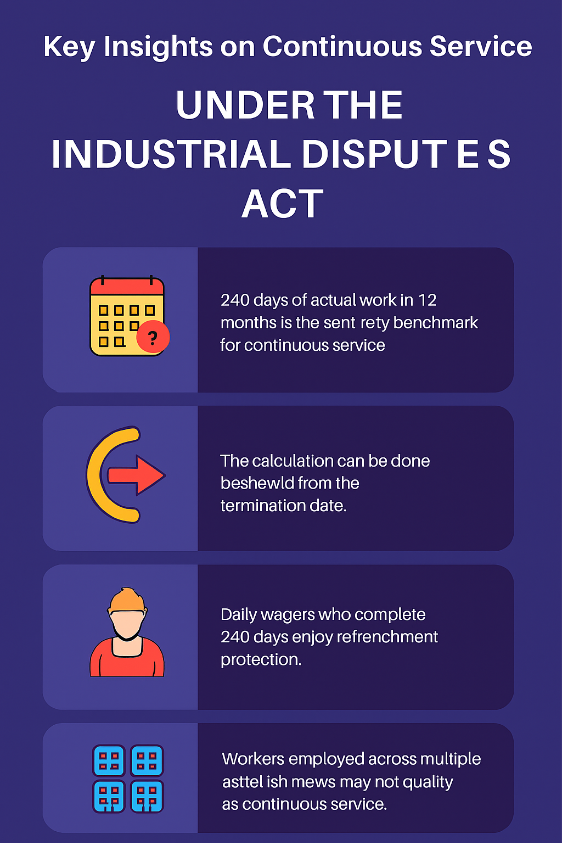
- 240 days of actual work in 12 months is the statutory benchmark for continuous service.
- The calculation can be done backward from the termination date.
- Daily wagers who complete 240 days enjoy retrenchment protection.
- Workers employed across multiple establishments may not qualify for continuous service.
- Courts strictly enforce the 240-day threshold—239 days is not enough.
Conclusion
Continuous service under Section 25B is more than a numerical calculation, it is a legal safeguard that ensures workers are not left vulnerable to arbitrary termination. By understanding how the 240-day rule operates, both employers and employees can navigate retrenchment and termination processes with clarity and compliance. For HR teams and labour law practitioners, mastering this concept is essential to avoiding disputes and ensuring lawful workforce management.
Join the Conversation
Your thoughts matter. Share your perspective in the comments—healthy dialogue helps us all understand labour law better.
Need Guidance?
Feel free to book a consultation. Expert advice can make compliance smoother and more effective.
Spread the Knowledge
If you found this article useful, don’t keep it to yourself—share it with colleagues, friends, or on social media. Together, we can build greater awareness of labour rights and responsibilities.
Disclaimer – This blog post is a general guide. It should not be considered legal advice. Consult a legal professional for more details.