 Total Visitors
  Online Users
  Today
Today  Yesterday

The Short Answer
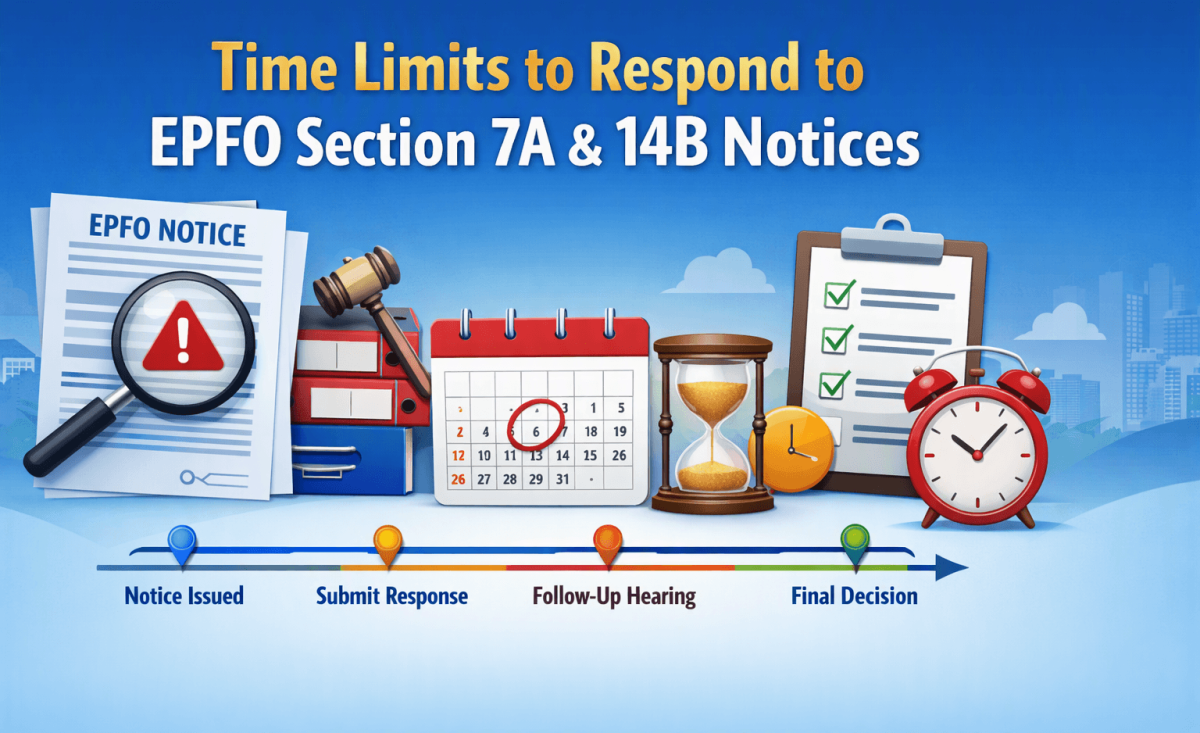
The legally binding deadline to respond to a Section 7A or 14B notice is the specific hearing date stipulated on the EPFO summons. Failure to appear on this exact date empowers the Assessing Officer to pass an enforceable ex-parte order. For inquiries initiated under the Code on Social Security, 2020, employers are protected by a strict five-year jurisdictional limitation barring the initiation of proceedings for older defaults, and any ex-parte order must be challenged within three months of its communication.
The Operative Deadline: The Summons Hearing Date
Under the EPF Act, 1952, and the successor provisions in the Code on Social Security, 2020, the EPFO Compliance Guidelines mandate that a summons must specify the period of default and a definitive hearing date. This date is not advisory; it is a judicially enforceable deadline.
Employers are legally obligated to appear on the specified date. Failure to do so triggers Section 7A(3A) of the EPF Act (and corresponding Code provisions), which authorizes the Assessing Officer to proceed ex-parte and determine financial liability based solely on available records.
Ex-Parte Orders and the Three-Month Set-Aside Window
If an ex-parte order is issued, the employer has a statutory window of exactly three months from the date of communication of such order to file an application to set it aside. This timeline is governed by Section 7A(4) of the EPF Act and Section 125(6) of the Code.
An application to set aside an ex-parte order requires proving non-service of the summons or demonstrating “sufficient cause” that prevented appearance. The proviso to both Section 7A(4) and Section 125(6) establishes a strict standard: mere technical irregularities in the service of the show cause notice are insufficient grounds to set aside the order if the EPFO can prove the employer had actual knowledge of the proceedings.
The Jurisdictional Five-Year Bar and Sunset Clauses
The enforcement landscape shifted materially with the consolidation of the labour laws into the Code on Social Security, 2020 (implemented November 21, 2025, with Central Rules notified May 8, 2026). Section 125 of the Code introduces a jurisdictional limitation on the EPFO.
- Bar on Initiation: The assessing officer cannot initiate inquiries for alleged defaults that occurred more than five years prior to the date of the notice. This is a jurisdictional bar, meaning an assessment order violating this five-year limit is a legal nullity.
- Inquiry Duration: Once validly initiated, the authority must endeavor to conclude the inquiry within two years. This period can be extended by a maximum of one year, subject to recording reasons in writing and submitting them to the CPFC or Director General.
- Legacy Proceedings: For inquiries that were already pending on November 21, 2025, the third proviso to Section 125(2) enforces a hard sunset clause. These proceedings must be concluded by November 21, 2027.
Explicit Statutory Penalties and the VISHWAS Transition
Penalties for PF defaults depend heavily on the date the default occurred, dividing the liability into two regimes:
- Defaults Pre-dating June 14, 2024: Penalties fall under Section 14B of the EPF Act. However, eligible employers can utilize the VISHWAS, 2026 scheme, which drastically reduces damages to concessional rates: 0.25% per month (up to 2 months), 0.50% per month (2 to 4 months), and 1.00% per month (beyond 4 months). Without VISHWAS eligibility, the standard 14B staggered rates apply, capping at 25%.
- Defaults On or After June 14, 2024: Penalties are governed by Section 128 of the Code on Social Security, 2020, read with the EPF Scheme, 2026.
- Mandatory Interest: Regardless of the damages regime, delayed payments attract simple interest of 12% per annum under Section 7Q of the EPF Act or Section 127 of the Code.
Non-compliance also triggers coercive recovery under Sections 8B to 8G (bank attachment, property sale) and criminal prosecution under Section 14 (Code Section 133).
Statutory Appeals: The 60-Day Mandate
If an employer intends to challenge an assessment order passed under Section 7A or Section 125, the primary remedy is filing an appeal before the EPF Appellate Tribunal (CGIT).
The statutory limitation to file this appeal is 60 days from the date of the order. The Tribunal may grant an extension of up to 60 additional days (totaling a maximum of 120 days) if the employer proves sufficient cause for the delay. Appeals filed beyond 120 days are time-barred and will be dismissed.
What Employers Must Do Now
To mitigate financial and legal risks upon receiving an EPFO notice, corporate management must execute the following steps:
- Appear on the First Date: Do not rely on adjournment applications. The Orissa High Court has upheld ex-parte assessments where employers repeatedly failed to produce documents despite adjournments. Appear on the mandated date, and if an adjournment is necessary, file written submissions simultaneously to demonstrate diligence.
- Raise Jurisdictional Objections Immediately: If a new notice covers wage months older than five years, formally object to the jurisdiction under Section 125 before the Assessing Officer. Failure to raise this jurisdictional fact early may prejudice your position in a subsequent appeal.
- Audit Contractor Beneficiary Identification: When the EPFO assesses dues on workers engaged through contractors, the authority must record findings on the identity of those workers. As held by the Punjab and Haryana High Court in Regl. Provident Fund Commr. v. Faridabad Thermal Power Station, an order is unsustainable if it fails to identify contractor-engaged beneficiaries. Note that this defense applies specifically to contractor scenarios, whereas direct employee dues are routinely assessed via ECR filings and wage registers.
- Calculate VISHWAS Eligibility: Segregate the default periods to determine which liabilities fall under the concessional VISHWAS 2026 rates versus the standard Section 128 Code penalties.
Are you facing an issue regarding an EPFO Section 7A or 14B notice? Miscalculating compliance can lead to severe statutory penalties. Fill out the Claim Your Free Confidential Consultation form on our homepage, and our legal team at Key4Comply will assist you instantly.
Note: The legal landscape is currently in transition between the EPF Act, 1952, and the Code on Social Security, 2020. Specific legal advice must account for the date of the alleged default and the date of the enforcement notice.
Disclaimer: All articles, blogs, guides, and resources published on this website relate to Indian labour laws and compliance frameworks. The content is provided for general informational and educational purposes only and must not be construed as legal advice. Readers should consult our legal team or a qualified advocate for advice on specific workplace disputes or compliance audits.