

The Real-Life Scenario
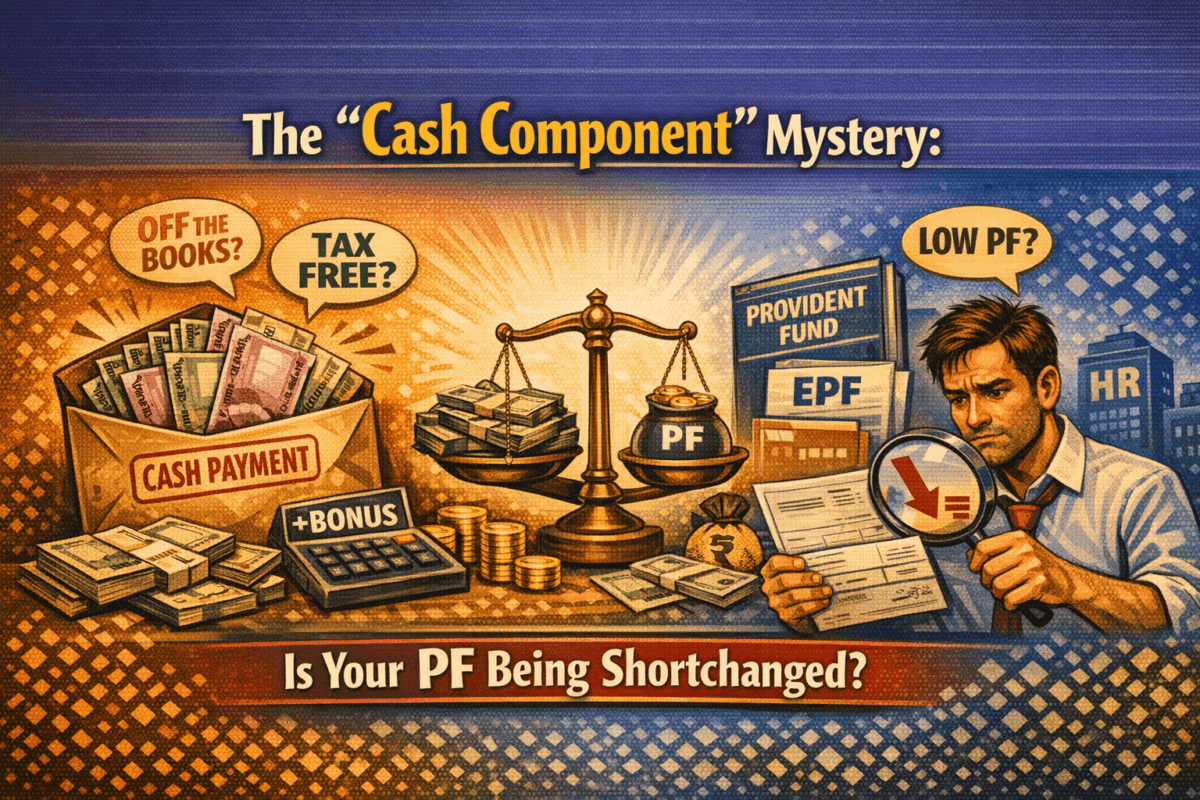
Your salary arrives partly via bank transfer, partly in cash. When you check your EPF portal, contributions are calculated only on the bank-transferred portion. HR calls it a “tax-saving hack.” In reality, this practice may be shrinking your retirement savings and violating labour law.
1. What Counts as “Salary” for PF?
| Law | Definition | Impact |
| EPF Act, 1952 (Sec. 2(b)) | “Basic Wages” include all emoluments earned while on duty, paid or payable in cash. | Cash payments are part of wages, regardless of mode of payment. |
| Code on Social Security, 2020 (effective 2026) | Introduces the 50% Rule: Allowances cannot exceed 50% of total remuneration. | Any excess allowances or cash side-payments are added back to “wages” for PF calculation. |
Key Point: Whether paid digitally or in cash, if it’s a regular part of your salary, it attracts PF.
2. Is Cash Payment Legal?
- Paying in cash is not illegal per se.
- But excluding cash from PF/ESI records = under-reporting wages.
- This is treated as evasion of statutory dues under EPFO compliance.
3. The Real Cost to Employees
- Lost Matching Contribution: Employer saves, but you lose 12% PF contribution.
- Compound Interest Loss: Over 20 years, missing PF on cash pay can reduce retirement corpus by lakhs.
- Reduced Insurance & Pension: EDLI (insurance) and EPS (pension) benefits shrink if wages are under-reported.
4. [FREE] Detailed Impact Calculator: Missing PF on ₹10,000 Cash Pay
Let’s break it down step by step:
Step 1: Monthly PF Contribution (Employee + Employer)
- PF rate = 12% of wages (employee) + 12% (employer).
- On ₹10,000 cash pay → ₹1,200 (employee) + ₹1,200 (employer) = ₹2,400/month.
Step 2: Annual PF Contribution Lost
- ₹2,400 × 12 months = ₹28,800/year.
Step 3: 20-Year Corpus Without Interest
- ₹28,800 × 20 years = ₹5.76 Lakhs.
Step 4: 20-Year Corpus With EPF Interest (8% p.a.)
Here we use the Future Value of an Annuity formula (because PF is a series of yearly contributions, not a one-time deposit):
FV = P × {(1+r)^n – 1}÷ r}
Where:
- FV = Future Value (total corpus after interest)
- P = Annual contribution (₹28,800)
- r = Interest rate per year (8% = 0.08)
- n = Number of years (20)
Step 5: Plugging in the values
FV = 28,800 × {(1+0.08) ^20 – 1} ÷ 0.08}
FV = 28,800 × {4.66- 1} ÷ 0.08}
FV = 28,800 × 45.75 ≈ ₹13,16,000]
That “extra cash in hand” today could cost you ₹13 Lakhs in retirement savings tomorrow.
5. Common Compliance Challenges for Employers
- SMEs often justify cash pay as “helping employees save tax.”
- In reality, it’s a compliance risk.
- By 2026, EPFO uses AI-driven cross-referencing between IT returns and PF deposits to detect discrepancies.
6. What Employees Can Do
- Ask for Salary Breakup: Ensure appointment letter shows full CTC.
- Apply the 50% Rule: Check if Basic + DA ≥ 50% of total pay.
- Monitor UAN Portal: Compare reported wages with actual take-home.
- File Grievance: Use EPFiGMS portal; EPFO can investigate anonymously.
7. Manager Myths vs Legal Reality
| What Employers Say | Legal Reality |
| “Cash doesn’t count for PF.” | False. All regular pay, including cash, is part of wages. |
| “Splitting salary into allowances avoids PF.” | False. Allowances capped at 50%; excess added back to wages. |
| “This helps you save tax.” | False. It reduces PF, pension, and insurance benefits. |
| “EPFO won’t notice.” | False. EPFO uses AI cross-checks with tax filings. |
8. HR Compliance Checklist [FREE]
- Ensure Basic + DA = at least 50% of total remuneration.
- Include cash payments in wage records for PF/ESI.
- Avoid artificial splitting of salary into allowances.
- Maintain transparent salary structures in appointment letters.
- Use digital transfers for traceability and compliance.
- Align payroll with EPFO’s definition of “wages.”
Conclusion: Don’t Trade Your Future for Today’s Cash
In Indian labour law, cash is part of wages if it’s regular pay. Excluding it from PF is not a tax hack — it’s a compliance violation that shrinks your retirement safety net. With the 2026 Labour Codes, the definition of “wages” is clearer than ever: All regular pay attracts PF.
Employees must safeguard their future corpus, and HR must ensure compliance to avoid penalties.
Disclaimer:
This article is for educational and informational purposes only and does not constitute legal advice. While the content reflects the Code on Social Security 2020 and the EPF Act, specific calculations can vary based on individual salary brackets and voluntary higher contributions. Always consult with a qualified PF consultant or legal professional for your specific case.