

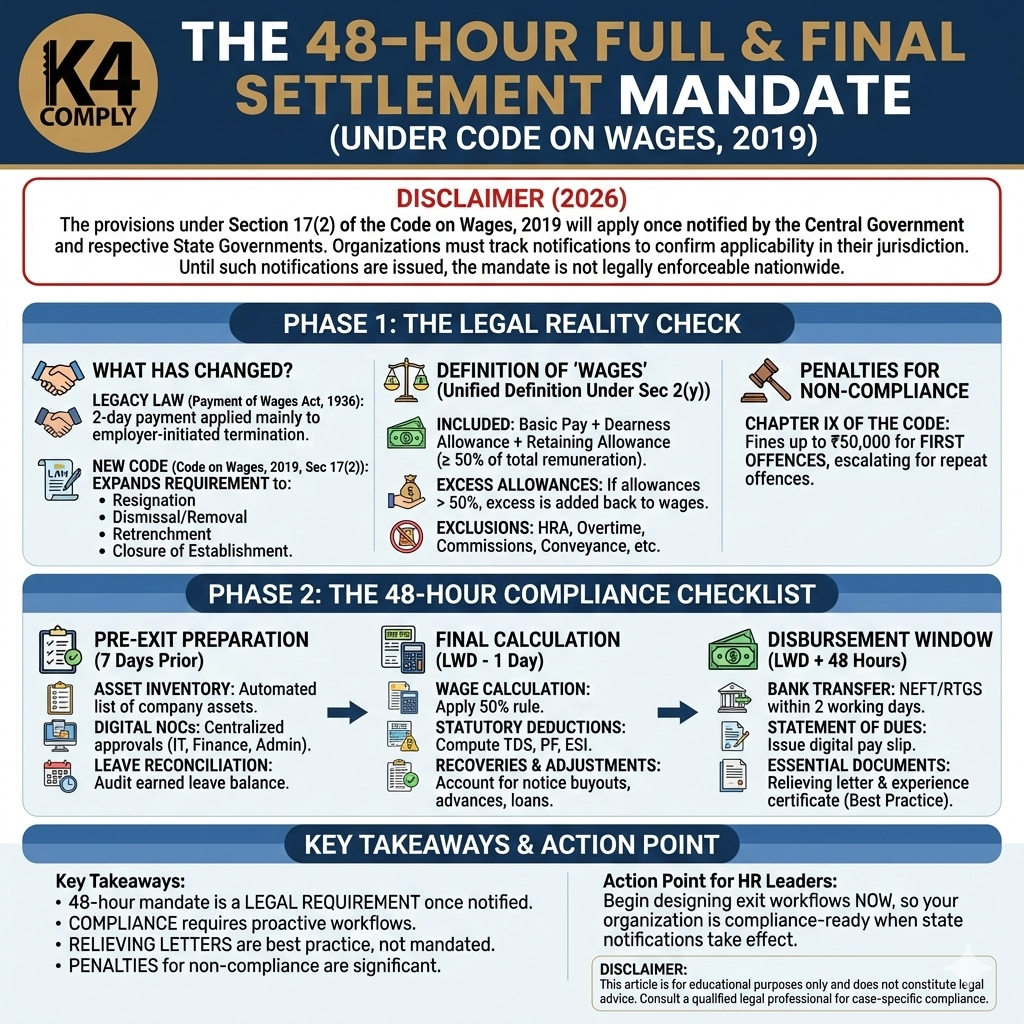
Disclaimer
The provisions under Section 17(2) of the Code on Wages, 2019 will apply once notified by the Central Government and respective State Governments. Organizations must track notifications to confirm applicability in their jurisdiction. Until such notifications are issued, the mandate is not legally enforceable nationwide.
Phase 1: The Legal Reality Check
What Has Changed?
- Legacy Law: Under the Payment of Wages Act, 1936, the requirement to pay within two working days applied mainly to cases of employer-initiated termination.
- New Code: Section 17(2) of the Code on Wages, 2019 expands this requirement to:
- Resignation
- Dismissal or removal
- Retrenchment
- Closure of the establishment
Definition of “Wages”
- Unified definition under Section 2(y):
- Included: Basic Pay + Dearness Allowance + Retaining Allowance (≥ 50% of total remuneration).
- Excess Allowances: If allowances exceed 50%, the excess is added back to wages for compliance.
- Exclusions: House Rent Allowance (HRA), overtime, commissions, conveyance allowance, and other statutory exclusions.
Penalties for Non-Compliance
- Chapter IX of the Code prescribes fines up to ₹50,000 for first offences, escalating for repeat offences.
Phase 2: The 48-Hour Compliance Checklist
Pre-Exit Preparation (7 Days Prior)
- Asset Inventory: Automated list of company assets to be returned.
- Digital NOCs: Centralized HRMS approvals from IT, Finance, and Admin.
- Leave Reconciliation: Audit earned leave balance for encashment readiness.
Final Calculation (LWD – 1 Day)
- Wage Calculation: Apply the 50% rule for accuracy.
- Statutory Deductions: Compute TDS, PF, and ESI contributions.
- Recoveries & Adjustments: Account for notice buyouts, advances, or loans.
Disbursement Window (LWD + 48 Hours)
- Bank Transfer: Ensure NEFT/RTGS processing within two working days.
- Statement of Dues: Issue digital pay slip with clear breakdown.
- Essential Documents: Relieving letter and experience certificate recommended (best practice, not statutory).
Key Takeaways
- The 48-hour mandate is a legal requirement once notified, not a voluntary HR policy.
- Compliance requires proactive workflows, not last-day calculations.
- Relieving letters and certificates enhance employee experience but are not mandated by law.
- Penalties for non-compliance can be significant, making early preparation essential.
Action Point for HR Leaders: Begin designing exit workflows now, so your organization is compliance-ready the moment state notifications take effect.
Disclaimer: This article is for educational and informational purposes only and does not constitute legal advice. While every effort has been made to ensure the accuracy of this information as of January 2026, Indian Labour Laws are subject to state-specific rules and ongoing notifications. Always consult with a qualified legal professional or labour law consultant before making changes to your company policies.