

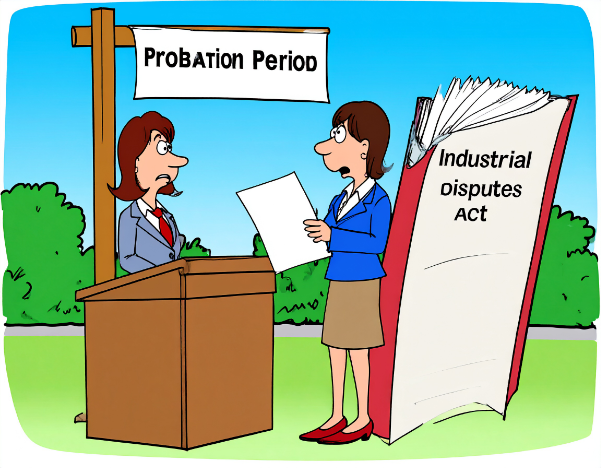
Termination during probation is one of the most frequently litigated issues in Indian employment law. Employers often assume that probationers can be removed freely, while employees believe that any termination triggers retrenchment protections under the Industrial Disputes Act, 1947. The truth lies somewhere in between. Indian courts have consistently held that probationers do not enjoy the same security of tenure as confirmed employees, and therefore, termination for unsatisfactory performance during probation is generally not treated as retrenchment. Understanding this distinction is essential for HR teams, compliance professionals, and business owners who want to avoid legal pitfalls.
- Why Termination of a Probationer Is Not Retrenchment
Section 2(oo) of the ID Act defines retrenchment broadly but also carves out specific exclusions. One such exclusion applies to termination of a probationer whose services are discontinued due to unsatisfactory performance or failure to meet the standards required for confirmation.
Courts have consistently held that:- A probationer does not acquire a right to hold the post during the probation period.
- Termination for unsatisfactory work is not retrenchment because it falls within the employer’s contractual and managerial prerogative.
This principle is reflected in judicial commentary, including the Madhya Pradesh High Court’s analysis in Mukhtyar Singh v. Food Corporation of India, which clarified that termination during probation does not attract retrenchment protections.
- Termination Within a Probation Period of Less Than One Year
When a probationer is terminated within the initial probation period typically less than one-year courts have treated such termination as non-retrenchment.
This is because:- The employee has not yet earned the right to continue in the role.
- The employer is merely assessing suitability, not penalizing the employee.
- Section 2(oo) does not treat such termination as retrenchment.
The Delhi High Court reaffirmed this in Deccan Charters Pvt. Ltd. v. Sarita Tiwari, holding that termination of a probationer in accordance with the appointment terms does not amount to retrenchment.
- When Probation Exceeds One Year: Does Section 25F Apply?
The legal landscape becomes more nuanced when probation extends beyond one year.
The Karnataka High Court has observed that:- If a probationer completes more than one year of service,
- and the employer terminates the employee without justification,
- the termination may attract Section 25F requirements.
This does not mean that every termination after one year becomes retrenchment. Instead, courts examine whether:
- The probation was genuinely extended for valid reasons,
- The termination was based on unsatisfactory performance, or
- The employer used probation as a pretext to avoid retrenchment obligations.
If the termination is genuinely performance-based, it remains non-retrenchment. But if the employer cannot justify the extended probation or the grounds for termination, Section 25F may apply.
- Supreme Court and High Court Views on Probationary Termination
The Supreme Court has repeatedly held that:- A probationer can be discharged for unsatisfactory service,
- Such discharge is not punitive,
- And therefore, does not amount to retrenchment.
Multiple High Courts including Madhya Pradesh and Karnataka have echoed this reasoning, emphasizing that probationers do not acquire a legal right to the post until they are formally confirmed.
This aligns with the broader principle that probation is a period of assessment, not entitlement.
- No Inquiry Required for Termination of a Probationer
Unlike permanent employees, probationers are not entitled to:- A domestic inquiry,
- A show-cause notice, or
- A detailed justification for termination,
unless the termination is stigmatic or punitive.
Labour Courts have upheld that:
- Termination for unsatisfactory performance,
- Without assigning reasons,
- And without an inquiry,
is legally valid, provided the employer follows the terms of appointment and avoids statutory violations.
- Key Takeaway: Probationers Have No Inherent Right to Continue
The legal position can be summarized as follows:- Probationers do not have a vested right to hold the post.
- Termination during probation for unsatisfactory performance is not retrenchment.
- Section 25F applies only in limited circumstances, such as unjustified termination after prolonged probation.
- Employers must ensure that termination orders are non-stigmatic and consistent with appointment terms.
Conclusion
Termination during probation is legally permissible and generally falls outside the scope of retrenchment under the Industrial Disputes Act. As long as the employer acts in good faith, follows the terms of employment, and avoids punitive language, the termination of a probationer is considered valid. For HR teams and compliance professionals, understanding these nuances is essential to avoid unnecessary litigation and ensure lawful workforce management.
Join the Conversation
Your thoughts matter. Share your perspective in the comments—healthy dialogue helps us all understand labour law better.
Need Guidance?
Feel free to book a consultation. Expert advice can make compliance smoother and more effective.
Spread the Knowledge
If you found this article useful, don’t keep it to yourself—share it with colleagues, friends, or on social media. Together, we can build greater awareness of labour rights and responsibilities.
Disclaimer – This blog post is a general guide. It should not be considered legal advice. Consult a legal professional for more details.