 Total Visitors
  Online Users
  Today
Today  Yesterday

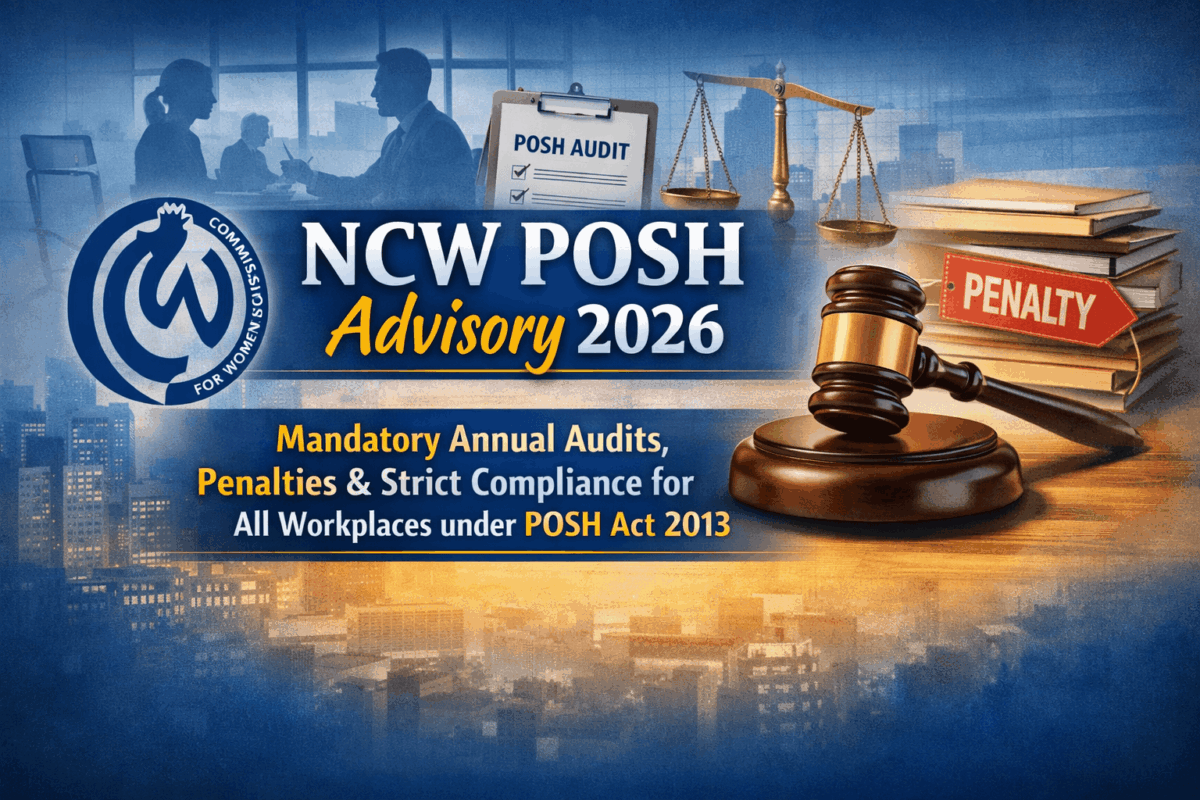
The National Commission for Women (NCW) has issued a comprehensive advisory to all States and Union Territories, calling for strict and uniform implementation of the Sexual Harassment of Women at Workplace (Prevention, Prohibition and Redressal) Act, 2013 (POSH Act). The advisory, issued on June 19, 2026, introduces a series of new compliance and monitoring measures designed to strengthen workplace safety and safeguard the dignity of women across India.
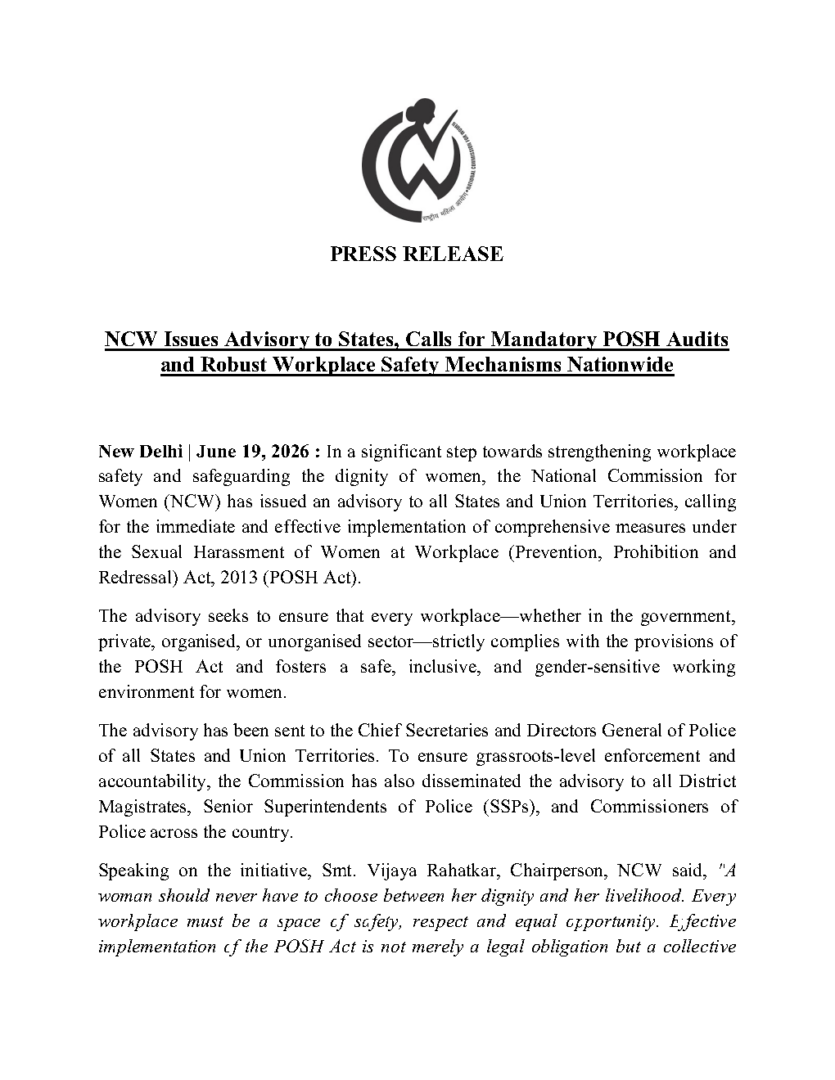
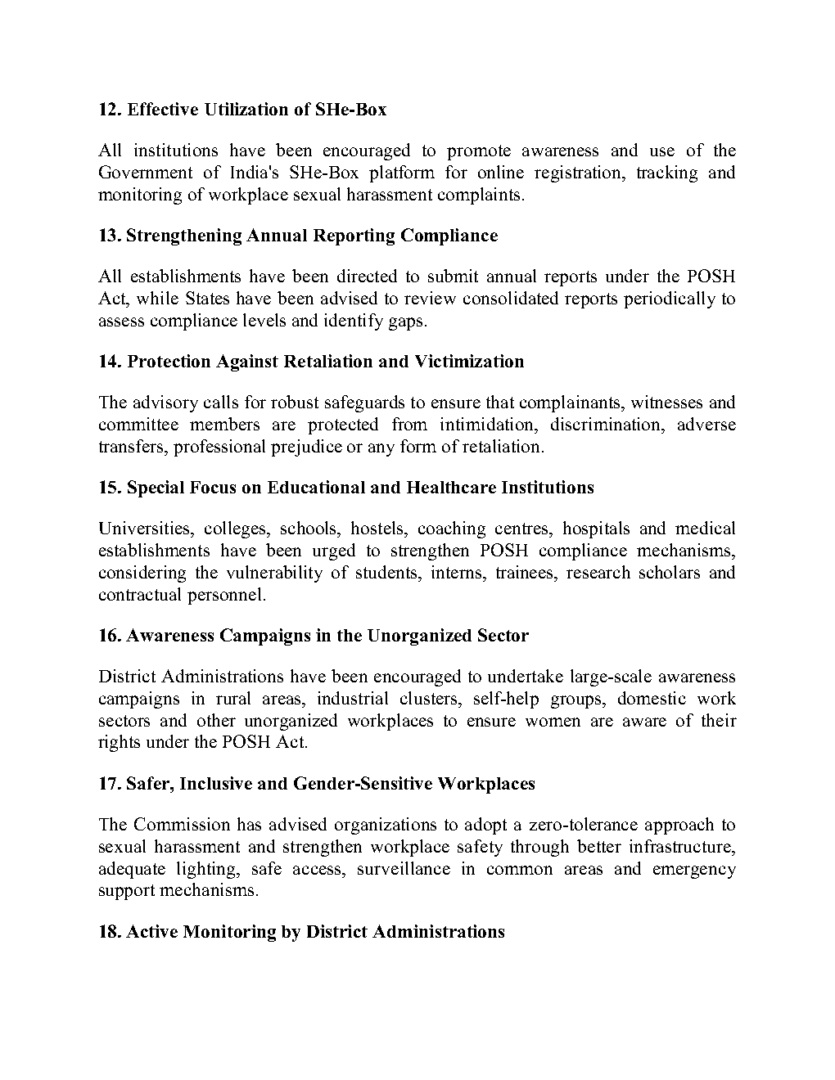
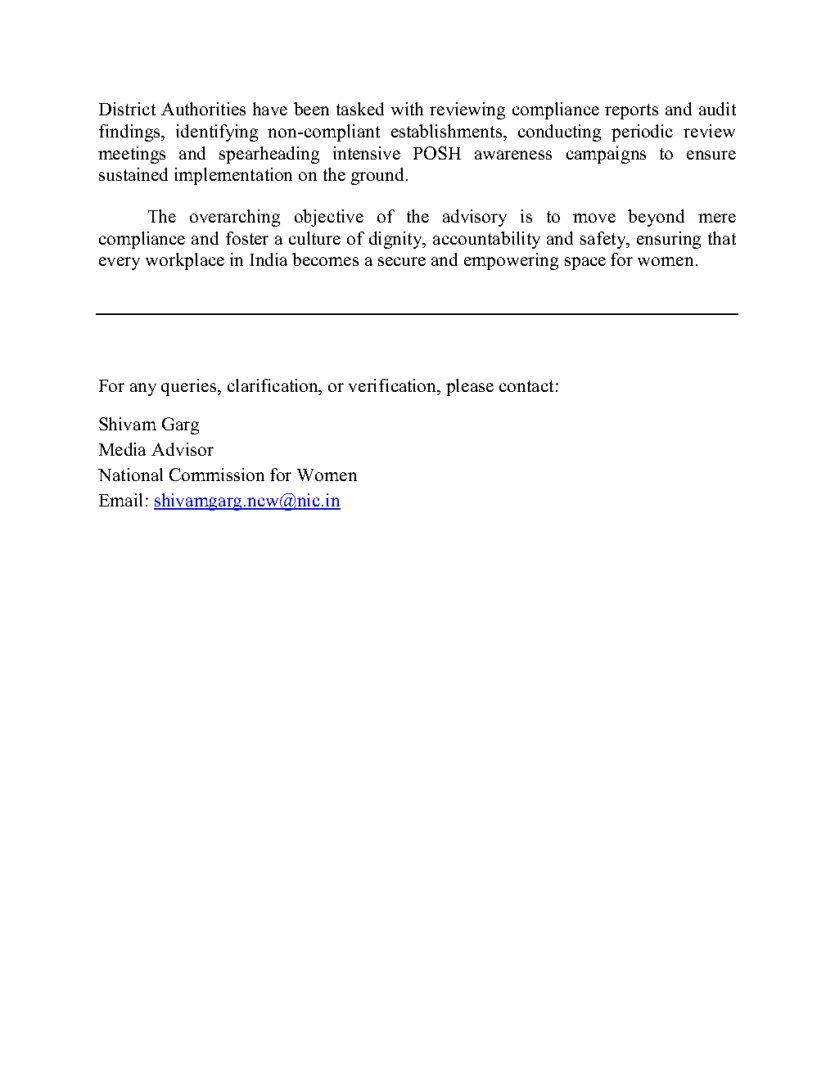
The advisory has been sent to chief secretaries, police chiefs, district magistrates, and commissioners of police across every state and Union Territory, with clear instructions to ensure district-level reach. The NCW has emphasized that every workplace i.e. whether in the government, private, organised, or unorganised sector; must strictly comply with the provisions of the POSH Act and foster a safe, inclusive, and gender-sensitive working environment.
Speaking on the initiative, Hon’ble NCW Chairperson Vijaya Rahatkar stated:
“A woman should never have to choose between her dignity and her livelihood. Every workplace must be a space of safety, respect and equal opportunity. Effective implementation of the POSH Act is not merely a legal obligation but a collective responsibility towards ensuring women’s empowerment and participation in nation-building.”
Why This Advisory Now?
For years, many Indian workplaces have treated POSH guidelines as a procedural formality; constituting a committee, framing a policy, and filing annual reports without substantive oversight. The NCW advisory seeks to address systemic gaps in workplace safety and implementation of the POSH Act across various sectors. The advisory mandates annual audits and stricter monitoring; non‑compliance attracts statutory penalties under Section 26 of the POSH Act. The objective is to ensure that the law is not just on the books but actively enforced and monitored.
Key Advisory Directives at a Glance
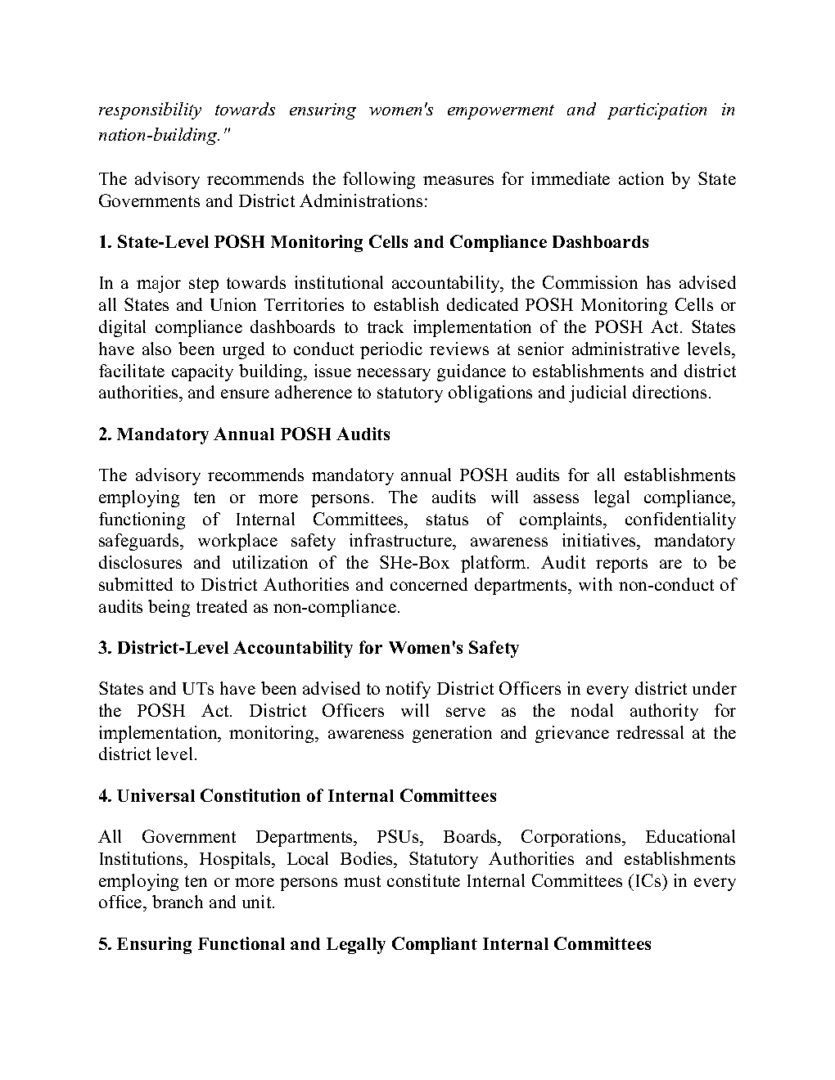
1. Mandatory Annual POSH Audits
The most significant recommendation is the introduction of mandatory annual POSH audits for all establishments employing 10 or more persons. These audits will assess:
- Legal compliance with the POSH Act
- Functioning and effectiveness of Internal Committees (ICs)
- Complaint disposal mechanisms and timelines
- Confidentiality safeguards
- Workplace safety infrastructure
- Awareness initiatives conducted
- Mandatory disclosures made
- Utilisation of the SHe-Box platform
Audit reports must be submitted to District Authorities and concerned departments, with non-conduct of audits being treated as non-compliance.
Failure to conduct the annual audit could attract a fine of up to ₹50,000 under Section 26 of the POSH Act, with repeat violations attracting double the penalty.
2. Constitution of Internal Committees (ICs)
All government departments, Public Sector Undertakings, boards, corporations, educational institutions, hospitals, local bodies, statutory authorities, and establishments employing 10 or more persons must constitute Internal Committees (ICs) in every office, branch, and unit.
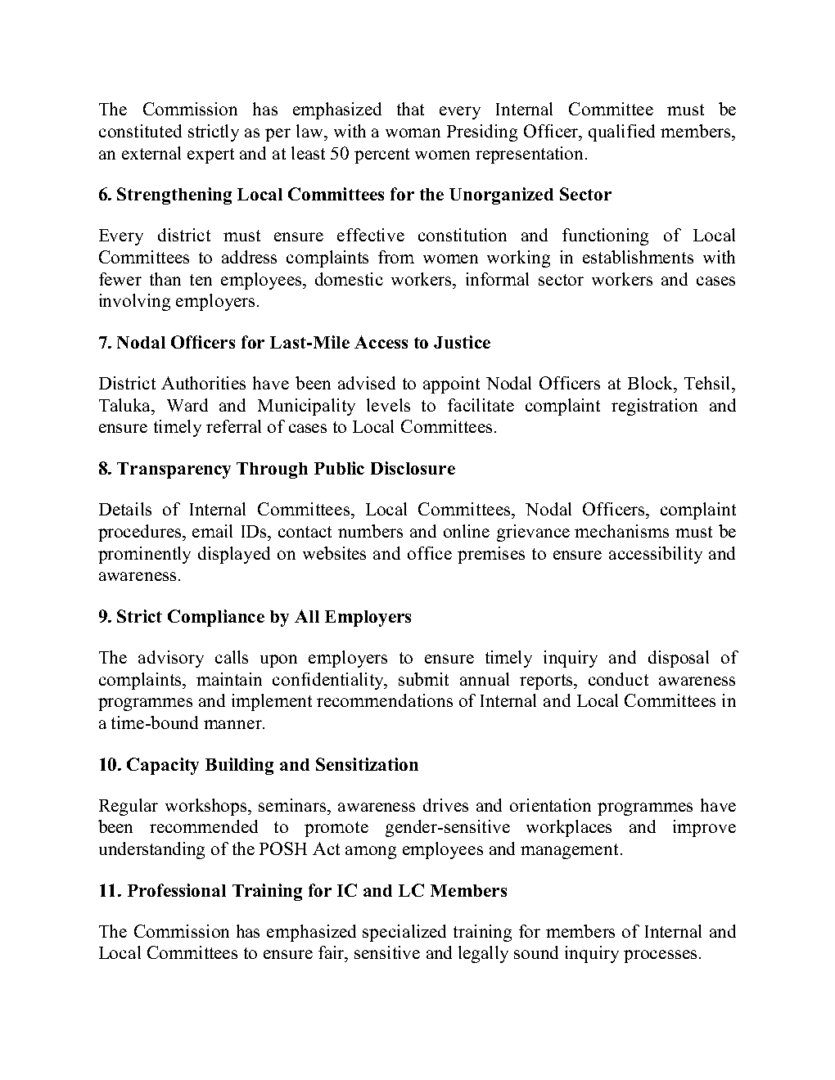
Every Internal Committee must be constituted strictly as per law, with:
- A woman Presiding Officer
- Qualified members
- An external expert (independent and impartial)
- At least 50% women representation
3. Local Committees for the Unorganised Sector
Every district must ensure the effective constitution and functioning of Local Committees to address complaints from:
- Women working in establishments with fewer than 10 employees
- Domestic workers
- Informal sector workers
- Cases involving employers
4. Appointment of District Officers
States and UTs have been advised to notify District Officers in every district under the POSH Act. These officers will serve as the nodal authority for:
- Implementation of the POSH Act
- Monitoring compliance
- Awareness generation
- Grievance redressal at the district level
5. Appointment of Nodal Officers at Grassroots Level
District authorities have been directed to appoint Nodal Officers at block, tehsil, taluka, ward, and municipality levels to:
- Facilitate complaint registration
- Ensure timely referral of cases to Local Committees
6. Transparency and Public Disclosure
Details of Internal Committees, Local Committees, Nodal Officers, complaint procedures, email IDs, contact numbers, and online grievance mechanisms must be prominently displayed on websites and office premises to ensure accessibility and awareness.
7. Promotion of SHe-Box Platform
All institutions have been encouraged to promote awareness and use of the Central Government’s SHe-Box platform for online registration, tracking, and monitoring of workplace sexual harassment complaints.
8. POSH Monitoring Cells and Digital Dashboards
States and UTs have been advised to establish dedicated POSH monitoring cells or digital compliance dashboards to track implementation of the POSH Act, rather than relying solely on employer self-reporting.
9. Protection Against Victimisation
The advisory calls for robust safeguards to ensure that complainants, witnesses, and committee members are protected from:
- Intimidation
- Discrimination
- Adverse transfers
- Professional prejudice
- Any form of retaliation
10. Capacity Building and Sensitisation
Regular workshops, seminars, awareness drives, and orientation programmes have been recommended to promote gender-sensitive workplaces and improve understanding of the POSH Act.
11. Training of IC/LC Members
Committee members must be trained on their duties and the inquiry process i.e. from complaint receipt to final report.
12. Annual Reporting Compliance
All establishments must submit annual reports as per Section 21 of the POSH Act.
13. Special Focus on Education and Healthcare
Universities, colleges, schools, hostels, coaching centres, hospitals, and medical establishments have been urged to strengthen POSH compliance mechanisms, considering the vulnerability of students, interns, trainees, research scholars, and contractual personnel.
14. Awareness in Unorganised Sector
District administrations have been directed to run awareness campaigns in rural areas, industrial clusters, Self-Help Groups, domestic work, and other unorganised sectors.
15. Zero-Tolerance Workplace Environment
Organisations should adopt a zero-tolerance approach to sexual harassment and strengthen workplace safety through:
- Better infrastructure
- Adequate lighting
- Safe access
- Surveillance in common areas
- Emergency support mechanisms
What This Means for Employers
| Requirement | Details |
| Mandatory POSH Audit | Annual audit for all establishments with 10+ employees |
| Audit Submission | Report to be submitted to District Authorities & concerned departments |
| Penalty for Non-Compliance | Fine up to ₹50,000 (repeat violations: double) |
| IC Constitution | In every office, branch, and unit with 10+ employees |
| IC Composition | Woman Presiding Officer + external expert + 50% women members |
| Transparency | Display IC/LC details, procedures, contacts on website & premises |
| SHe-Box | Promote and ensure active use of the platform |
| Annual Reports | Mandatory submission as per Section 21 |
| Monitoring | States to set up POSH monitoring cells/digital dashboards |
Certain states, such as Maharashtra, have already initiated measures to integrate POSH compliance checks into annual inspections. The state government has also made it compulsory for all new private establishments seeking registration and existing ones applying for renewal to constitute an Internal Complaints Committee.
The Trigger Case
The NCW’s inspection at a large corporate establishment revealed lapses in Internal Committee functioning, prompting directions for stricter compliance across all its units. Following a hearing, the Commission directed all units of the concerned establishment with ten or more employees to:
- Constitute separate Internal Committees within four weeks
- Conduct comprehensive POSH training programmes
- Ensure submission of annual POSH reports to concerned authorities
This case prompted a wider review of POSH compliance across various sectors, leading to the comprehensive advisory now issued.
State-Level Responsibilities
States and UTs have been urged to:
- Establish dedicated POSH monitoring cells or digital compliance dashboards
- Conduct periodic reviews at senior administrative levels
- Facilitate capacity building
- Issue necessary guidance to establishments and district authorities
- Ensure adherence to statutory obligations and judicial directions
District authorities have been advised to:
- Monitor ICs and LCs
- Review audits
- Address non-compliance
- Conduct review meetings
- Run intensive POSH awareness campaigns
Key Takeaways
| Aspect | What This Means |
| From Procedural to Substantive | POSH compliance moves from self-certification to verified audit |
| Accountability | Annual audits with statutory penalties for non-compliance |
| Transparency | Public disclosure of IC/LC details and procedures |
| Digital Monitoring | SHe-Box platform and digital dashboards for tracking |
| Grassroots Reach | Nodal officers at block, taluka, ward, and municipality levels |
| Protection | Strong safeguards against victimisation |
| Special Sectors | Focus on education, healthcare, and unorganised sectors |
Conclusion
The NCW’s advisory represents a significant step in strengthening the enforcement framework of the POSH Act. The introduction of mandatory annual audits, dedicated monitoring cells, digital dashboards, and grassroots-level nodal officers creates a robust accountability mechanism aimed at ensuring that the POSH Act is effectively implemented across all workplaces.
As NCW Chairperson Vijaya Rahatkar aptly noted, effective implementation of the POSH Act is a collective responsibility towards ensuring women’s empowerment and participation in nation-building. Employers are advised to ensure strict adherence to the POSH Act and NCW’s directives to avoid statutory penalties and safeguard workplace dignity.
Disclaimer: The information provided in this article is for general informational and educational purposes only and does not constitute legal advice. While every effort has been made to ensure the accuracy of the information, the provisions of the POSH Act, 2013, the NCW advisory, and any related notifications are subject to official amendments, judicial interpretations, and state-specific implementations. Employers, institutions, and individuals are strongly advised to consult qualified legal professionals or certified compliance experts for specific guidance tailored to their circumstances. We do not accept any liability for any loss, damage, or legal consequence incurred as a result of reliance on the information contained herein.