 Total Visitors
  Online Users
  Today
Today  Yesterday

What Changed and Why It Matters Today
The question we hear most often from HR leaders and business heads is: “With the POSH Act already in place, what new protections do the Labour Codes actually provide for women?”
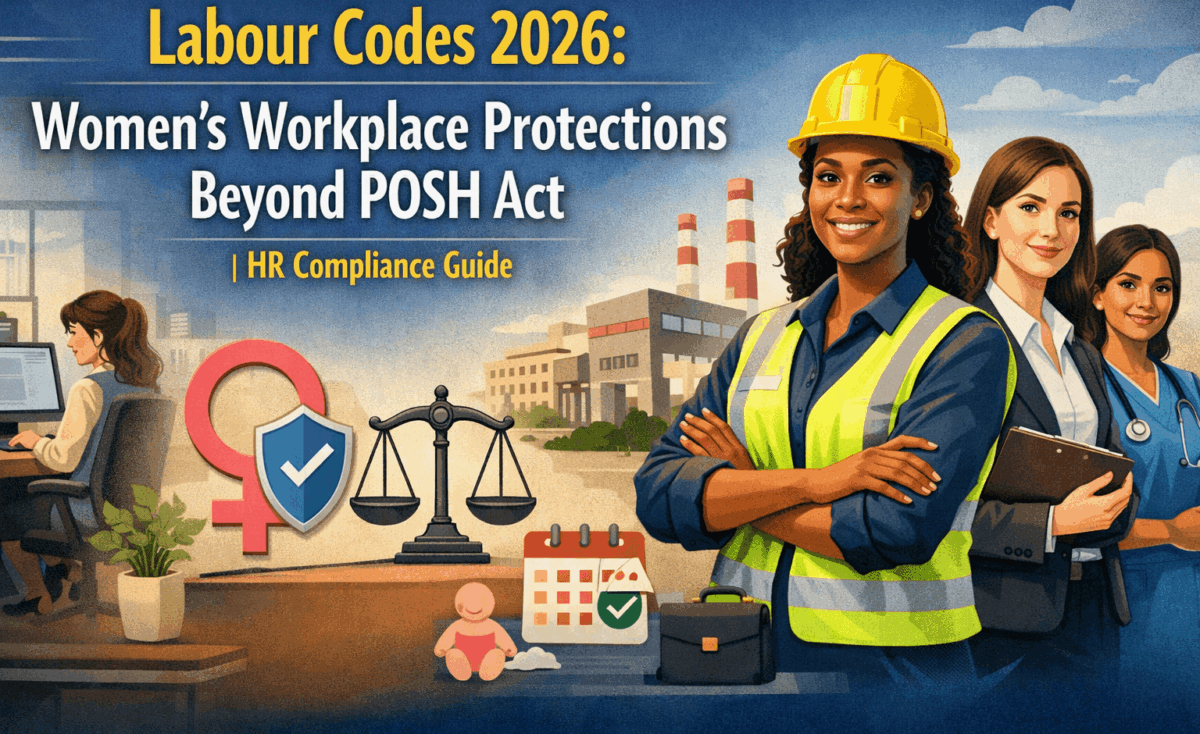
It’s a fair question. The Sexual Harassment of Women at Workplace (Prevention, Prohibition and Redressal) Act, 2013; the POSH Act remains India’s comprehensive legislation addressing sexual harassment at work. But the new Labour Codes, operationalised through Central Rules notified in May 2026, don’t just replicate existing protections. They add structural, systemic, and preventive layers that expand the scope of workplace safety and equality beyond the redressal mechanism.
The POSH Act remains the primary law for sexual harassment redressal. The Labour Codes complement it by ensuring equal pay, mandating women’s representation in grievance bodies, enabling safe night-shift participation, and strengthening maternity-related protections.
The Dual-Regime Framework: Legacy vs. New Rules
The POSH Act (2013): The Redressal Backbone
The POSH Act establishes the foundational framework that every employer must already be familiar with:
| Aspect | Provision |
| Applicability | All workplaces, regardless of employee count |
| ICC Mandate | Every workplace with 10+ employees must constitute an Internal Complaints Committee |
| ICC Composition | Senior woman as Presiding Officer + at least 2 internal members + 1 external member; minimum 50% women representation |
| Complaint Timeline | Within 3 months (extendable by 3 months) |
| Inquiry Timeline | 90 days from receipt of complaint |
| Annual Reporting | Mandatory filing of annual report (Form A) to District Officer |
| Penalties | ₹50,000 for first contravention; doubled for repeat offences; business registration cancellation possible |
Key Recent Development (2025–2026): The SHe‑Box Portal; a digital grievance and compliance monitoring platform has been made mandatory for all workplaces. The Supreme Court’s directions in Aureliano Fernandes v. State of Goa & Ors. (2025) accelerated this push, requiring State authorities to verify ICC constitution and upload compliance data onto the portal.
The Labour Codes: Additional Protective Layers
The four Labour Codes viz. Code on Wages 2019, Industrial Relations Code 2020, Code on Social Security 2020, and OSH Code 2020 introduce complementary protections that extend beyond what POSH mandates:
| Protection Area | Source | Key Provision |
| Equal Pay for Equal Work | Code on Wages, 2019 | Prohibition of gender-based discrimination in wages, recruitment, and employment conditions for same/similar work |
| Women’s Representation in GRC | Industrial Relations Code, 2020 | Adequate representation of women in Grievance Redressal Committees—not less than their proportion in the workforce |
| Women’s Representation on Advisory Boards | Code on Wages, 2019 | One-third members of Central/State Advisory Boards must be women |
| Night-Shift Work | OSH Code, 2020 | Women can work in all establishments (including factories) between 7 PM–6 AM, with safety measures, transport, and voluntary written consent |
| Maternity Benefits | Code on Social Security, 2020 | 26 weeks’ paid leave; 80-day eligibility period; simplified certification; 12 weeks for adopting/commissioning mothers |
| Crèche Facility | Code on Social Security & OSH Code | Mandatory for establishments with 50+ workers; 4 visits/day for nursing mothers |
| Work-from-Home Flexibility | Code on Social Security & Model Standing Orders | Allowed after maternity leave on mutual agreement; service sectors can offer WFH |
What This Means for Your Organisation: A Side-by-Side Comparison
The POSH Act and the Labour Codes serve different but complementary purposes. Here’s how they work together in practice:
| Scenario | POSH Act | Labour Codes |
| A woman is subjected to unwelcome sexual conduct at work | Provides full redressal mechanism viz. ICC inquiry, interim relief, recommendations, penalties | Not applicable |
| A woman is offered lower pay than a male colleague for the same role | Not addressed | Code on Wages prohibits discrimination in wages and recruitment |
| A woman wants to work night shifts in a factory | Not covered | OSH Code permits with safety safeguards and written consent |
| A woman is harassed and fears retaliation; she needs a safe forum | ICC provides confidential inquiry | GRC (under IR Code) provides an additional forum for workplace grievances, with mandated women’s representation |
| A woman returns from maternity leave and needs flexible work arrangements | Not covered | Social Security Code allows WFH on mutual agreement |
| A woman faces harassment during remote work or on digital platforms | POSH Act’s definition of “workplace” is expansive but digital harassment is not explicitly addressed | Not covered |
| A woman in the unorganised sector faces harassment | POSH Act coverage extends to unorganised workers, but enforcement especially Local Committees remains weak | Labour Codes expand benefits and working condition protections but do not replace POSH redressal |
Core Compliance Checklist: Actionable Steps for HR and Management [FREE]
1. POSH Act Compliance (Non-Negotiable Baseline)
- Constitute ICCs in every workplace with 10+ employees; ensure proper composition (senior woman Presiding Officer, external member, 50% women members, three-year tenure).
- File Annual Reports (Form A) with the District Officer; this is a statutory obligation under Section 21 of the POSH Act.
- Onboard onto SHe-Box Portal—mandatory registration and disclosure of ICC details are now legally required.
- Conduct Annual POSH Training for all employees and not just women; document attendance and content.
- Display POSH Policy prominently at the workplace and communicate to all employees during induction.
2. Labour Codes Compliance (New Obligations)
- Review Recruitment and Wage Policies—ensure no gender-based discrimination in hiring, wages, or employment conditions for same/similar work (Code on Wages, Section 3).
- Constitute Grievance Redressal Committees (GRCs) under the Industrial Relations Code for establishments with 20+ workers; ensure women’s representation matches their proportion in the workforce.
- Evaluate Night-Shift Readiness—if employing women in night shifts, implement: door-to-door GPS transportation, female security personnel where feasible, CCTV coverage, and adequate lighting; obtain written consent from each woman worker.
- Set Up Crèche Facilities if employing 50+ workers; it must be within prescribed distance; allow 4 daily visits for nursing mothers.
- Update Service Rules / Standing Orders to include: WFH provisions (for service sectors, subject to mutual agreement), and treat sexual harassment as defined misconduct.
Financial and Operational Risk Analysis
Compliance Risks
| Risk Area | Legacy Regime | New Labour Codes | Implications |
| Wage Discrimination | Equal Remuneration Act, 1976 covered wage parity | Code on Wages expands prohibition to recruitment and conditions of employment | Organisations with gender-based wage disparities face potential claims and penalties |
| ICC Non-Compliance | Penalty up to ₹50,000 | Same penalty, but SHe-Box monitoring increases detection risk | Non-compliance with ICC constitution can attract penalties, licence cancellation, or inspection-based enforcement |
| Night-Shift Violations | Factories Act prohibited women from night work | OSH Code permits with safety safeguards and consent | Employment without safety measures or consent invites inspection, penalties, and potential shutdown |
Financial Impact Considerations
- Overtime Costs — The expanded definition of “wages” under the Codes means overtime (payable at twice the ordinary rate) must be calculated on a higher base, potentially increasing costs significantly.
- Transportation Costs — Employing women in night shifts requires door-to-door transportation, security, and surveillance infrastructure; factor in these operational costs.
- Crèche Infrastructure — Establishments with 50+ workers must provide crèche facilities; factor in capital expenditure and operational costs.
Disclaimer: This content is provided for educational and informational purposes only and does not constitute formal legal counsel, solicitation, or lawyer-client relationship. The information herein is based on available Central and State notifications, judicial pronouncements, and statutory provisions as of July 2026. Labour being a Concurrent Subject under the Indian Constitution, State-specific rules, notifications, and judicial interpretations may introduce additional, varying, or conflicting compliance obligations not addressed herein. Statutory provisions are subject to amendment, repeal, or judicial re-interpretation without prior notice. Employers and organisations are strongly advised to consult with qualified legal professionals including advocates, labour law consultants, and compliance practitioners for advice tailored to their specific organisational structure, industry classification, operational geography, and workforce composition. The authors, publishers, and distributors expressly disclaim any liability for actions taken or not taken based on this content, and no warranty- express or implied is made regarding the accuracy, completeness, timeliness, or fitness for purpose of this information. Readers should independently verify all compliance requirements with appropriate governmental authorities and legal counsel. This content does not override or supersede any legal obligation imposed by competent statutory authorities.