 Total Visitors
  Online Users
  Today
Today  Yesterday

Understanding the Official Mandate: Statutory Breakdown
The Government of Karnataka, through an official circular issued by Hon’ble Chief Secretary Dr. Shalini Rajneesh, I.A.S., has issued a strict compliance directive under the Sexual Harassment of Women at Workplace (Prevention, Prohibition and Redressal) Act, 2013 (POSH Act).
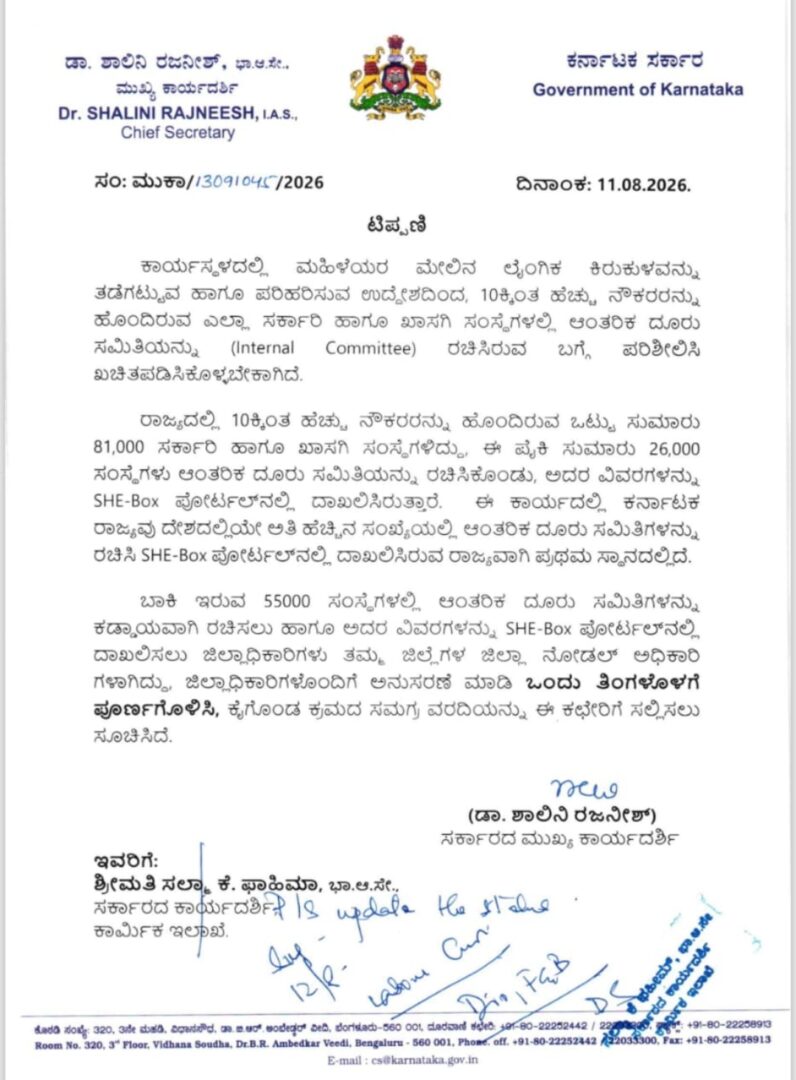
This notification reinforces statutory obligations for all government bodies and private establishments operating in Karnataka.
1. Statutory Framework & Scope
Under Section 4 of the POSH Act, any government or private organization employing 10 or more people is legally required to constitute a functional Internal Committee (IC). Furthermore, the state directive mandates that all establishments register their IC details on the centralized SHe-Box (Sexual Harassment Electronic Box) portal managed by the Ministry of Women and Child Development.
2. Current Compliance Landscape in Karnataka
The state government reviewed registration data on the SHe-Box portal and outlined current baseline metrics:
| Metric | Official Document Detail | Statutory & Administrative Context |
| Total Target Organizations (10+ Staff) | 81,000 | Estimated total eligible establishments in Karnataka under Section 4. |
| Currently Registered on SHe-Box | 26,000 | State-reported registered Internal Committees. |
| Pending Compliance | 55,000 | Unregistered/non-compliant establishments required to complete registration. |
While administrative records highlight significant progress with 26,000 registrations, roughly 55,000 establishments remain pending compliance.
3. Regulatory Directives & Enforcement Mechanics
The directive establishes clear administrative mechanisms for enforcement:
- Compliance Window: The circular requires compliance within 30 days of issue; failure to register IC details on SHe-Box may attract legal sanctions.
- Enforcement & Supervision: District Collectors (Deputy Commissioners) act as the designated District Nodal Officers to enforce compliance across their respective districts.
- Inter-Departmental Reporting: The Department of Labour is tasked with monitoring progress and submitting a comprehensive action-taken report to the Chief Secretary’s office.
- Penalties for Non-Compliance: Under Section 26 of the POSH Act, non-compliant employers face fines up to ₹50,000. Repeat offences may lead to double penalties and potential cancellation or non-renewal of business licenses or statutory registrations.
4. Mandatory Employer Obligations
To ensure full compliance under the law, employers must adhere to the following statutory duties:
- Constitute Internal Committee (Section 4): Establish an IC by written order comprising a senior female Presiding Officer, at least two employee members, and an independent external member.
- General Employer Duties & Awareness (Section 19): Provide a safe working environment, display penal consequences of sexual harassment prominently in the workplace, and organize regular workshops and sensitisation programs for staff.
- Portal Registration & Nodal Appointment: Register the organization on the central SHe-Box portal and upload the designated details of the Presiding Officer and IC members.
- Annual Reporting (Section 21): Prepare and submit an annual report detailing the number of complaints received and disposed of to the District Officer and appropriate authorities.
Conclusion
The directive enforces statutory compliance; establishments failing to act within 30 days risk formal inspection and legal penalties under Section 26 of the POSH Act.
Disclaimer: The content provided in this publication is for informational and educational purposes only and does not constitute formal legal advice, legal opinion, or a binding interpretation of regulatory policies. Readers and organizations should consult with a qualified legal professional or POSH practitioner to ensure specific compliance with the Sexual Harassment of Women at Workplace Act, 2013, and localized government orders.